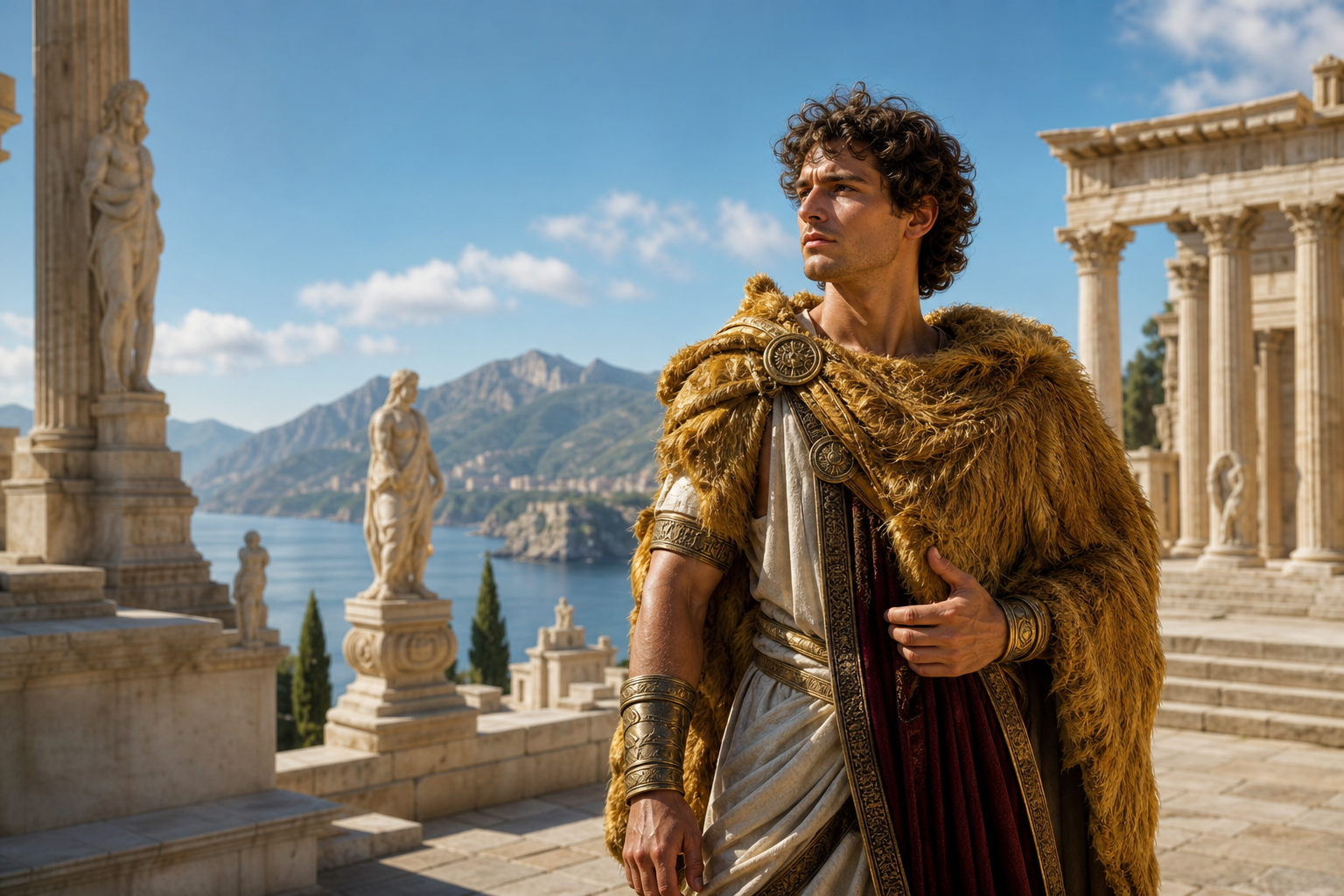
The Golden Fleece: The True Story Behind the Mythical Quest
Few legends from the ancient world glitter with such intense allure as the quest for the Golden Fleece. It is a story that has echoed through millennia, a foundational myth of heroism, adventure, and the perilous collision of mortal ambition with divine will. At its heart is a single, extraordinary object: the fleece of a sacred, winged ram, its wool spun from pure gold. This was no mere treasure; it was a symbol of legitimacy, a sign of divine favor, and an artifact of such power that it could secure a kingdom. The journey to retrieve it, undertaken by the hero Jason and his unparalleled crew of champions, the Argonauts, represents one of the great epic voyages of Western literature, predating even Homer's Odyssey in the mythological timeline. But what if this grand tale is more than just a myth? What if, beneath the layers of sorcery, sea monsters, and divine intervention, lies a kernel of historical truth—a garbled memory of a real expedition into a land of fabulous wealth, driven by the timeless human desires for gold, power, and glory? This article will journey back in time, not only to recount the thrilling saga of Jason and his quest but also to delve into the fascinating historical and geological theories that suggest the Golden Fleece was a very real, and very tangible, prize. We will navigate the treacherous waters of the Black Sea, confront the machinations of gods and kings, and ultimately ask whether the quest for the Golden Fleece was a daring raid on a forgotten kingdom and its unique, ingenious technology for harvesting gold. The story is not just one of heroism but also of profound darkness, betrayal, and the tragic consequences that so often shadow great endeavors. It is a testament to the idea that the most sought-after treasures often demand the steepest price, not in gold, but in blood, honor, and humanity itself.
The Divine Origins of the Gilded Ram
The story of the Golden Fleece does not begin with heroes and ships, but with a desperate act of divine intervention born from familial betrayal. In the kingdom of Boeotia, King Athamas had taken a new wife, Ino, after tiring of his first, the cloud-nymph Nephele. Ino, consumed by jealousy and ambition for her own children, despised her stepchildren, Phrixus and Helle. She devised a wicked scheme to eliminate them. First, she secretly arranged for the kingdom’s crop seeds to be roasted before planting, ensuring a catastrophic famine. When a desperate King Athamas sent messengers to the Oracle at Delphi to seek a solution, Ino intercepted them, bribing them to return with a false prophecy: the gods demanded the sacrifice of Phrixus and Helle to restore the land’s fertility. Athamas, heartbroken but fearing divine wrath, reluctantly agreed to sacrifice his own children. As they were led to the sacrificial altar, their mother, Nephele, watching from the heavens, could bear it no longer. She prayed to the gods for their salvation, and Hermes responded. He sent a magnificent, winged ram, whose fleece was spun from pure gold, to rescue them. The ram, a creature of divine lineage, swooped down to the altar, and Phrixus and Helle scrambled onto its back. It soared into the sky, carrying them away from their doom and across the sea. The journey was perilous, and tragedy soon struck. As they flew over the strait separating Europe and Asia, the young Helle lost her grip and fell from the ram’s back, plunging into the waters below. The strait would forever bear her name: the Hellespont, or "Sea of Helle." Phrixus, alone and grieving, clung tightly to the magical creature as it continued its journey eastward, finally arriving in the distant, exotic land of Colchis, on the shores of the Black Sea. The king of Colchis, Aeetes—a son of the sun god Helios and brother to the sorceress Circe—welcomed the boy. In gratitude for his miraculous salvation, Phrixus sacrificed the golden ram to Zeus the Deliverer. He then presented the incredible Golden Fleece to King Aeetes, who, recognizing it as a potent symbol of power and divine blessing, accepted it with avarice. Aeetes consecrated the fleece to Ares, the god of war, and hung it from a great oak tree in a sacred grove. To guard this immense treasure, he placed a fearsome, sleepless dragon, the Drakon Kholkikos, to watch over it day and night. There in the dark grove of Colchis, the fleece remained—a relic of divine power, a symbol of kingship, and a temptation for any mortal bold or foolish enough to seek it.
The Usurper's Challenge: Jason and the Quest's Inception
Generations later, the fate of the Golden Fleece became entangled with another story of a stolen throne, this time in the kingdom of Iolcus in Thessaly. The rightful king, Aeson, had been overthrown by his ambitious half-brother, Pelias. Aeson’s son, Jason, the true heir, was secretly sent away to be raised in the wilderness by the wise centaur Chiron, who tutored many of Greece’s greatest heroes. Jason grew into a strong and noble young man, and upon reaching adulthood, he set out to Iolcus to reclaim his birthright. Meanwhile, Pelias lived in a state of paranoid fear. He had been warned by an oracle to "beware the man with one sandal." This cryptic prophecy haunted him, and he watched every visitor to his court with suspicion. The fateful day arrived when Jason, traveling to Iolcus, came upon an old woman struggling to cross the turbulent Anauros river. Taking pity on her, he hoisted her onto his shoulders and carried her across. He did not know that this was no ordinary crone, but the goddess Hera in disguise, testing the character of the young hero who she would champion. In the struggle against the current, Jason lost one of his sandals in the thick river mud. He arrived in the marketplace of Iolcus, a striking figure, but conspicuously clad in only a single sandal. When Pelias saw him, he was struck with terror, recognizing the man from the prophecy. Hiding his fear behind a mask of cunning hospitality, he questioned Jason. Jason boldly declared his identity and his claim to the throne. Pelias, a masterful manipulator, feigned agreement. He told Jason he would gladly relinquish the kingdom, but there was one condition. He spoke of a lingering curse upon their family line, a miasma brought about because their ancestor, Phrixus, remained unburied in a foreign land. The ghost of Phrixus, he claimed, had appeared to him in a dream, begging to be brought home and demanding that the Golden Fleece be retrieved to appease the gods. Pelias painted the quest as a noble and pious duty, a heroic undertaking that would not only cleanse their family of its sins but also bring eternal glory to whoever accomplished it. It was a perfect trap. The journey to Colchis was considered impossible, a suicidal voyage to the edge of the known world, a land of barbarians and monsters from which no one had ever returned. Pelias was certain he was sending his young rival to his death. But Jason, full of youthful fire and a thirst for glory, saw only the challenge and the honor. He accepted the impossible task, vowing to return with the Golden Fleece and claim his throne. The stage was set for the greatest maritime expedition in Greek mythology.
Did you know? The name "Argonauts" literally means "sailors of the Argo," combining the ship's name, Argo, with the Greek word 'nautes' (sailor).
The Argonauts Assemble: A League of Heroes
Word of Jason's audacious quest spread like wildfire throughout the Hellenic world. The challenge of a seemingly impossible journey for a prize of divine origin resonated deeply within the heroic spirit of the age. This was not a task for a single man; it required a crew of the bravest, strongest, and most skilled individuals Greece had to offer. And so, they came. From every corner of the land, heroes, demigods, princes, and adventurers, each a legend in their own right, answered the call to adventure. This assembly of champions would become known as the Argonauts, named after their vessel, the Argo.

The ship itself was a marvel, the greatest of its time. It was built by the master shipwright Argus, with the direct aid of the goddess Athena, Jason’s divine patron alongside Hera. The Argo was a penteconter, a galley with fifty oars, but it was far more than a simple boat. Athena herself fitted a magical timber into its prow—a beam taken from the sacred, speaking oaks of Dodona, a center for the worship of Zeus. This enchanted wood gave the ship a measure of consciousness and the ability to speak and utter prophecies, serving as a divine guide for the crew in their darkest hours. As the ship took form, its crew began to assemble, a roster that reads like a who’s who of Greek mythology. There was the mighty Heracles, the strongest man in the world, taking a brief hiatus from his Twelve Labors. There was the divine musician Orpheus, son of the Muse Calliope, whose lyre could charm stones, beasts, and even the gods themselves. The twin heroes Castor, the horse-tamer, and Pollux, the boxer—the Dioscuri—joined the crew, bringing their formidable combat skills. Zetes and Calais, the winged sons of Boreas, the North Wind, offered the power of flight. And there was Peleus, who would one day father the great Achilles; Telamon, father of Ajax; the keen-eyed lynx-man Lynceus, who could see beneath the earth; and Tiphys, the master helmsman who would steer the Argo through uncharted waters. Unusually for such tales, some accounts also include the huntress Atalanta, a swift and deadly female hero who more than held her own among the men.
With Jason as their chosen leader, this league of extraordinary heroes finally boarded the Argo. As Orpheus played a powerful hymn to the gods, the fifty Argonauts rowed the great ship out of the harbor of Pagasae. Their departure was a spectacle, with crowds cheering them on, even as many believed they were sailing to their deaths. Ahead of them lay a vast, unknown sea, rumored to be home to savage tribes, terrifying monsters, and treacherous geographical hazards. The goal was Colchis, the land at the world's end, and the prize was the Golden Fleece. The greatest adventure of the heroic age had begun.
Did you know? The dragon's teeth sown by Jason were from the same dragon killed by Cadmus when he founded the city of Thebes, linking two major Greek myths through a single, potent artifact.
Trials by Sea and Sorcery: The Perilous Journey to Colchis
The voyage of the Argo was not a simple A-to-B journey but a grueling, episodic series of trials that tested the Argonauts’ every skill, their courage, and their unity. Each challenge they overcame was a testament to their collective strength and individual talents, forging them into a legendary crew. Their first major stop was the island of Lemnos, a land inhabited only by women. The Lemnian women, led by Queen Hypsipyle, had murdered all the men on the island in a vengegeful uprising. They initially planned to kill the Argonauts as well, but instead welcomed them, hoping they would repopulate the island. The heroes stayed for a year, fathering a new generation, and only the stern rebukes of Heracles, who had impatiently remained with the ship, convinced them to abandon the island’s comforts and remember their quest. Soon after, another tragedy struck that cost them their strongest member. When the Argo landed in Mysia, Heracles’s young companion and beloved, Hylas, went ashore to fetch water. The boy was so beautiful that the nymphs of the spring were captivated by him and pulled him into the water to live with them forever. Heracles, mad with grief, plunged into the forest searching for Hylas, refusing to give up. The Argo was forced to sail without him, leaving the mighty hero behind.
Continuing their journey, the Argonauts reached Salmydessus in Thrace, the home of the blind king and seer, Phineus. He was being tormented by the Harpies, foul bird-women creatures who would swoop down every time he tried to eat, snatching the food from his hands and defiling what was left. The heroes took pity on him, and the winged brothers, Zetes and Calais, put their unique gifts to use. As the Harpies descended, the sons of the North Wind took to the air, pursuing the monsters with drawn swords. They chased them far across the sea, securing a promise from the goddess Iris that the Harpies would never torment Phineus again. In gratitude, the seer used his prophetic abilities to help the Argonauts. He warned them of the dangers ahead and gave them crucial advice for their most feared obstacle: the Symplegades, or the Clashing Rocks. These were two enormous, floating cliffs at the mouth of the Black Sea that would smash together, crushing any ship that attempted to pass between them. Phineus instructed Jason to first release a dove. If the dove made it through, they should row with all their might, for the gods would grant them passage. If the dove was crushed, their quest was doomed, and they should turn back. Arriving at the terrifying strait, they followed the seer’s advice. They released the dove, which flew swiftly between the rocks. The cliffs crashed together just as it passed, clipping only its tail feathers. Taking this as their sign, the Argonauts rowed with desperate, god-given strength. As the rocks pulled apart, the Argo surged forward. The cliffs smashed together behind them, and while the very tip of the ship’s stern ornament was splintered, they had made it through. From that day forward, the Symplegades became fixed and never troubled sailors again. They had conquered one of the great barriers of the mythical world and had finally entered the hostile, unknown waters of the Euxine Sea, the gateway to Colchis.
Colchis: The Fleece, the Witch, and the Dragon
After their perilous journey, the arrival of the Argo in Aea, the capital of Colchis, was met not with celebration but with deep suspicion. To King Aeetes, these heavily armed Greek strangers were not guests but a profound threat. When Jason stood before the throne and announced his purpose—to claim the Golden Fleece—Aeetes was filled with rage. He saw the demand not as a heroic quest but as a brazen attempt to steal his kingdom’s most sacred treasure and a symbol of his own power. Yet, like Pelias, he masked his fury with a veneer of deceptive civility. He agreed to give Jason the fleece, but only if the hero could prove his worth by completing a series of "impossible" tasks.
Did you know? In some earlier versions of the myth, Medea is not a love-struck princess but a powerful, independent figure who chooses to help Jason and leave with him on her own terms. The romantic, helpless version was popularized later.
First, Jason had to yoke two Khalkotauroi, enormous bulls with bronze hooves and breath of fire, forged by the god Hephaestus. Then, he had to use these monstrous beasts to plow a large field. Finally, he had to sow the field with dragon's teeth. Aeetes knew what would happen next: from the sown teeth would spring an army of fully armed warriors, the Spartoi, who would turn on the sower and tear him to pieces. It was a death sentence. But Jason’s fortunes were about to turn, for he had powerful, unseen allies. The goddesses Hera and Athena, who had watched over his journey, intervened directly. They conspired to make Aeetes’s own daughter, Medea, fall in love with Jason. Medea was no ordinary princess; she was a powerful sorceress, a priestess of the goddess of witchcraft, Hecate. Struck by a magical arrow from Eros, Medea became utterly infatuated with Jason and was torn between loyalty to her father and her newfound, all-consuming passion. Her love for Jason won out. She secretly met with him and, in exchange for a promise of marriage and a new life in Greece, she offered her magical aid. She gave him a potent ointment that would make him impervious to fire and iron for a single day. She also told him the secret to defeating the Spartoi: once they rose from the earth, he should throw a stone into their midst. Confused, they would turn on each other, fighting to the death until none were left.

The next day, Jason faced the trial. Anointed with Medea’s potion, he fearlessly approached the fire-breathing bulls. Their flames washed over him harmlessly, and with his divinely augmented strength, he wrestled them into submission and forced them into the yoke. He plowed the field and sowed the dragon’s teeth. As the earth-born warriors sprang from the furrows, he threw the stone as Medea had instructed. The Spartoi immediately began fighting amongst themselves in a chaotic battle, and Jason easily dispatched the few survivors. He had accomplished the impossible. Aeetes was stunned and furious, certain that Jason had received inside help. He reneged on his promise and began plotting to destroy the Argonauts and burn their ship. Medea, knowing her father’s treachery and that her own life was now in danger, acted swiftly. That night, she led Jason to the sacred grove of Ares where the Golden Fleece was kept. There, hanging on the branches of the great oak, it illuminated the darkness with its divine light. Guarding it was the sleepless dragon. But the serpent was no match for Medea’s sorcery. Chanting a powerful spell and sprinkling potent herbs, she lulled the great dragon into a deep, magical slumber. While the monster slept, Jason climbed the tree, untied the magnificent fleece, and carried it down. With the prize in their hands, they raced back to the Argo, where the rest of the crew waited anxiously. Under the cover of darkness, they pushed off from the shore, rowing silently away from Colchis with its stolen treasure and its betrayed princess.
The Horrific Escape and the Tragic Aftermath
The escape from Colchis was as fraught with peril and moral darkness as the journey there. When King Aeetes discovered the fleece was gone and his daughter had fled, he launched his fleet in furious pursuit, led by his son, Medea’s brother, Apsyrtus. The swift Colchian ships began to close in on the slower, heavier Argo. What happened next is one of the darkest moments in the myth, a testament to Medea’s terrifying ruthlessness. According to the most gruesome version of the tale, recounted by Apollodorus, Medea lured her brother onto an island under the pretense of a truce, where Jason ambushed and killed him. Medea then dismembered her brother's body and scattered the pieces into the sea. The pursuing Colchian fleet was forced to stop and gather the remains of their prince for proper burial, allowing the Argo to escape. This horrific act of fratricide cast a dark stain over their victory, a sin that would require divine purification and would haunt Jason and Medea for the rest of their lives.
Did you know? The Svaneti region of Georgia still has local legends and historical practices involving the use of sheepskins to collect gold from rivers, a practice that continues to lend credence to the historical basis of the myth.
Their voyage home was no easier. They were driven off course and had to face many of the same monsters Odysseus would later encounter. They sailed past the island of the Sirens, whose enchanting song lured sailors to their deaths. The crew was only saved by Orpheus, who played his lyre so beautifully and loudly that it drowned out the Sirens’ deadly melody. They navigated the treacherous strait between the monster Scylla and the whirlpool Charybdis. Their final major challenge came at the island of Crete, which was guarded by Talos, a giant man of bronze created by Hephaestus. Talos circled the island three times a day, hurling boulders at any approaching ships. He had one vulnerability: a single vein running from his neck to his ankle, sealed by a bronze nail. Medea used her powers to either drive the giant mad or to trick him, promising immortality, into removing the nail. When he did, the ichor—the blood of the gods—flowed out of him like molten lead, and the great bronze giant crashed to the ground, lifeless.
Finally, the Argo returned to Iolcus. Jason triumphantly presented the Golden Fleece to Pelias. But the usurper, shocked that Jason had survived, refused to give up the throne. Once again, Medea’s dark arts came to the fore. She demonstrated her power to Pelias's daughters by cutting up an old ram and boiling it in a cauldron with magical herbs, from which a young lamb emerged. She promised them they could do the same for their aging father. Eager to rejuvenate him, the daughters killed Pelias, cut him up, and boiled him in a cauldron. But Medea withheld the true magical herbs, and the king was simply, gruesomely, dead. While this act of vengeance removed Pelias, it was so horrific that it turned the populace against Jason and Medea, and they were driven into exile, settling in Corinth. Their story ends not in glory, but in tragedy. In Corinth, Jason, ever the opportunist, decided to abandon Medea to marry the daughter of the king, seeking a more legitimate path to power. Medea, consumed by a grief and rage born of love and betrayal, enacted a final, devastating revenge. She sent a poisoned robe to the new bride that burned both her and her father to death. Then, to inflict the ultimate pain on Jason, she killed the two sons she had borne him. Her vengeance complete, she escaped in a chariot drawn by winged dragons, sent by her grandfather Helios. Jason was left with nothing. He died a lonely, unheroic old man, years later, while sitting in the shadow of his decaying, beached ship, the Argo. He was killed when a piece of the rotting prow—the same sacred beam that had once guided him—fell and struck his head, an ignominious end for the hero who had once led the greatest quest of his age.
Beyond the Myth: Historical and Geological Theories
For centuries, the story of the Golden Fleece was considered pure fantasy. However, modern scholarship and archaeology have uncovered compelling evidence suggesting that the myth may be an allegorical retelling of real historical events. The key lies in the location of Colchis—a real kingdom that existed in what is now modern-day Georgia, on the eastern coast of the Black Sea. Ancient historical sources, including the works of Herodotus and Strabo, describe Colchis as a fantastically wealthy region, particularly renowned for its gold. This historical reality provides the foundation for the most compelling theory behind the myth: that the "Golden Fleece" was a literal tool for a sophisticated form of gold mining.
The most prominent theory, first suggested by the Roman historian Appian and the Greek geographer Strabo, is that the myth describes a real practice of placer mining used in the Caucasus region for millennia. Mountain rivers and streams in this area, particularly in the Svaneti region of Georgia, are rich in gold dust and small nuggets washed down from their sources. The ancient people of Colchis developed an ingenious method to capture this gold. They would stretch a sheepskin, with its dense woolly fleece, across a wooden frame and submerge it in a gold-bearing stream. The heavy gold particles flowing in the water would become trapped in the oily, intricate fibers of the wool. After some time, the fleece would be removed from the water and hung up to dry. Once dry, the gold dust could be shaken or combed out. A fleece used in this manner for an extended period would become so thoroughly encrusted with glittering gold particles that it would appear to be made of pure gold—a literal "golden fleece."
From this perspective, the epic quest of the Argonauts transforms from a mythological fairy tale into a plausible, albeit romanticized, historical narrative. It may represent an early Greek maritime expedition, perhaps one of the first long-distance voyages into the Black Sea, which the Greeks called the Euxine ("Hospitable") Sea. This expedition could have been a military raid or a proto-colonial mission aimed at discovering the source of Colchis’s legendary wealth and perhaps stealing this incredibly valuable mining technology. The monsters and magical trials encountered along the way could be mythological embellishments of real navigational hazards, hostile tribes, and the inherent dangers of sailing into uncharted territory. King Aeetes’s hostility, the "impossible" trials, and the sleepless dragon guarding the fleece become metaphors for a powerful king jealously guarding his kingdom’s most valuable economic secret from foreign rivals. Medea’s betrayal could symbolize a local faction or individual who, for reasons of love, ambition, or political dissent, aided the Greek intruders.
Other theories exist as well. Some propose the fleece was not a mining tool but a symbol of royal power, perhaps a specific sacred animal skin used in enthronement ceremonies, whose theft would be a major political coup. Others suggest the fleece was a metaphor for a lost text or scroll containing secret metallurgical knowledge—the "skin" being the parchment and the "gold" being the valuable information written upon it. Whatever its true nature, the intersection of the myth with the verifiable geology and history of ancient Georgia is too strong to be a mere coincidence. The Golden Fleece was almost certainly a real object, or at least a real concept, representing the immense mineral wealth of the Caucasus and the desire of the Greeks to access it. The myth, therefore, serves as a powerful cultural memory of early contact, conflict, and the exchange of technologies between the Aegean world and the rich, remote kingdoms of the Black Sea.
In conclusion, the legend of Jason and the Golden Fleece is a story that operates on multiple, profound levels. On the surface, it is one of the world's great adventure stories, a sweeping epic of heroism, magic, and monsters that defined an entire generation of Greek heroes. It is a thrilling narrative of a long and perilous voyage to the edge of the known world for an object of unimaginable value. Yet, beneath the mythological glamour lies a darker, more complex tale of human nature. It is a story about ambition turning into greed, about love turning into obsession and horrific revenge, and about how the pursuit of glory can lead to a tragic and dishonorable end. Jason, for all his heroism, is ultimately a flawed and opportunistic figure, whose story serves as a cautionary tale about the consequences of broken oaths and betrayal. However, the most fascinating layer is the one that connects this ancient story to our own world. The compelling evidence that the Golden Fleece was a real technological innovation—an ingenious tool for extracting gold—transforms the myth into a vessel of historical memory. It allows us to see the story not as a fantasy, but as a romanticized account of a daring expedition driven by economic and political motivations that are timeless and universal. The saga of the Argonauts becomes a deeply human story about the clash of cultures, the quest for resources, and the transfer of knowledge across the ancient world. The fleece itself, whether a magical artifact of the gods or an earthly symbol of geological wealth, remains the ultimate prize. Its enduring power as a symbol lies in this very complexity, reminding us that our myths are not just stories; they are the gilded, embroidered chronicles of our own history, ambition, and enduring quest for the unattainable.
How we verify this article
By the History Unlocked editorial team
This text is built on historical facts stored in our database and drafted with AI assistance. No signed human review is recorded for this article. Report any inaccuracy: we correct it and update the modified date.
Updated on
AI-assisted drafting.
Read our editorial standardsEnjoyed this? Discover more articles in the category Mythology & Ancient Gods