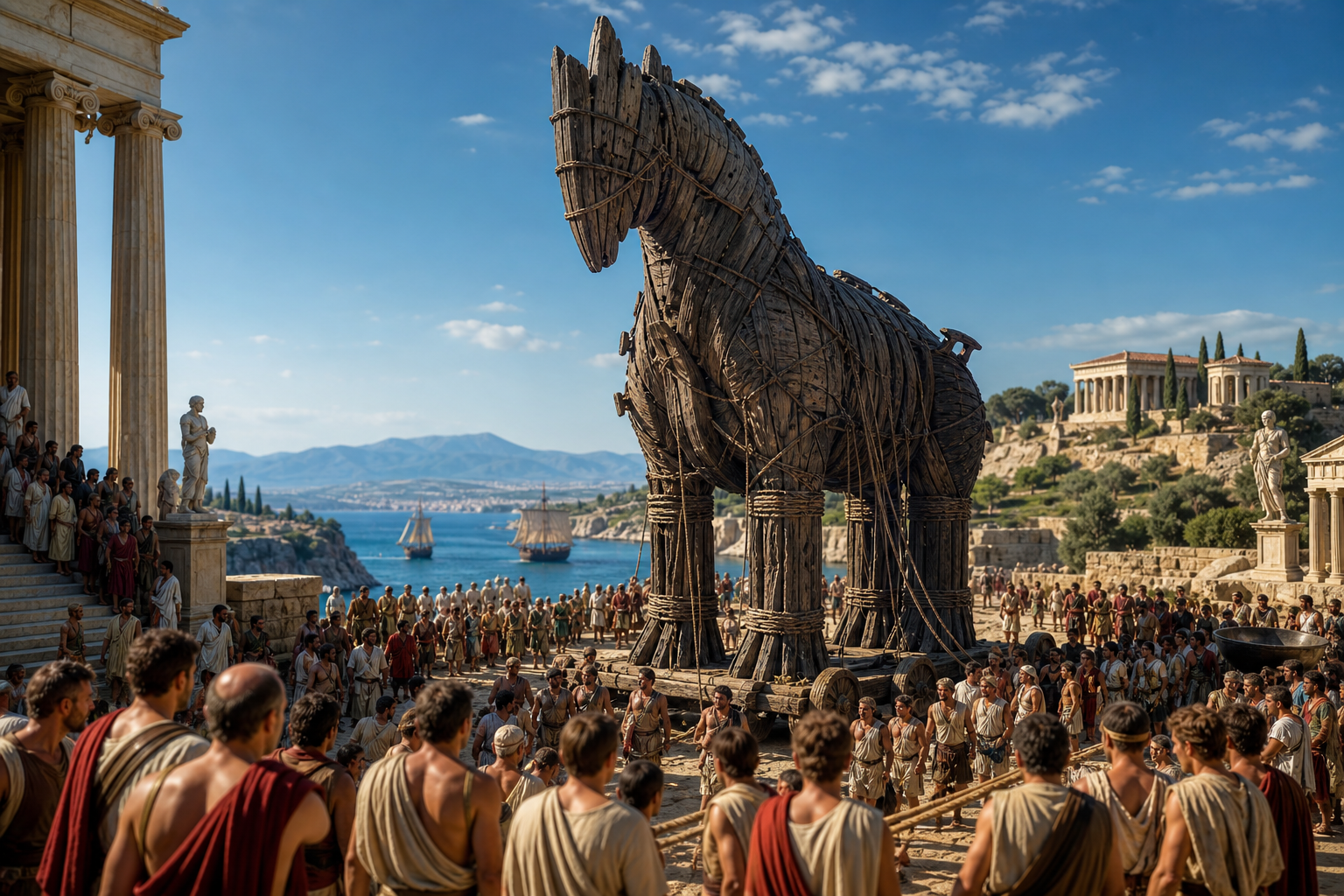
The Trojan Horse: Myth, Archaeology, and Enduring Mystery
The Trojan Horse has stamped itself into the imagination of generations as the ultimate instrument of deception: a wooden beast, hollowed and filled with warriors, dragged past watchful gates, and left to sleep like an offering until night fell and doom came. It is a story that moves between poetry and diplomacy, between ritual offering and military cunning. A narrative born of oral performance and later inscribed by poets like Virgil has proven remarkably adaptable; it can be read as clever stratagem, tragic lesson about hubris, or a mythic condensation of a protracted conflict. The charm of the tale is as much in its ambiguity as in its drama—Homer’s Iliad, the great epic that frames the Trojan War, never records the Horse; instead the episode first appears in later and disparate sources, which has given scholars centuries of fertile ground for interpretation.
This article takes a long, close look at the Trojan Horse from multiple angles: literary genealogy, archaeological evidence at Hisarlik (the site commonly identified as Troy), historical plausibility, later cultural reception, and the symbolic afterlife of the horse in Western thought. I aim to keep strictly to verifiable facts where they exist and to distinguish clearly between what is documented and what remains speculative. What follows is a narrative thread that seeks to knit together classical texts (Homer, Virgil, Quintus, and later chroniclers), Hittite diplomatic archives referring to Wilusa and Ahhiyawa, 19th- and 20th-century archaeological stratigraphy at Hisarlik, and modern interpretations from historians, philologists, and archaeologists. The goal is not to declare a single definitive solution to the enigma, but rather to present the most robust picture we have today and to explain why the story continues to fascinate—and to confound.
The Horse that appears in the late epic tradition is a compact, theatrical device. Yet the real horse of history may be less literal and more complex: a ritual practice, a linguistic misunderstanding, a siege engine, or a symbolic tale shaped by centuries of oral improvisation. The interplay of literary invention and archaeological fact creates a mystery in its own right. As we proceed, expect close readings of the texts, careful attention to excavated layers and artifacts, and a survey of plausible military and cultural explanations. The Trojan Horse is not merely an artifact of ancient imagination; it is a mirror reflecting how later generations remembered, reenvisioned, and repurposed a conflict at the edge of the Late Bronze Age world.
Did you know? The Iliad, composed in the 8th century BCE tradition, does not tell the story of the Trojan Horse; the full horse narrative is supplied later, notably by Virgil in the 1st century BCE.
Literary origins and the evolution of the Trojan Horse narrative
The story of the Trojan Horse, as many readers first encounter it, is often credited to Homer, but the Iliad itself does not narrate the fall of Troy. The principal ancient account that supplies the horse in dramatic detail is Virgil's Aeneid (late 1st century BCE), which gives the compact and influential Latin version: Ulysses (Odysseus) conceives the stratagem, the Greeks build a great wooden horse, and the Trojans, persuaded by Sinon’s lies and the apparent abandonment of the Greeks, bring the horse inside the walls. The hidden warriors emerge at night and open Troy's gates to the returning Greek army.
Virgil is not, however, the originator of the motif. The story exists in a rich body of Greek epic and post-epic tradition that expanded and embroidered the tale in different directions. Quintus Smyrnaeus, writing in late antiquity, provides a version that fills gaps left by Homer and earlier epics. Latin and Greek prose accounts by authors such as Dares Phrygius and Dictys of Crete (both of whom claim to be eyewitnesses, though actually much later and obviously pseudonymous) present a more straightforward chronicle-like narrative that was widely used in medieval Europe.
The diverse textual witnesses show significant variations: who builds the horse, whether Laocoön warns the Trojans (and his famous fate with the serpent occurs in Virgil and in supporting sculptural traditions), the role of the goddesses and omens, and the precise mechanics of how the Greeks re-enter Troy. These differences are instructive because they reveal how oral tradition and literary appropriation repurposed the core motif to serve different aesthetic, moral, or political ends. In Roman hands, especially Virgil’s, the story becomes an allegory: the fall of Troy is reimagined as the necessary prequel to Roman destiny, a moral tale about deception and pietas that serves Augustan ideology.
Did you know? Carl Blegen’s excavations in the 1930s established the Troy I–IX framework and helped shift scholarly focus toward Troy VI and VIIa as possible historical analogues for Homeric Troy.
From a philological standpoint, the absence of the horse in Homer suggests that the device might have been a later addition to the mythic cycle or was told by bards in a part of the tradition that Homer did not include. Many scholars accept that the Homeric epics represent specific snapshots of a far larger oral tradition. Thus, the Horse may well have been circulating in other epic songs or local legends that were later incorporated and reshaped. The fact that the episode becomes central in Virgil underscores both the malleability of epic memory and the capacity for literary authors to transform prior mythic material to suit new narrative and ideological purposes.

The transmission of the Horse story through medieval Europe followed complex routes. Dares and Dictys, whose texts circulated widely in the Middle Ages, offered 'historical' alternatives to poetic versions, and medieval chroniclers—lacking access to Virgil in some contexts—made use of these prose narratives in rewriting Trojan origins for new political aims. Geoffrey of Monmouth and other medieval writers used Trojan ancestry as a foundation myth for various nations. The diversity of medieval reworkings demonstrates how the episode took on new meanings across centuries, filtered through different lenses of historiography, myth-making, and monarchy.
Throughout these textual traditions the Horse plays multiple roles: as instrument, as sacrificial votive, as ruse. Its polyvalence helps explain the tenacity of the image. It is theatrical and portable, ideal for poets and painters. It can be small enough to house a few men or large enough to embody whole civic fates. Its power lies in ambiguity: does it function as a war-machine, a corrupted gift, or a metaphoric punishment for Troy’s failings? The texts never quite agree, and that disagreement has been fertile ground for both imaginative retellings and scholarly hypotheses.
Did you know? Some scholars have suggested that the word "horse" could reflect a metaphor for a siege engine or ship name, rather than a literal wooden animal dragged into Troy.
Archaeology at Hisarlik: layers of Troy and historical context
The question of whether the Trojan War corresponds to a historical event became a focus of nineteenth- and twentieth-century archaeology. The site most commonly identified as ancient Troy is Hisarlik in northwestern Anatolia, first systematically investigated by Heinrich Schliemann in the 1870s after he was inspired by Homeric geography. Schliemann’s discoveries—most famously the so-called "Treasure of Priam"—captured public imagination but also provoked controversy. Schliemann's excavation methods were crude by modern standards and he destroyed significant archaeological contexts; later investigators criticized him for careless stratigraphic removal and for potentially misattributing finds from multiple levels.
After Schliemann, Wilhelm Dörpfeld refined the stratigraphic work and identified several occupational layers. In the 1930s Carl Blegen excavated the site and proposed the nomenclature of Troy I–IX, identifying several major phases. Modern consensus tends to focus on Troy VI and Troy VIIa as the most plausible candidates for a Late Bronze Age city that could correspond to the legendary Troy. Troy VI (c. 1700–1250 BCE) shows evidence of impressive fortifications and wealthy dwellings consistent with an important Late Bronze Age city. Troy VIIa (c. 1250–1180 BCE) exhibits signs of violent destruction and hurried abandonment that could fit a context of warfare or raid during the twilight of the Bronze Age.
Archaeological dating is never exact; calibrated radiocarbon dates, pottery typologies, and stratigraphic relationships provide overlapping clues. The conventional scholarly bracket for a hypothetical Trojan War aligns with the late thirteenth to early twelfth centuries BCE—roughly the period of upheaval often associated with the Late Bronze Age collapse across the eastern Mediterranean. Importantly, Hittite texts from the second millennium BCE refer to a polity called Wilusa, which many scholars identify with Ilios/Troy, and to Ahhiyawa, plausibly linked to the Achaean Greeks. These textual correspondences suggest that the political landscape evoked by epic memory had a real-world counterpart: rivalries, raids, and shifting alliances across the Anatolian coast and the Aegean world.
Did you know? The Laocoön sculpture, rediscovered in Rome in 1506, played a major role in shaping Renaissance and later visualizations of the Trojan Horse narrative.
Nevertheless, the archaeological record does not produce a single dramatic wooden horse or any direct physical evidence of the famous stratagem. What it does show is a pattern of occupation, wealth, destruction layers, and continuity that could plausibly accommodate a warlike encounter in the late Bronze Age. The absence of explicit material culture attributable to the Horse underlines the difference between literary artifact and archaeological preservation: wood decays, perishable materials disappear, and the record that survives is fragmentary and partial.

Archaeologists continue to refine the chronology of the site, using modern techniques like calibrated C14 dating, micromorphology, and careful ceramic seriation to disentangle complex occupation histories. The picture that emerges is one of a city at the crossroads of maritime trade and political contention—precisely the sort of place that could be remembered in long oral traditions as the focal point of a large-scale war.
Military plausibility and alternative interpretations of the Horse
When historians and military scholars ask whether the Trojan Horse was plausible as a literal device, they bring multiple lines of evidence into play: ancient siegecraft, ethnographic parallels, linguistic readings, and the logic of oral tradition. A literal wooden horse large enough to conceal a contingent of warriors is feasible in terms of carpentry and manpower for Late Bronze Age Mediterranean societies; the problem is not technical feasibility but historic likelihood and circumstantial evidence. No direct archaeological trace of such a contraption survives at Hisarlik, nor would we expect wood to endure in most contexts for three millennia.
Did you know? The modern computing term "Trojan horse," describing concealed malware, is a direct metaphorical borrowing from the ancient tale of deception.
Some scholars propose that "horse" could be a metaphor or a mistranslation of a term for a siege engine or a symbolic emblem. A well-discussed hypothesis suggests that "horse" might denote a wheeled war machine, such as a battering ram or a movable tower, which could have been described metaphorically using animal imagery. Alternatively, some have argued that the horse could represent a ritual offering—a votive effigy used in a deceptive rite or sanctuary trick that culminated in the fall of the city. Indo-European cultic parallels show ritual use of horses in funerary and votive contexts, which might bear on interpretation, though parallels do not constitute proof.
A linguistic approach notes that the Greek word for horse (hippos) is stable, but translations and later retellings could have transmitted a once-metaphoric usage as literal. Another theory links the story to a ship's name—perhaps a ship called 'Horse' that bore deserters or hidden attackers. Maritime ruses were common in antiquity, including false retreats, feigned gifts, and infiltration by disguised sailors; any such tactic might have been recast by later poets into the iconic image of the Horse.
Military historians stress that a protracted siege followed by treachery is entirely plausible in Late Bronze Age terms. The Mycenaean world had capable naval power and experience of coastal raids; a concerted campaign, either allied or mercenary, could have breached Troy’s defenses through subterfuge. The famous story of Sinon—a Greek left behind to lie to the Trojans—fits classic paradigms of trickery in war: leaving a feigned offering, exploiting local ritual expectations, and using performance to manipulate enemy decision-making. Such tactics find parallels in other ancient contexts where psychological warfare and theatrical deception play important roles.
Did you know? Heinrich Schliemann’s famed "Treasure of Priam" was removed from the site in the 19th century and later became a subject of debate regarding provenance and stratigraphic associations.
Nevertheless, any literalist reconstruction runs into problems of evidentiary silence. Wood, ropes, and leather vanish; the archaeological record at Troy is stratified and complex; and Homer’s silence in what is ostensibly the culminating catastrophe of the war suggests that the tale of the Horse was not, for the earliest epic tradition, the center-stage mechanism of Troy’s fall. This helps explain why scholars accept multiple possible readings: the Horse could have been literal, metaphorical, or some strange mixture of both—an historical ruse later dramatized as a monumental horse in the hands of imaginative poets.
In recent decades, experimental archaeology and comparative military studies have shown how ancient artisans could have built large wooden constructions and how such devices could be transported on wheeled platforms. That demonstrates technical feasibility but leaves the central historical question open: whether any such device was used at Hisarlik in the relevant period. The answer remains unknowable with certainty; archaeology can constrain the possibilities but rarely can it confirm singular dramatic moments in the way narrative tradition claims.
The Trojan Horse in art, medieval reworkings, and modern culture
The image of the Horse has proven irresistible to artists and storytellers. In ancient art, especially vase painting, we find scenes that appear to reference episodes surrounding the fall of Troy, including Trojan women, warriors emerging, and figures that can be linked to the later literary motif of the Horse. The Roman world amplified the image via Virgil, and subsequent Western art and literature drew on Virgilian stock. In the Middle Ages, as classical texts were selectively available, narratives of Troy were filtered through sources like Dares Phrygius and Dictys, producing a Trojan tradition that emphasized chivalric and genealogical connections—the idea of Troy as ancestor to later European lineages.
Renaissance artists and writers revived Virgil more faithfully, and the Horse appears in paintings, tapestries, and stage designs as an emblem of cunning and catastrophe. In the 19th century, the story took on additional political resonance: national histories appropriated the Trojan past to craft heroic ancestries. The sculptural group known as the Laocoön (discovered in Rome in the early first century CE) influenced modern reconstructions of the narrative, as the dramatic scene of Laocoön and his sons being silenced by serpents seems to corroborate Virgil’s account and became an iconic visual counterpart to the text.
More recently, popular culture has reimagined the Horse for film, literature, gaming, and even cybersecurity, where the term "Trojan horse" describes malicious software that hides destructive code inside benign-looking programs. Hollywood’s portrayals have varied: the 2004 film Troy notably omits the Horse, perhaps to favor a more 'historical' depiction and to avoid the fantastical element; other adaptations lean fully into mythic spectacle. The Horse’s versatility—at once historical emblem, theatrical prop, and moral object lesson—helps explain why it endures across media.

Artists have also used the horse to explore themes of trust, betrayal, and human folly. The palpable drama—enemies concealed within a gift—renders the story visually and emotionally compelling. Museums today display artifacts associated with Greek and Anatolian Bronze Age cultures that contextualize the milieu of the myth, even if none provides a smoking-gun proof of the Horse itself. The Horse’s afterlife in culture demonstrates how a single myth can radiate meanings across epochs: political legitimacy, moral caution, theatrical ingenuity, and technological metaphor.
Symbolism, memory, and the Horse as cultural metaphor
Beyond its episodic drama, the Trojan Horse functions as a rich symbol in cultural memory. It condenses anxieties about hospitality and trust (xenia in Greek), about the vulnerability of open societies, and about the capacity for seemingly benign rituals—or gifts—to hide mortal danger. The Horse therefore sits at the intersection of ritual studies, anthropology, and political thought. In the ancient Mediterranean, gift-exchange and ritual offering were fraught with reciprocal expectations and potential for dishonor if norms were violated; the Horse transforms these rituals into an instrument of conquest, thus inverting sacred social practices into tactical instruments.
The Horse is also emblematic of oral tradition’s capacity to distill complex socio-political events into memorable tropes. A multi-year war with shifting alliances, long sieges, and multiple skirmishes condenses, in narrative memory, into a single dramatic act of subterfuge. Such condensation serves mnemonic and pedagogical ends: a compact story is easier to transmit across generations than a complex campaign. The elegance of the myth lies in this compression—it tells more than it recounts, evoking the entire war's moral and political fallout in one emblematic moment.
In modern times, the term "Trojan horse" has been secularized into a broad metaphor for covert subversion. From cybersecurity to political rhetoric, it denotes things that appear benign but conceal harmful intentions. This modern usage reflects a continuing cultural fascination with deception and hidden agency—elements that the ancient tales also foregrounded, albeit in a different register. The continuity of the metaphor testifies to the myth's adaptability and its power as an ethical and rhetorical tool.

Scholars of memory studies emphasize that myths like the Trojan Horse are not mere errors or distortions of historical fact; they are forms of collective sense-making. The myth encodes anxieties, legitimizes outcomes (as in Roman readings), and serves pedagogical purposes. Each retelling reshapes the past to meet present concerns, which is why the Horse remains malleable: it can be a cautionary tale about gullibility, a demonstration of military cleverness, or a foundational episode of national mythmaking.
Conclusion: Why the Trojan Horse still matters
The Trojan Horse persists because it is both an irresistible narrative and a fertile conceptual tool. Historically, the precise details of how—or even whether—a horse-shaped stratagem was used at Hisarlik remain unresolved. Archaeology anchors the legend in a plausible setting: a wealthy, fortified city at a strategic juncture in the Late Bronze Age that suffered violent destruction during a period of regional turmoil. Hittite texts mentioning Wilusa and Ahhiyawa hint at historical correspondences with Greek-speaking polities; yet those texts do not narrate epic episodes in the mythical register familiar from Virgil.
Literarily, the Horse gains force through accumulation: layers of narrative accretions transformed perhaps modest historical memory into mythic event. The absence of the episode in Homer complicates claims for historical certainty, but not the myth's cultural efficacy. The Horse’s persistence demonstrates how stories operate across centuries, absorbing new meanings from every age that retells them. Whether as a carpentry feat, a metaphor for siege technology, a ritual deception, or a poetic invention, the Horse serves as a focal point for questions about how humans remember, narrate, and use the past.
The endurance of the Trojan Horse also teaches a lesson about the intersection between evidence and imagination. Archaeology provides crucial context and constraints; it does not always supply neatly packaged narratives to confirm poetic detail. Philology reveals the mutable character of oral tradition; it shows how single episodes can be grafted, amplified, or repurposed. Cultural history shows how such narratives become tools for identity, morality, and entertainment. Together, these perspectives do not yield a final answer but they do illuminate the conditions under which the myth could have emerged and why it has persisted.

Ultimately, the Trojan Horse remains a story that resists closure. It invites us to interrogate the boundary between history and myth while reminding us of the power of narrative to shape collective memory. For historians and archaeologists, it is a case study in interdisciplinary reasoning; for artists and storytellers, it is an inexhaustible motif for exploring deceit and destiny. The Horse endures because it captures something profoundly human: the capacity to craft, transmit, and reinvent stories that hold our attention and our anxieties across millennia.
How we verify this article
By the History Unlocked editorial team
This text is built on historical facts stored in our database and drafted with AI assistance. No signed human review is recorded for this article. Report any inaccuracy: we correct it and update the modified date.
Updated on
AI-assisted drafting.
Read our editorial standardsEnjoyed this? Discover more articles in the category Mythology & Ancient Gods