Troy: Myth and Reality — Tracing the City of Ilios
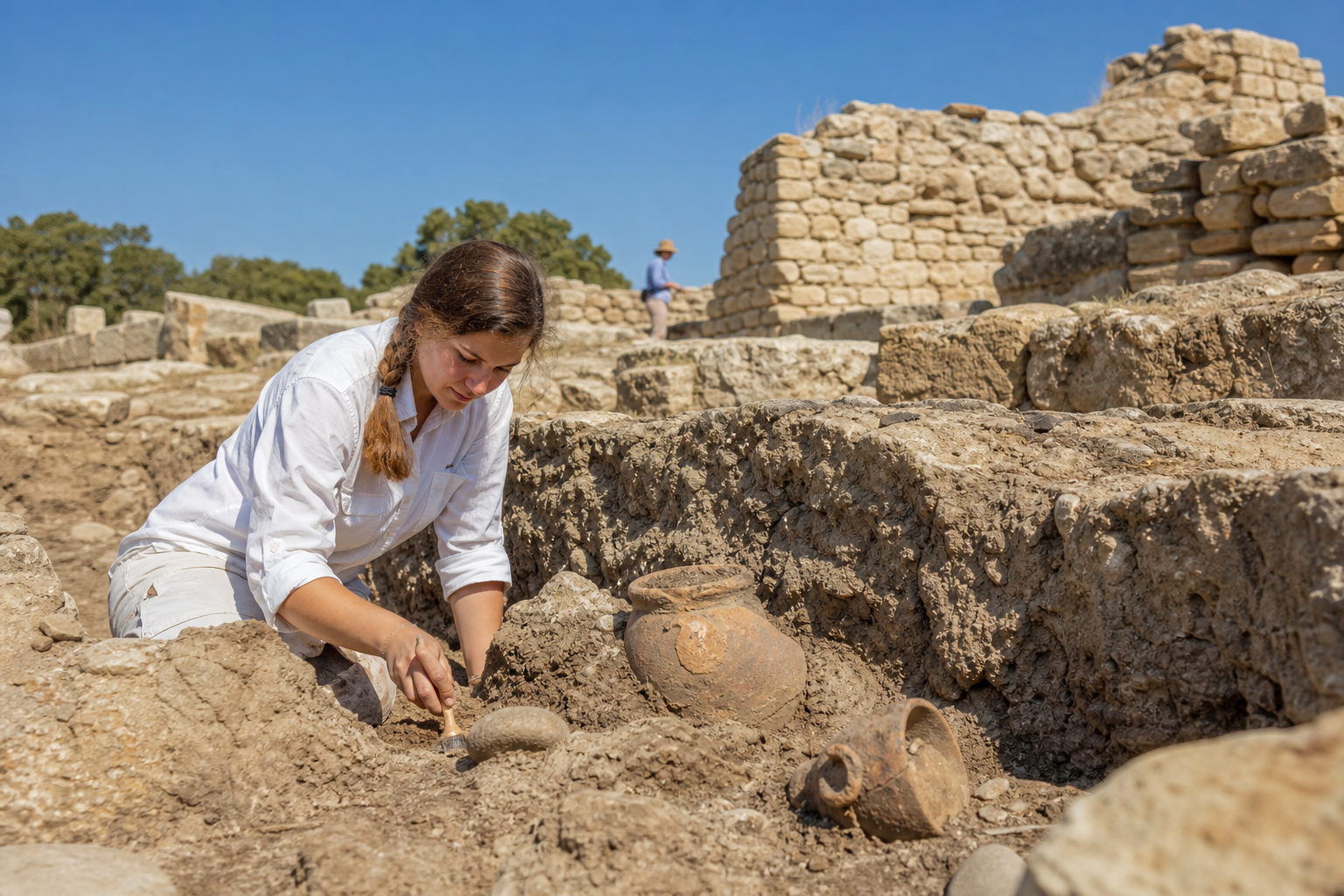
When a name flickers through the centuries with the light of both poetry and war, it invites a certain kind of searching that combines imagination with method. Troy — Ilios, Ilion, Wilusa — sits at that luminous hinge between story and material trace. To read Homer is to be drawn into a world of gods and heroes where the walls of a single city shape epics that defined Greek identity for millennia. To walk the terraces of Hisarlik, the mound on the Turkish coast where modern archaeology has located Troy, is to confront layers of beaten earth, collapsed walls, and pottery fragments that compress millennia into stratified testimony. Between these two experiences lies a long debate: which parts of the myth drew upon memory, which were later invention, and how do we responsibly reconstruct a past that is both real and refracted by legend?
The story of Troy is therefore both stubbornly simple and maddeningly complex. In its simplest terms Troy was a place where Bronze Age polities met — mercantile, strategic, and often contested. In its most resonant guise, Troy is a literary symbol of desire, hubris, and the catastrophic cost of war. The historian and the romantic meet there: the former examines chronology, ceramics, and texts; the latter reads the Iliad and imagines Achilles’ grief and Helen’s fate. Archaeology has provided new ways to read the past without erasing the power of story. Scientific techniques — stratigraphy, radiocarbon dating, and soil analysis — allow us to place destruction layers, migration horizons, and trade networks into timeframes that can be correlated with Hittite or Mycenaean records. Yet even as data accumulates, the questions that made Troy an object of fascination in the nineteenth century persist: was there a historical core to the Trojan War? If so, which layer of the mound corresponds to Homer’s city? And what does the persistence of the myth tell us about memory and identity in the Late Bronze Age and beyond?
This article follows that double pursuit. It traces how Homeric poetry and later tradition shaped expectations; it narrates the archaeology that first unearthed Troy and the controversies that still swirl around Schliemann’s dramatic claims; it explains the stratigraphic sequence that turned a single mound into seven or more cities; and it connects Troy to the wider Late Bronze Age world of Hittite archives and Mycenaean trade. It also engages modern debates about the ethics of excavation, cultural heritage, and what new science — from DNA to radiocarbon wiggle-matching — can and cannot tell us. Along the way, small curiosities will illuminate odd corners of the story: misidentified trophies, treaty names that echo Homeric places, and archaeological finds that complicate rather than confirm simple narratives. The goal is not to resolve every mystery but to let the layered evidence speak for itself, while keeping alive the sense of wonder that made generations risk everything to find the fallen city of legends.
Did you know? The name Wilusa in Hittite texts likely corresponds phonetically to Greek Ilios (Ilios/Ilium), making the royal archives of Hattusa a crucial external witness to Troy's identity.
Troy in Homer and Later Tradition
Homer’s Iliad, composed in a form we estimate around the eighth century BCE though relying on much older oral traditions, is both a poet’s masterpiece and a source for the image of Troy that has endured for Western culture. The Iliad does not recount the entire Trojan War but focuses on a brief period in the final year of the conflict, illuminating the human cost through scenes of duels, divine interventions, and the iconic grief of Achilles. The city in Homer is a place of walls and palaces, of council-halls and harbors, of captured women and heroic confrontations. Yet Homer’s Troy is also, crucially, an amalgamated place: the poet weaves a tapestry of memories and motifs rather than a precise geographic or historical report.
Classical and later Greek writers continued to shape Troy’s image, supplying genealogies, alternative versions of the war, and lists of heroes. Virgil’s Aeneid in the Roman tradition repurposed Troy into a foundational myth for Rome, altering emphasis and character in the process. For many centuries, however, Troy remained more a place of story than of verifiable historical record. It had a mythic charisma that resisted straightforward historicization: poets and playwrights used Troy as a mirror for human themes — honor, fate, and the ravages of war — rather than as a subject for empirical inquiry.
The emergence of philology and antiquarian curiosity in the eighteenth and nineteenth centuries reframed the question. Scholars began to ask if the Homeric epics preserved echoes of Late Bronze Age events and whether the geography described — the Scamander (Karamenderes), the ships’ harbors, the sequence of landmarks — could be tied to real places. These textual investigations coincided with, and eventually propelled, the era of archaeological exploration. The process would not be linear: poetry set expectations that archaeology struggled to meet or to overturn. Sometimes Homeric descriptions appeared surprisingly consistent with Bronze Age realities — such as references to chariot warfare and palace economies — while at other times the epic’s stylized language resisted neat correspondence with the archaeological record.
Did you know? Schliemann’s so-called "Priam’s Treasure" was taken to Berlin and later ended up in Moscow’s Pushkin Museum after WWII; its removal and ownership have been long debated in heritage circles.
Yet this tension is productive. Reading Homer alongside material culture opened the possibility that the poem preserved a cultural memory: communities remembering conflict between Aegean and Anatolian polities, perhaps refracted through centuries of oral retelling. The Hittite texts from Hattusa, discovered later and written in cuneiform, gave a startling corollary: names like Wilusa appear in Hittite sources and phonetically resemble Ilios — a philological bridge that made it plausible to identify Wilusa with Homeric Troy. The correspondence does not prove the entire epic, but it does provide an independent voice, a contemporaneous administrative record, that links the Trojan horizon to the documented geopolitical dynamics of the Late Bronze Age.
Archaeological Rediscovery: Heinrich Schliemann and the Victorian Quest
The figure most associated with the modern discovery of Troy is Heinrich Schliemann, a German businessman turned amateur archaeologist who believed passionately that Homer’s epics held historical truth. In 1870 he secured permission to excavate at Hisarlik, a tell (settlement mound) on the northwest Anatolian coast, after William Gell and others had tentatively suggested the site. Schliemann’s approach was dramatic and sweeping: influenced by 19th-century romanticism and imperial energy, he used a strategy of trenches and aggressive digging intended to expose “Homeric” levels quickly. In 1873 this zeal produced what he proclaimed to be the treasure of King Priam — a cache of gold, silver, and other objects he associated with Homer’s accounts.
The public response was immediate. Newspapers and learned societies celebrated Schliemann as a discoverer who had made myth real. Yet his methods and his claims were soon contested. Schliemann’s tunneling had damaged significant layers and contexts, compromising future study. Moreover, later archaeologists refined the stratigraphy of Hisarlik and showed that a great deal of what Schliemann attributed to Homeric Troy belonged to much earlier or later periods. Nevertheless, his finds — including a suite of magnificent gold objects — forced a reconceptualization of Bronze Age wealth in the Aegean-Anatolian world and sparked a broader archaeological interest that has lasted ever since.
Did you know? Troy VIIa contained significant Mycenaean-style pottery, suggesting contact or influence from Aegean communities during the Late Bronze Age.
Schliemann’s removal of the so-called Priam’s Treasure to Berlin — and its later relocation to the Pushkin State Museum in Moscow after World War II — remains a sensitive and contested chapter in the history of archaeology and cultural heritage. The episode raises enduring questions about provenance, exportation, and the ethics of excavation, especially when early excavators removed objects with little regard for stratigraphic context. Schliemann’s assistant and later wife, Sophia Schliemann, famously posed with the treasures in staged photographs that further mythologized the find. Yet the object assemblages themselves are invaluable: they demonstrate sophisticated metallurgy, long-distance exchange, and the conspicuous display of wealth in the Bronze Age.
The aftermath of Schliemann’s work included an evolving professionalization of archaeology. Scholars such as Wilhelm Dörpfeld advanced systematic stratigraphy, proposing a sequence of occupation that divided the mound into multiple layers. Later, in the 1930s, Carl Blegen’s American excavations applied more controlled techniques and refined ceramic chronologies. Each successive generation built on previous efforts, correcting mistakes and deepening the historical picture. The story of Troy’s rediscovery thus mirrors the maturation of archaeology itself: from a chase for spectacular finds to a method-driven science attentive to context, dating, and the messy realities of human occupation.

The Seven (or More) Cities: Stratigraphy and the Layers of Hisarlik
One of Troy’s most striking features to archaeologists is its palimpsest-like quality: the mound of Hisarlik contains multiple cities built atop one another, reflecting centuries of rebuilding, abandonment, and reuse. Early workers established a sequence that came to be popularly summarized as Troy I through Troy IX (or even more granular subdivisions), each representing different phases from the Early Bronze Age through the Roman period. Understanding which layer corresponds to the Homeric city — and whether Homeric memory refers to a single destruction event or a protracted history of conflict — is central to the debate.
Did you know? The Hittite "Alaksandu Treaty" names a ruler of Wilusa; its survival in Hittite archives provides one of the clearest external references to a polity that can be linked to Troy.
Troy II (roughly 2600–2300 BCE) reveals a fortified Early Bronze Age settlement with rich burials and a degree of social complexity that surprised 19th-century scholars. Later layers, particularly Troy VI (circa 1700–1250 BCE) and Troy VIIa (around 1250–1000 BCE), have attracted most attention in discussions of a Late Bronze Age Troy that could be historically linked to Homer’s Iliad. Troy VI displays massive stone fortifications, multi-room houses, and architectural sophistication suggesting prosperity and urban organization; the visible damage and signs of earthquake have led some scholars to argue that Troy VI experienced a catastrophic end — potentially a natural disaster — in the mid to late second millennium BCE.
Troy VIIa, stratigraphically above VI, shows smaller, more crowded habitations and evidence of a violent destruction layer in the late Bronze Age. The ceramic assemblage, including Mycenaean pottery styles, points to active cultural contacts with Aegean polities. Many historians propose that Troy VIIa is the most plausible candidate for a city besieged or sacked in a context that could have been transformed into the memory recorded in epic tradition. Still, the transition from Troy VI to VIIa and the exact chronology remain debated; some propose that Troy VI persisted longer, while others emphasize the cultural break visible in the pottery and house types of VIIa.
The multi-layer sequence complicates any simple mapping from poem to layer. Homer’s memory could reflect a composite of different traumatic events aggregated into a single narrative. Moreover, the region itself — the Troad — was a crossroads of trade and diplomacy, and repeated conflicts would not have been unusual. Archaeologists now use a suite of methods to refine dates and interpret processes: detailed ceramic seriation, microstratigraphy, thermoluminescence dating of ceramics, and targeted radiocarbon dating of short-lived samples. These techniques provide probability ranges rather than precise years, and they must be integrated with textual evidence from Hittite sources and Aegean chronologies to form coherent narratives.
Did you know? Mycenaean-style pottery at Troy demonstrates not only trade but possibly the presence of Mycenaean craftspeople or close cultural emulation in the Late Bronze Age.

Hittites, Wilusa, and the Late Bronze Age Geopolitics
One of the most remarkable developments in the study of Troy was the recognition that Hittite archives speak of a polity called Wilusa — a name linguistically close to Ilios. These cuneiform texts, written in the Hittite capital of Hattusa (modern Boğazkale), date from the second millennium BCE and record treaties, royal correspondence, and diplomatic maneuvers. The Hittite letters and treaties refer to places and names — including Wilusa, the kingdom of Arzawa, and a people called the Ahhiyawa — that help situate western Anatolia in a network of Late Bronze Age power politics.
The content of Hittite texts is tantalizing. The Tawagalawa Letter, for example, mentions conflict and diplomacy involving places that may correspond to Homeric actors; the Alaksandu Treaty names a ruler of Wilusa, and other texts record disputes that suggest western Anatolia was contested by Hittite interests and other western polities. The possible identification of the Ahhiyawa with the Achaeans (Mycenaean Greeks) is debated but supported by several scholars who note that Ahhiyawa appears in Hittite sources as a powerful western entity capable of intervening in Anatolian affairs. If Ahhiyawa equals Mycenae or Mycenaean-led coalitions, the Hittite evidence offers an external corroboration that conflicts involving Wilusa could have occurred in the Late Bronze Age and that those events were significant enough to enter official correspondence.
Archaeological evidence at Hisarlik complements the Hittite texts: elements of international trade, Mycenaean-style pottery, and indications of fortifications all fit a picture of a city embedded within broader diplomatic and commercial systems. Yet the Hittite perspective is not Homeric narrative: it is administrative, legal, and often terse. It records names, not stories. Historians must therefore read both kinds of evidence together: the Hittite archives show that western Anatolia was politically active and contested, while Homeric poetry dramatizes the human and moral dimensions of a remembered or imagined conflict.
Did you know? Manfred Korfmann’s excavations argued for a larger urban zone around Hisarlik, suggesting Troy may have been a major trade hub — a claim that sparked intense debate in the archaeological community.
The dialogue between textual and material evidence also creates pitfalls. German and Anglo-American scholars in the late nineteenth and early twentieth centuries sometimes allowed philological parallels to overly shape archaeological interpretation; more recent work stresses caution. Still, the convergence is striking enough to suggest that the seed of the Trojan story — a conflict involving a city in western Anatolia, neighboring polities, and Aegean actors — has a plausible historical nucleus.
The Trojan War: Myth, Memory, and Material Culture
When historians ask whether the Trojan War "happened," they confront a category error: the Iliad is not a chronicle but a poetic condensation of memory, moral reflection, and narrative art. However, that does not mean material traces are irrelevant. Material culture — architecture, ceramics, burial practices, and objects of metalwork — reveals social structures and connections that could support a backdrop for epic memory. For instance, evidence for chariotry, palace economies, and widespread long-distance exchange during the Late Bronze Age corresponds with elements deployed in Homeric narrative.
The Late Bronze Age Mediterranean was an era of palaces and diplomacy where prestige goods traveled across networks linking the Aegean, Anatolia, the Levant, and Egypt. Mycenaean-style pottery at Troy, exchange of metals and luxury items, and the presence of strong defensive walls are all consistent with a city that mattered in its regional context. If a violent episode occurred — whether a siege, raid, or political overthrow — it could certainly have been magnified in oral tradition into the epic saga known to later poets. The timeframe often proposed by scholars for such events sits within the tumultuous period that culminated in the Late Bronze Age collapse around 1200 BCE, when multiple polities in the eastern Mediterranean experienced destruction, population movements, and economic disruption.
Did you know? The persistence of Troy in literature and art across millennia shows how a city can become an ethical and cultural symbol, used to discuss everything from heroism to imperial destiny.
However, archaeological evidence rarely supports a single neatly packaged "war of Troy" as Homer depicts. Instead, the record points to repeated episodes of conflict, economic change, and cultural blending. The dramatic final scenes of the Iliad — the burning of the city and the death of many heroes — may synthesize several traumatic memories into one redemptive closure. Moreover, the social meaning of such a remembered conflict could have shifted as different communities retold the story, projecting contemporary values onto the past. For example, later Greek audiences heard in the Trojan saga a tale that justified colonization, tested heroic ideals, and provided moral exempla for social behavior.
Material evidence thus does not settle the question by itself but places constraints on plausible reconstructions. The presence of fortifications, evidence of destruction layers in the late Bronze Age, and the distribution of imported pottery create a circumstantial case that the Trojan narrative grew from real political tensions. Yet the specifics — the roles of named individuals, the involvement of particular kings, or the precise causes of destruction — remain elusive. The historian’s task is to acknowledge both the power of poetic memory and the limits of what fragments of pottery and stone can tell us about human motives decades or centuries later.

Modern Debates: Science, Heritage, and the Future of Troy
Recent decades have seen archaeology at Troy become increasingly scientific and interdisciplinary. Geophysical surveys, including magnetometry and ground-penetrating radar, have supplemented trench excavation and allowed archaeologists to map subsurface anomalies without wholesale intrusion. Targeted radiocarbon dating of short-lived samples (such as seeds or charred grain) has provided calibrated ranges for destruction layers, while studies of animal bones, botanical remains, and isotopes have deepened understanding of diet, trade, and mobility. DNA analysis of human remains elsewhere in the Aegean and Anatolia opens future possibilities for tracing population movements, though ethical and preservation concerns limit what can be done at Hisarlik itself.
Did you know? Carl Blegen's controlled excavations in the 1930s refined the stratigraphic sequence at Hisarlik and clarified many of the early interpretative errors.
A central modern debate concerns the characterization of Troy in regional terms. Manfred Korfmann, who led extensive excavations from 1988 to 2005, argued that Troy was a large, strategically placed trade hub with a harbor facilitating east-west exchange. His claims generated controversy — some scholars disputed the extent of the city’s maritime infrastructure and population estimates — but they also pushed researchers to refine fieldwork and integrate environmental studies. The interplay of marine geology, geomorphology, and archaeology shows how dynamic the Troad coastline has been over millennia, affecting harbor viability and settlement patterns.
Heritage issues remain urgent. The politicized histories of Schliemann’s finds, the movement of artifacts during wartime, and the commodification of antiquities create ethical challenges. Contemporary Turkish archaeological authorities manage the site within the framework of national heritage, and international collaboration has increased. Protecting the mound from tourism pressures, looting, and environmental change demands resources and careful planning. At the same time, Troy’s place in global imagination means that scholarly narratives must be accessible: responsible public archaeology explains nuance, acknowledges uncertainty, and resists simplifying myth into tourist slogan.
Perhaps the most intriguing frontier is integrative interpretation: combining texts (Homeric, Hittite), material culture, and environmental data to narrate a plausible historical scenario while preserving the epic’s literary richness. This approach does not seek to "solve" Homer but to show how a complex Bronze Age city could have produced the memories that lyric and epic codified. It accepts that some mysteries may persist — names without graves, treaties without narrative context — and it values the tension between evidence and story as a productive engine of inquiry.

Conclusion: Troy as Mirror and Archive
To end where the story began: Troy remains both a mirror of human imagination and an archive of human activity. The city’s layered ruins give material form to centuries of occupation, trade, and conflict. The Homeric epics provide a narrative architecture that shapes how later peoples remembered and reused the past. Between the two, archaeology and textual studies produce a nuanced portrait in which the Trojan War is neither pure fiction nor reducible to a single historical event. The reality is more interesting: a place where international diplomacy, local politics, and memorable violence intersected, later refracted into world-making literature.
Understanding Troy means accepting ambiguity. It asks us to respect the precision of stratigraphy and the poetic force of Homer with equal humility. It also obliges us to grapple with the ethical responsibilities of conserving and interpreting sites that mean different things to different audiences. Schliemann’s dramatic recoveries taught the public to desire a tangible past; modern archaeology teaches how that desire can be satisfied responsibly, through careful excavation, scientific dating, and collaborative scholarship.
The myth and the mound continue their dialogue. New methods — improved dating, DNA analysis, landscape archaeology, and interdisciplinary synthesis — will refine our understanding. But the appeal of Troy will always exceed any single dataset. Its power lies in being a place where story and stuff meet: where words compose memory and where layers of earth hold the slowly decaying records of human choices. For students of history, Troy is a case study in how to read absence as well as presence, to read silence in the strata as telling, and to value stories that survive precisely because they answered deep human needs for meaning in the aftermath of violence.

How we verify this article
By the History Unlocked editorial team
This text is built on historical facts stored in our database and drafted with AI assistance. No signed human review is recorded for this article. Report any inaccuracy: we correct it and update the modified date.
Updated on
AI-assisted drafting.
Read our editorial standardsEnjoyed this? Discover more articles in the category Archaeology & Discoveries