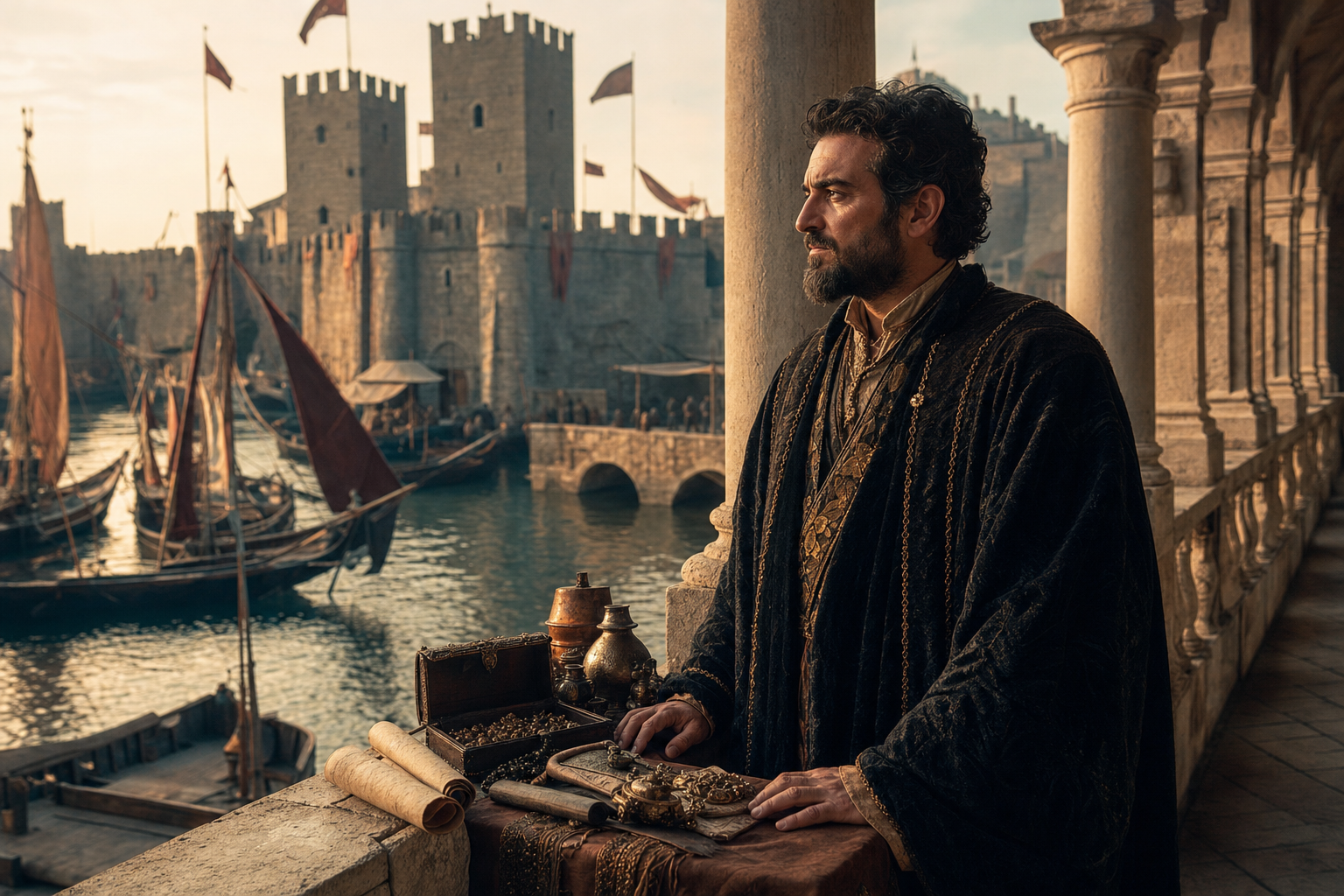
Venice's Merchants: Masters of Medieval Trade and Mystery
In the hush before dawn, when fog hangs like a curtain over the canals and ferries slip past the sleeping palaces, the city of Venice feels less like stone and water and more like the hull of a great ship that has weathered centuries. Beneath the lacquered facades and golden mosaics of the Serenissima's public face there thrummed a quieter, grittier life: the life of merchants. These men and women—owners of galleys, partners in shadowy partnerships, masters of ledgers and letters—built a mercantile empire whose reach extended from the lagoons of the Adriatic to the bazaars of Alexandria, the warehouses of Constantinople, and the fairs of Flanders. Their story is part commerce, part politics, and part something almost conspiratorial: a web of contracts and covenants, secret knowledge and careful calculation that made Venice a node of exchange unlike any other in medieval Europe.
The merchants of Venice did not simply trade goods; they traded influence. They negotiated with rulers and popes, marshalled fleets, convinced craftsmen to settle on islands, and created institutions that would outlast kingdoms. They were responsible for commodities that shaped diets and economies across continents—pepper that seasoned tables from Paris to Prague, silk that clothed courts, alum that fixed dyes, and sugar that turned sweets from luxury to aspiration. They were also guardians of techniques—the crystalline art of Murano glass, the complex bookkeeping that turned risk into manageable account, the legal instruments that could turn a voyage into a shared speculation rather than a private catastrophe.
To walk through Venice with an understanding of its merchants is to enter a world where the line between market and state was porous, where private wealth financed public expeditions, and where the city's famed beauty was an outward sign of inward calculation. This article will take you into that world: how geography and law shaped commerce; what goods moved through Venetian ships and warehouses; the business practices and institutions merchants relied upon; their social life and cultural imprint on the city; and the rivalries and global shifts that eventually tested Venetian dominance. Along the way, curious footnotes and images will point to the lesser-known details and singular artifacts that illuminate the human drama of medieval trade—stories of fire and secrecy, clever accounting and brutal naval encounters, of families who rose and fell by the fortunes of their fleets. The scene is set. The ledgers are open. Let us begin with the lagoon itself, the silent partner in every Venetian bargain.
Did you know? The Rialto area was so central to commerce that in 1097 the doge’s government fixed a permanent customs house there, establishing an early institutional anchor for Venice's trading dominance.
Geography, Foundation, and the Making of a Maritime People
Venice's geography is the prologue to its mercantile tale. The city grew from a scattering of islets in a sheltered lagoon, a refuge for those fleeing barbarian incursions as the Western Roman world fragmented. By the late 9th and 10th centuries the islands had become a viable urban center, and by the 11th and 12th centuries Venice's orientation toward the sea had hardened into deliberate policy. The canals were not only thoroughfares but the city's arteries for commerce: every palazzo fronted by water signaled access to the market. The Rialto district—an area named for the 'pitch' or 'fork' of the Grand Canal—emerged early as the commercial heart, a patchwork of fondachi (warehouses and inns), money-changers, brokers, and stalls. Its importance can be traced to the constant movement of goods and people along the Adriatic and into the broader Mediterranean.
The economic habits of a maritime people differ from those of a hinterland state. Landlocked lords might measure power in acres and levies; Venetians measured it in cargoes, convoy schedules, and safe passage. Maritime orientation demanded logistics—shipyards, navigational knowledge, and the ability to maintain fleets. Venice developed the Arsenal, a massive complex of docks and workshops where hulls could be assembled with remarkable speed and where oars, sails, rope, and cannon were stockpiled. From as early as the 12th century, the Arsenal's output and organization allowed Venice to field fleets faster than many rivals, and by the later medieval period it had become an industrial wonder: thousands of workers, an evolving process of standardized parts, and a quasi-military labor discipline that married state needs to merchant protection.
The lagoon itself offered both sanctuary and a difficult operating environment. Channels and shoals required expert pilots and intimate knowledge of tides and winds—skills that Venetian sailors cultivated and jealously guarded. Geography also infused politics: the Republic of Venice moved to secure access to the Adriatic's mouths and islands, creating a string of maritime possessions and trading posts that served as supply points and toll stations for Venetian convoys. Control of the lagoon was thus inseparable from the protection of commerce. The city’s political class—many of them merchants by background—crafted a government and legal system designed to prioritize and stabilize trade, from rules governing harbor dues to maritime contracts adjudicated by skilled notaries.
Did you know? After the Fourth Crusade, Venice acquired strategic ports and islands that transformed the city into a spatial hub connecting grain shipments from the Black Sea directly to Italian and western markets.
This combination of natural shelter, engineered infrastructure, and legal order made Venice uniquely suited to become a commercial superpower. Yet geography alone cannot explain the city's success. The distribution networks, the institutions that smoothed risk, and the human networks that crossed languages and faiths were as important as docks and canals. Venetian merchants operated at the intersection of West and East, not merely by route but by habit: fluent in the lexicon of the sea and adept at bridging cultural divides. The next section will follow the caravans, convoys, and commodities that flowed through Venetian hands and warehouses.

Trade Networks and Commodities: From the Black Sea to the Spice Islands
If geography and infrastructure supplied the stage, it was the demand for goods that supplied the actors. Venetian merchants built an empire by knitting together trade networks that spanned the Mediterranean, penetrated the Black Sea, and linked to overland routes stretching toward Central Asia. Their ships carried goods that were sought after in European markets—primarily spices (pepper, cinnamon, cloves, nutmeg), silks and textiles, precious metals, dyes, glassware, salt, and grain. At the same time, Venice became a crucial node for exports from Europe: raw wool, timber, metals, and later manufactured goods flowed outwards. The city’s merchants were not merely middlemen; they invested in production, secured monopolies, and sometimes controlled entire segments of a commodity chain.
The Black Sea region and the Eastern Mediterranean were especially vital. From the late 11th century onward, Venetian merchants established factories and quarters—commercial enclaves where they could store goods, house agents, and navigate local politics—at key ports: Constantinople, Tana near the Cimmerian Bosporus, Chios, Crete, and later at sites in the Aegean and eastern Adriatic. The Fourth Crusade (1202–1204) dramatically reshaped Venetian access to these networks. Tasked with transporting Crusader fleets—and, through a chain of events set in motion by calculation and debt—Venetians persuaded the crusaders to attack Zara and eventually Constantinople. Venice emerged from the sack of Constantinople (1204) with favorable rights and territories: important trading colonies and a strengthened foothold in the Byzantine trading system. This violent episode delivered territories and privileges that amplified Venice's presence in the East and opened lucrative channels for grain, silk, and luxury trades.
Did you know? The commenda contract allowed investors to finance voyages with limited liability, effectively separating ownership of capital from the perils of navigation—a legal innovation crucial for expanding long-distance trade.
The island of Crete (known to Venetians as Candia) became a cornerstone of Venetian overseas policy after 1204, serving as a breadbasket for Venice and a base for the island’s sugar production and agricultural exports. Venice held Crete for centuries, until it fell to the Ottomans in 1669, and during that time Cretan products and Venetian plantation management infused the Mediterranean economy. Likewise, Venetian influence in ports such as Negroponte (Euboea) and parts of the Peloponnese provided staging points for the movement of goods and fleets.
Long-distance trade required specialization. Spices from the Indian Ocean passed through a chain of intermediaries—Arab and Persian merchants, Genoese and Venetian agents, and finally European buyers. Venetian mariners, through negotiated privileges and sometimes force, secured favored positions in these chains. As trade with the East intensified in the later medieval centuries, Venetian merchants increasingly relied on credit instruments, notaries, and detailed contract forms to manage the flow of capital and risk. That infrastructure of trust—legal documents, recognized customs practices, and the reputations of merchant houses—was as crucial to the flow of pepper and silk as the hulls of the ships.
Venice’s merchants also adapted to European markets. Northern fairs—Bruges and later Antwerp—became destinations for Venetian craft goods and eastern luxuries. Flemish merchants brought cloth to Venice in exchange for spices and eastern fabric. This interdependence is visible in the organized fleets known as the 'muda'—state-sanctioned convoys that linked Venice to Flanders and other crucial nodes in northern Europe. The muda system coordinated departures, provided security, and synchronized commerce in a way that civilian fleets alone could not.
Did you know? In 1291 the government moved Venice’s glassmakers to Murano to contain fire hazards and to protect the lucrative, closely guarded techniques of glass production.

Business Practices and Institutional Innovation: Contracts, Credit, and the Notary
Merchants do not function without rules and tools. In medieval Venice, a sophisticated legal and financial ecosystem evolved to manage risk, allocate capital, and secure trust across linguistic and political boundaries. One of the most important devices was the commenda: a contract in which an investor provided capital to a merchant or captain for a specified voyage, sharing in profit but insulated from direct management of the voyage. This limited-risk partnership encouraged investment in maritime ventures and allowed capital to be pooled without exposing investors to day-to-day maritime dangers. The commenda was a widespread Mediterranean innovation and a foundation of Venetian mercantile expansion.
Complementary to the commenda were bills of exchange and letters of credit. These instruments allowed merchants to move value without moving coin—vital in an era when bullion could be scarce or dangerous to transport across contested seas. Venetian merchants often worked with money changers and bankers, the cambisti, who operated in and around the Rialto. Notaries recorded transactions with meticulous care; the Venetian notarial archives are a historian’s treasure-trove precisely because they preserve contracts, shipping manifests, and legal disputes in such abundance. The state codified commercial law and often adjudicated disputes in ways that favored stable trade and predictability—features that encouraged foreign merchants to establish operations in Venice.
These legal frameworks were reinforced by social and economic institutions. The fondaco (from Arabic fonduk) was a hybrid warehouse-inn that served as a base for foreign merchants: the Fondaco dei Tedeschi housed German merchants, the Fondaco dei Turchi later hosted Ottoman traders, and similar arrangements existed for other communities. Within a fondaco, merchants could store goods, sleep, transact business, and, crucially, be regulated by Venetian law. The fondaco system allowed Venice to concentrate foreign merchant activity in monitored spaces, controlling customs, preventing smuggling, and capturing revenue through rents and duties.
Did you know? Marco Polo was captured at the naval Battle of Curzola (1298) and, while imprisoned in Genoa, recounted his travels—which later became one of the most influential travel narratives of the medieval world.
Another innovation was the state’s involvement in fleet organization. The Venetian government not only taxed and regulated trade but also actively organized convoys and provided naval protection. The Arsenal's capacity to outfit warships and merchant ships underpinned this politico-commercial model: the Republic could protect convoys, enforce tolls, and, when necessary, project force to secure trading privileges. Maritime insurance, while not identical to modern insurance, emerged in practices where risks were shared among investors and documented by notaries.
Accounting practices in Venice were rigorous. While double-entry bookkeeping is often associated with later figures like Luca Pacioli, Venetian merchants used a range of sophisticated ledgers and accounting techniques to track transactions. These approaches allowed merchants to manage multifaceted enterprises that stretched across ports and decades. Reputation, too, was a currency: merchant houses accrued creditworthiness through successful voyages and transparent dealings recorded by the notarial network.

The Social World of Merchants: Palaces, Patronage, and the Patrician Identity
Wealth shapes society as profoundly as it does buildings. Venetian merchants translated their fortunes into palazzi along the Grand Canal, into visible patronage of religious institutions, and into a political architecture that tied commerce to governance. By the late 13th century the Serrata (1297) had closed the Great Council of Venice to new entrants, effectively sealing political power within a defined patriciate. Many of those who occupied the Great Council had mercantile backgrounds; the oligarchy that ruled Venice thus fused commercial leadership with political authority. This fusion made the interests of merchants a matter of state policy and vice versa.
Did you know? The Archivio di Stato in Venice contains tens of thousands of notarial acts and mercantile records, providing an unparalleled documentary basis for reconstructing medieval Mediterranean trade.
Palaces were statements of pedigree as well as wealth. The facades that fronted the canal displayed not merely aesthetic taste but the power to command stone and labor. Merchant families invested in churches and confraternities known as scuole, which performed social welfare, organized religious festivals, and staged elaborate rituals that communicated civic cohesion and family prestige. These institutions also functioned as networks of trust, providing connections that could be mobilized for commercial purposes.
Cultural patronage extended beyond religious benefaction. Merchants commissioned works of art, supported humanists and chroniclers, and became collectors whose tastes reflected the cosmopolitan sensibility forged by trade. Goods from the East—silks, precious stones, exotic woods—were integrated into domestic display as markers of taste and global reach. The city’s markets—where a Venetian noble might buy eastern pepper and a Genoese merchant sell wool—were places where cultural exchange happened alongside the exchange of goods.
But the social world of merchants could be precarious. Merchant fortunes rose and fell with the success of voyages and the stability of shipping lanes. Family networks mitigated risk: marriages consolidated capital and influence, while kinship networks extended credit and protection. Women in merchant families, though often excluded from formal political roles, played pivotal roles in household economic management and in the social bonds that preserved family reputations.
Did you know? The Portuguese rounding of the Cape of Good Hope in the late 15th century redirected much of the spice trade, undermining Venice’s role as the primary European intermediary for eastern spices.
The movement of skilled labor was also socially consequential. In 1291, the Venetian Republic ordered glassmakers of Venice to move their furnaces to the island of Murano. The decision had multiple aims: to reduce fire risk in the crowded heart of Venice and to centralize the production—and thus the secrecy—of glassmaking techniques. Murano became the guarded heart of Venetian glass, an industry that supplied both functional and luxury wares across Europe and reinforced Venice’s reputation for craftsmanship. Such decisions show how merchant interests, state policy, and artisanal labor were braided together in the city's social fabric.
Rivalries, Conflict, and the Politics of Protection
No mercantile system survives without conflict. Venice’s rise provoked competition and occasionally open warfare. Genoa, its chief maritime rival, contested control of Mediterranean trade routes and markets. Naval confrontations punctuated the history of the two republics: the Battle of Curzola (Korčula) in 1298 was a notable Genoese victory in which Marco Polo—then a young Venetian merchant—was captured; his imprisonment in Genoa is where he dictated the account known as The Travels of Marco Polo. These naval battles were not mere skirmishes; they were existential contests over the sea lanes that carried spices, grain, and silver.
Venetian power also encountered the rising Ottoman state in the eastern Mediterranean. The fall of Constantinople in 1453 to the Ottomans transformed the geopolitical landscape. Venetian merchants, once closely tied to Byzantine markets and privileges, had to renegotiate relationships with an ascendant Ottoman empire. The loss of certain Atlantic and Levantine routes, the shifting control of key ports, and the Ottoman expansion into the Aegean and the Eastern Mediterranean gradually constrained Venetian maritime options.
Did you know? After the Fourth Crusade (1204) Venice acquired Crete (Candia), which remained an important Venetian possession and agricultural base until it fell to the Ottomans in 1669.
The age of exploration presented another structural challenge. The Portuguese voyage around Africa to India (Vasco da Gama, 1498) and the subsequent opening of Atlantic routes shifted the center of long-distance spice trade away from Mediterranean intermediaries and toward Atlantic powers like Portugal, Spain, and later the Dutch and English. Venice tried to adapt—maintaining roles in overland and Mediterranean trade and emphasizing manufactured goods such as glass and luxury textiles—but the economic centers of gravity were moving.
Warfare, too, was a heavy burden. Maintaining defenses, fleets, and garrisons in overseas possessions required resources. Catastrophic events—naval defeats, fires that destroyed warehouses, a bad season of storms—could cascade into bankruptcies. Venice’s political system tried to stabilize commerce through regulation, naval protection, and diplomatic agreements, but it could not shelter merchants from every risk. Still, the Republic’s resilience is striking: it survived centuries of conflict, adapted to changing commercial patterns, and preserved a civic culture that remained deeply interwoven with commerce until the late 18th century.

The Material Legacy: Architecture, Artifacts, and the Archive
The physical traces left by Venice’s merchants are everywhere: in warehouses and palaces, in the artifacts that placed eastern luxury into western homes, and in the astonishing documentary archive that historians rely upon. The Fondaco dei Tedeschi (the warehouse and lodging for German merchants) and similar institutions testify to how Venice organized foreign trade. These buildings were liminal spaces where legal jurisdiction, commercial negotiation, and cultural contact converged. The fondaci contained storage rooms, living quarters, and sometimes their own chapels; merchants lived among their goods and their books, protected by the rules and rents imposed by the Republic.
Treasure is not only material. Venice’s bureaucratic culture produced one of the richest archival deposits in Europe. Notarial records, shipping lists, merchant ledgers, and diplomatic correspondence fill the Archivio di Stato in Venice, allowing historians to reconstruct trade routes, contract forms, and family fortunes in painstaking detail. Through these documents we can read the terms of commenda contracts, follow a sequence of bills of exchange, and understand the legal remedies available when a ship went missing. The archival density is itself a product of a commercial mentality: Venice needed records to enforce contracts, levy duties, and manage its empire.
Art and architecture bear similar testimony. Merchant-funded churches hold mosaics and altarpieces that incorporate exotic motifs and materials. Palazzi facade loggias display the status not only of families but of merchants turned patrons. Murano glass objects—delicate goblets, chandeliers, mirrors—transcended mere utility to become signs of cosmopolitan taste. Sometimes design encoded origin: certain enamel techniques or patterned silks signaled eastern provenance; a specific style of glasswork spoke to the guarded secrets of Murano furnaces.
The archival and material legacies also illuminate daily life. Shipping manifests show seasonal rhythms—when grain from the Black Sea arrived, when furs and timber returned north, when spices were contracted for Flanders. Notarial depositions and legal suits reveal the perils merchants faced: piracy, storms, the death of a captain, or the abrupt seizure of goods in a foreign port. These human details—calculated in pages of legalese and manifest numbers—bring the merchant’s world into vivid relief.
Conclusion: Echoes of the Merchant Republic
To stand today on the steps of a Venetian palazzo or to trace the faded ledger entries in an archive is to appreciate how deeply trade shaped civic identity. The merchants of Venice created a civilization in which commerce was not merely a private endeavor but a public vocation. They transformed the city into a hub whose influence radiated across sea and land, integrating markets and cultures through contracts, convoys, and a disciplined bureaucratic culture. Their innovations in finance, their rules for shipping and partnership, and their ability to coordinate fleets and markets under state oversight produced a durable if not invincible system.
Yet the story of Venice’s merchants is not only one of triumph. It is a narrative of adaptation and vulnerability: adaptation to new markets and diplomatic contexts, vulnerability to shifting routes, rising states, and military technologies. The Portuguese circumnavigation of Africa, the steady power of Ottoman states, and the militarized rivalry with Genoa are reminders that commerce exists within a larger matrix of power. Venice’s eventual political end in 1797—when Napoleon dissolved the Republic and the Treaty of Campo Formio ceded the city to Austria—was the final punctuation in a long tale of resilience and transformation.
Still, the legacy persists. Modern financial practices, the idea of limited partnerships, and even the cultural cosmopolitanism of port cities can be traced in part to Venetian precedents. The city's archives and objects remain a laboratory for historians reconstructing the practices of earlier centuries. In the foggy dawn, when the first barges ply the canals and the city wakes, it is possible to imagine the merchants of the past—ledgers clasped, letters sealed, routes planned—moving through a world both familiar and strange. Their decisions shaped diets, fashions, and fortunes across continents; their institutions shaped law and finance; their palaces and archives left a material imprint visible to the modern eye.
The merchants of Venice were more than traders: they were architects of a commercial ecosystem that combined cunning, law, and maritime skill. They leave behind a city that seems almost to breathe with the patterns of trade—palaces facing the water, warehouses converted into museums, a language of contract and covenant encoded in its records. When we study Venice, we are studying an economy made visible, an empire of merchants whose mysteries are recorded in both marble and ink. Their story is a reminder that commerce can produce art and institutions capable of enduring long after the markets they served have moved on.

How we verify this article
By the History Unlocked editorial team
This text is built on historical facts stored in our database and drafted with AI assistance. No signed human review is recorded for this article. Report any inaccuracy: we correct it and update the modified date.
Updated on
AI-assisted drafting.
Read our editorial standardsEnjoyed this? Discover more articles in the category Middle Ages