
Steel and Shadow: Medieval Weapons and Armor Explained
In the dim corridor between legend and craft, medieval weapons and armor stand as artifacts of human necessity and artistry. To step into their world is to follow whispers of iron struck hot, to hear the rhythm of hammers on anvils, and to feel the tug of strategy that shaped centuries of warfare. This is not merely a catalogue of forms—swords, bows, helmets—but a journey along the braided paths of technology, culture, and psychology. From the mail-clad warriors of the 11th century to the gleaming breastplates of the 15th, each piece was a response to a question: what must a man wear to survive, and what shape must his weapon assume to alter fate?
The medieval battlefield was an arena of contradiction. Beauty and brutality sat side by side: exquisitely tempered blades could be wielded to devastating precision; ornate harnesses served both to protect a lord and to proclaim his status. The arms and armor of this era were also deeply regional and adaptive. A Norman knight at Hastings wore a kite shield and a hauberk of interlaced rings; an English yeoman drew a longbow whose arrow would puncture mail at Agincourt; a Genoese crossbowman faced storms of arrows and the mud of Crécy. Each artifact carries a story of manufacture and use, of economic networks that brought steel and salt across continents, and of the evolving match between offense and defense that defined medieval military thought.
This article aims to walk that corridor with a lantern, to listen for the metallic heartbeat of the middle ages, and to examine in detail the weapons and armor that shaped battles and polities from roughly the 11th to the 15th centuries. Expect technical descriptions—but also mysteries: the signature on an Ulfberht blade that tells of a rare high-quality steel a millennium ago; the reasons a simple wooden shaft, tipped and fletched, could decide kings; the way armorers began to fashion plates that bent the rules of chance. We will analyze swords and polearms, bows and siege engines, the gradual shift from mail to articulated plate, and the smiths’ craft that made all this possible. Along the way, I will drop into moments of history—from Hastings to Crécy to Agincourt—to show how weapons and armor performed not in isolation but in the theater of human events.
Did you know? The Bayeux Tapestry (c. 11th century) provides one of the most important visual records of Norman weapons and mail armor used at the Battle of Hastings in 1066.
Evolution and Context: Weapons as Cultural Mirrors
To understand medieval weapons and armor is to appreciate them as cultural mirrors reflecting political organization, technology, and social roles. In early medieval Europe, the dominant heavy infantry gradually ceded the battlefield to cavalry elites whose wealth bought horses and armor. The Norman Conquest of England in 1066 is often invoked as a pivot; the Bayeux Tapestry immortalizes mail-clad cavalry and kite shields that embodied Norman military practice. But technology does not change by decree alone. Economic factors—access to iron, trade routes, and the capacity to sustain metallurgical workshops—drove what weapons could be produced in significant numbers.
The first half of the medieval millennium saw continuity in many forms: mail (chainmail) was the principal personal defense, helmets were commonly conical with nasal guards, and swords retained double-edged cutting geometry. The Viking Age and the Carolingian world spread pattern-welded swordmaking traditions and introduced high-quality blades bearing inscriptions, such as the enigmatic Ulfberht swords of the 9th–11th centuries. These blades, forged with higher-carbon steels than typical contemporaneous artifacts, suggest sophisticated smithing and unexpected long-distance trade in materials and techniques.
By the Late Middle Ages, however, an arms race of sorts reshaped weaponry. Plate elements were introduced to cover the weaknesses of mail; polearms and specialist weapons arose to counter plate; ranged arms proliferated into two major families, bows and crossbows—each with its own tactical niche. This progression was neither smooth nor uniform. Different regions—Italy, France, the German lands, England, and the Eastern Mediterranean—developed variants tuned to their doctrines. For example, Italian city-states invested in well-equipped mercenary companies and turned to heavy cavalry combined with well-armed infantry, which in turn encouraged widespread use of polearms and breastplates. In contrast, the English reliance on the longbow reflected socio-economic choices: widespread yeoman archers supplemented rather than replaced mounted nobility.
Did you know? Some Ulfberht swords contain steel that modern analysis suggests came from crucible-produced high-carbon material, a remarkable achievement for the 9th–11th centuries.
Technological innovations did not merely create better weapons; they raised new legal and ethical questions. The Second Lateran Council in 1139 famously banned the use of crossbows against Christians—an ecclesiastical attempt to limit what was perceived as a particularly deadly innovation. Laws and edicts such as this reveal how weapons could be controversial, altering conventions of honor and the acceptability of certain lethality.
The broader diplomatic and cultural landscapes also left their mark. Contacts with the Byzantine Empire and the Islamic world introduced different armoring concepts—lamellar, scale, and brigandine-like constructions—and sometimes superior raw materials or techniques. Crusading routes, mercenary travel, and trade lanes brought craftsmen and know-how into contact, accelerating the diffusion of ideas and sometimes producing hybrid solutions. Thus the medieval arsenal was not a monolithic repository but an evolving stew of local tradition and international exchange.

Swords and Blades: Anatomy, Types, and Lives of the Edge
No single weapon better symbolizes medieval combative identity than the sword. Yet the sword’s history in the Middle Ages is not a simple upward arc of improvement; rather, it is a tale of shifting priorities between cutting and thrusting, between one-handed and two-handed use, and between symbolic status and battlefield utility.
Did you know? The halberd’s design—combining axe, spike, and hook—made it exceptionally versatile; Swiss and German city militias used halberds extensively to counter knightly cavalry in the 14th–15th centuries.
Early medieval swords, descending from late Roman and Germanic predecessors, tended to be broad, double-edged, and optimized for cutting. Their construction often involved pattern-welding: twisting and welding strips of iron and steel to produce a composite blade combining toughness with an edge-holding core. By the Viking Age and into the early Middle Ages, these blades were sometimes etched with maker’s marks; the Ulfberht swords are the most famous example. Produced approximately from the 9th to the 11th centuries and marked with the name "ULFBERHT" inlaid on the blade, these swords were notable for their unusually high-carbon steel and sophisticated forging. Their presence across Europe reveals trade in both finished weapons and high-grade steels—possibly including trade links reaching into areas where bloom refining or crucible steelmaking provided superior iron.
As armor evolved, so did swords. The arming sword—a single-handed sword worn with a shield—remained common through the 12th and 13th centuries. Swords gradually acquired stiffer, more tapered points to pierce mail and exploit gaps. The hand-and-a-half or bastard sword emerged to give more leverage and reach, while the longsword of the 14th and 15th centuries often combined cutting edges with strong thrusting geometry and complex techniques recorded in fight manuals, such as those of Johannes Liechtenauer or Fiore dei Liberi. These fencing masters emphasized not just the sword’s anatomy but also timing, footwork, and the use of half-swording (gripping the blade for control and point attacks) to find vulnerabilities in plate.
Blade types also diversified in response to different environments. The knights of northern Europe favored heavier cutting and slashing blades for battlefield shock; in contrast, slender arming swords and estocs (starkly pointed swords) developed as counters to reinforced plate. The estoc, often without a sharpened edge, prioritized a narrow profile and rigid spine to exploit gaps and penetrate mail or the joints of plate.
Did you know? At the Battle of Crécy (1346), Italian Genoese crossbowmen were present and outmatched in part due to terrain and the longbow’s higher rate of fire; the battle demonstrated how conditions, not only technology, determine effectiveness.
Maintenance and repair formed a crucial part of a sword’s life. Sharpening, peening of nicks, and occasionally re-forging were everyday practices. Temuing and quenching techniques mattered hugely: the wrong quench could leave a brittle blade, while tempered blades offered a balance between hardness and resilience. Swords were not generic; they were made for particular hands, tactics, and social meanings. A sword inscribed with runes or inlaid decoration was at once weapon and heirloom, a bearer of oath and status.
Polearms, Axes, and the Blunt Arsenal: Design to Defeat Plate
When the first significant plate reinforcements appeared on mail-clad warriors, traditional cutting weapons lost some of their lethal advantage. In response, an array of polearms and blunt instruments proliferated—each a modular answer to protective metal. Polearms in medieval Europe embrace a range of forms: halberds, pollaxes, glaives, bills, and the polehammer. These weapons paired the reach and leverage of a wooden shaft with specialized heads that combined hooking, cutting, stabbing, and concussive functions.
The halberd, which became especially prominent in the 14th and 15th centuries, offered an axe blade for cleaving, a spike for thrusting, and a hook for pulling riders from horses. The pollaxe or poleaxe was often the weapon of choice in judicial duels and armored combat; its short haft allowed for precise strikes to visor joints and armpits, and its design included hammer faces and spikes intended to deform or concentrate force on plate. War hammers—like the bec de corbin (crow’s beak)—concentrated impact force into a small point, capable of denting or piercing plate and causing internal injury despite armor’s protection.
Did you know? The "coat of plates"—an intermediate step between mail and full plate—appears in archaeological and pictorial records from the 12th–13th centuries and demonstrates the gradual nature of armor evolution.
Axes retained a place in warfare both as tools of soldiers and as weapons. The massive Dane axe of earlier centuries could cleave in a single blow, while later partisan and executioner’s axes served specific tactical and symbolic roles. Meanwhile, blunt maces and flanged maces produced bone-breaking concussive blows that bypassed the cutting advantages of the sword. Flanges focused energy along narrow ridges that could create localized failure of plate.
A central tactical consequence of polearm proliferation was the democratization of anti-armor capability. Whereas earlier only heavily trained knights might possess the skills and equipment to defeat mail, polearms allowed infantry formations to threaten cavalry and armored nobles effectively. Infantry using coordinated thrusts, such as pike squares bolstered by halberdiers, disrupted cavalry charges and shaped battle outcomes—most famously in late medieval battles where disciplined infantry changed the calculus of chivalric dominance.
The materiality of these weapons also mattered. Polearms were often made by adapting agricultural tools; the bill is a direct example of a tool-weapon adapted from a farming implement. That made them cheap to produce and familiar to peasant levies, contributing to their rapid adoption.
Did you know? Medieval smiths sometimes used leather or organic padding beneath armor to mitigate blunt trauma; chroniclers of tournaments often mention padded gambesons as the first line of defense under mail.

Projectile Warfare: Longbows, Crossbows, and the Siege Art
Projectiles were decisive in medieval warfare because they offered a way to influence battle at range, disrupt formations, and negate armor through massed, penetrating force. Two distinct families—longbows and crossbows—dominated the medieval projectile realm on the battlefield, while siege engines like trebuchets and mangonels controlled fortifications.
The English longbow is perhaps the most storied medieval missile weapon. Made famous at battles like Crécy (1346) and Agincourt (1415), the longbow was a powerful, relatively cheap weapon that, in trained hands, could unleash deadly volleys at range. English archers trained from youth; laws required practice to maintain skill. Arrows with bodkin points were capable of penetrating mail and, in certain conditions, even early plate. The success of longbowmen at Crécy and Agincourt stemmed from a combination of factors: disciplined volleys, terrain selection (muddy fields that bogged down cavalry), and shot density. At Crécy, Genoese crossbowmen were outmaneuvered by English longbowmen, partly because of differences in rate of fire and other battlefield conditions.
Crossbows, meanwhile, offered a distinct tactical profile. Arbalests and heavy crossbows required mechanical aids—windlasses, goat’s-foot levers—to span but delivered tremendous penetrating power. Crossbowmen required less training to achieve battlefield competence than longbowmen did, and the weapon’s power made it a favorite among mercenaries and city militias. The church’s reaction to the crossbow—most famously the Second Lateran Council in 1139, which forbade their use against Christians—reflects the crossbow’s reputation for deadly effectiveness and its unsettling capacity to bypass the chivalric code of honor.
Did you know? Some late medieval city militias invested collectively in armor stocks to arm citizens during emergencies, reflecting communal approaches to defense in urban centers.
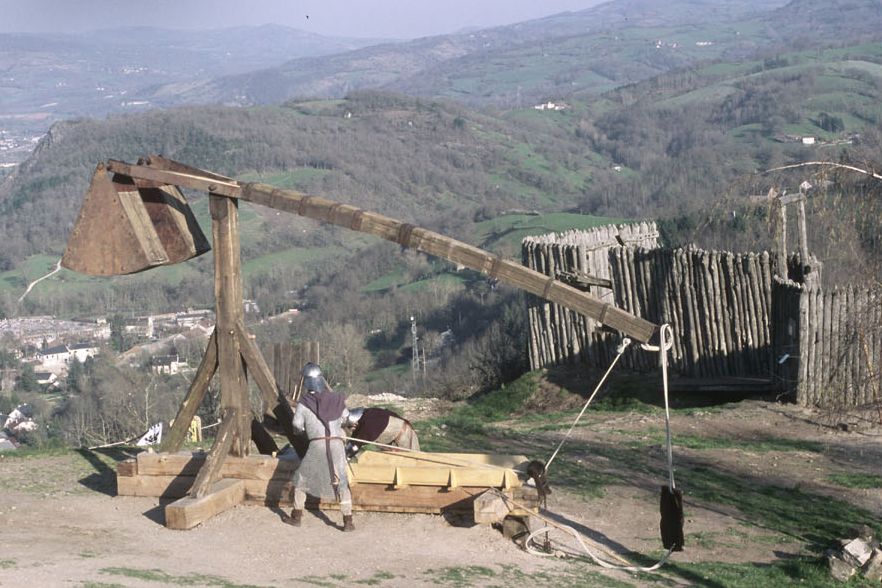
Siege engineering transformed static warfare into an arms race of mass, physics, and ingenuity. The counterweight trebuchet, appearing in Europe in the 12th century—possibly introduced from Byzantine or Islamic engineers—revolutionized siegecraft. It could hurl heavy stones or incendiaries against walls with terrifying force and accuracy. The traction trebuchet, older and often crewed by many men, gave way to counterweight designs that allowed greater mass and range. Trebuchets played crucial roles in sieges like Acre (1189–1191) and many later medieval confrontations.
Artillery of a different kind—early gunpowder weapons—began to appear in the late medieval period. Hand cannons and bombards started to test the relevance of traditional fortifications and armor. Though primitive by later standards, such devices foreshadowed a profound shift: when gunpowder matured, the logic of plate armor and stone walls would be dramatically altered.
Armor: From Mail to Full Plate, Protection as a Science
Armor in the medieval period transitioned from flexible mail to complex articulated plate garments in response to improved offensive technologies. Mail, composed of interlinked rings, provided excellent defense against cuts and moderate protection against thrusts. Its advantages included flexibility and relatively economical repair. Mail hauberks, chausses (mail leggings), and coifs dominated personal defense from early medieval centuries through the 12th and 13th centuries. The Bayeux Tapestry’s depictions of hauberk-clad warriors capture this dominant era of chainmail.
Did you know? The transition to full plate armor took place over centuries and was influenced as much by social rank and wealth as by simple technological availability.
As bladed and missile threats intensified, armorers began to tack plates onto mail. The coat of plates—an early 12th–13th century solution—featured iron or steel plates riveted inside leather or fabric, offering localized, rigid protection to vital areas while retaining some flexibility elsewhere. By the 14th century, the progressive addition of plate elements—breastplates, rerebraces, vambraces, poleyns (knee defenses), and greaves—produced hybrid harnesses that combined mail where mobility was paramount and plate where deflection was critical.
By the 15th century, full articulated plate harnesses reached their apogee. Milanese and German armors displayed distinct aesthetics and priorities: Italian (Milanese) harnesses tended toward smoother, rounded surfaces conducive to glancing blows, whereas German Gothic armor used fluting as both decoration and structural reinforcement. Plateaued into what we recognize as "knightly" armor, late medieval plate achieved remarkable coverage and articulated movement. A properly made 15th-century harness permitted surprising flexibility; a fully armored man could mount a horse, run short distances, and even master specialized close combat techniques designed for fighting in harness.
However, plate was not invulnerable. The advent of specialized weapons—maces, war hammers, poleaxes, and estocs—highlighted gaps and weaknesses. Joints and visors remained points of vulnerability, as did under-armor trauma resulting from transmitted concussive forces. Furthermore, armor was expensive, making complete harnesses a luxury of the well-off or a collective investment of wealthy urban militias.
The manufacturing of plate demanded a growing sophistication in metallurgy and furnace technology. Achieving consistent plate thickness, even temper, and precise articulation required workshops staffed with skilled armorers, pattern-makers, and leatherworkers. The result was protective gear that functioned both in war and in ceremonial contexts; armor became a language of identity, rank, and regional craft.
The Blacksmith’s Art: Materials, Techniques, and Trade
Beneath every blade and breastplate lies the smith’s judgement: the choice of iron, the heat of the forge, and the timing of the quench. The medieval blacksmith operated in a material world where ore quality, furnace type, and available fuel defined the possible. Early medieval Europe relied primarily on the bloomery furnace, which produced a spongy mass of iron intermingled with slag that required repeated forging to consolidate. Pattern-welding was a creative response to uneven material quality: by welding strips of varying carbon content, smiths could craft blades combining a hard edge with a resilient body.
The later medieval period witnessed improvements: larger furnaces, water-powered hammers, and more abundant charcoal supplies permitted production at greater scale and sometimes improved quality. The importation of higher-quality steels—whether by trade routes linking to the Islamic world and the East or by local innovations—changed the performance envelope. Wootz or crucible steel, associated with South Asia and known in Europe by limited trade, produced remarkable blades whose properties fascinated later smiths.
The smith’s technical decisions were manifold. Heat-treating—quenching and tempering—determined hardness and toughness. Differential hardening, used to create a hard edge and softer spine, appears in several traditions. For armor, the challenge was different: smiths needed to produce plates that were thin enough to be mobile but strong enough to resist denting or penetration. Riveting, rolling, and planing became important techniques in creating articulated harnesses. Apprenticeships and guild structures codified learning, while itinerant armorers and smiths moved between courts and cities, carrying patterns and secrets with them.
Beyond technique, trade networks were decisive. The dissemination of raw materials—iron ore, fluxes, and charcoal—and the movement of skilled craftsmen across borders shaped regional styles. Northern European centers excelled in certain types of mail and swordcraft, while Italian and German workshops developed distinctive plate-making reputations. Political factors—such as the patronage of courts, the presence of urban militias, or wartime demand—could make an armory flourish or wither.
Maintenance also required chain-like supply practices: armorers repaired plate after battle, remade straps, and reshaped helmets. Field smiths were essential to the medieval army, ready to recondition arrowheads, re-forge ax heads, or mend broken harnesses on campaign. The logistics of armor and weapon maintenance are often overlooked but were central to sustaining military capability.
Tactics, Psychology, and the Legacy of Weapons and Armor
Weapons and armor influenced more than just casualty counts; they shaped tactics, social hierarchies, and even legal norms. The presence of heavy cavalry favored shock tactics and pursuit, while the advent of disciplined infantry, longbows, or pike formations forced commanders to reconsider battlefield geometry. At Crecy and Agincourt, English commanders exploited terrain and concentrated missile fire to disrupt mounted charges, demonstrating that technology alone did not decide outcomes—training, discipline, and situational judgment mattered equally.
Armor had psychological effects as well. The sight of gleaming plate conveyed authority; harnesses and helmets obscured faces and could dehumanize opponents in the eyes of contemporaries. Tournaments and displays of arms reinforced social orders, making armor not only functional but ceremonial. The legal regulation of weapons—sumptuary laws regulating who could afford and display certain items—further embedded arms into social structure.
The later medieval introduction of gunpowder weapons would ultimately challenge the logic of plate and stone. Yet the medieval arms tradition should not be reduced to a prelude to firearms. Swords, polearms, bows, and armor each matured into sophisticated systems of offensive and defensive interplay with their own peak moments. Their legacy endures in modern reenactment, in the study of historical European martial arts (HEMA), and in the cultural imagination where knights and archers remain enduring figures.
As we study these artifacts today, new archaeological finds and metallurgical analyses continue to revise our understanding—revealing, for instance, the surprising distribution of high-grade steels or the ways in which common soldiers made do with adapted tools. The medieval sprawl of steel and leather was at once practical and symbolic, a material language that both protected and proclaimed.
The story of medieval weapons and armor is a study in reciprocal causation: weapons evolved in response to armor; armor adapted to new weapons; and both were shaped by economics, culture, and human daring. From the interlinked rings of mail to the articulated brilliance of 15th-century plate, from the surge of longbow volleys to the silent power of a crossbow bolt, these tools were instruments of survival and statements of identity.
Recognizing the craftsmanship behind each piece enriches our understanding—how a smith’s choices in heat and hammering translated into a weapon that could decide a lord’s fate, how infantry with polearms limited the supremacy of cavalry, how a well-placed volley at the right time reshaped a battle. The medieval armscape was not merely a technology but a theater of people and choices: serfs and masters, mercenaries and monarchs, smiths and strategists.
To handle a medieval sword or to study a harness is to touch a nexus of art, science, and conflict. Even as gunpowder would change the rules, the balance achieved in late medieval weaponry and armor reflects centuries of refinement. Those who wielded these arms left behind more than relics: they left lessons about adaptation, ingenuity, and the human dimensions of warfare. Perhaps the greatest mystery is how such profound ingenuity could coexist with the brutal necessities of war—a contradiction that continues to fascinate modern minds.

How we verify this article
By the History Unlocked editorial team
This text is built on historical facts stored in our database and drafted with AI assistance. No signed human review is recorded for this article. Report any inaccuracy: we correct it and update the modified date.
Updated on
AI-assisted drafting.
Read our editorial standardsEnjoyed this? Discover more articles in the category Middle Ages