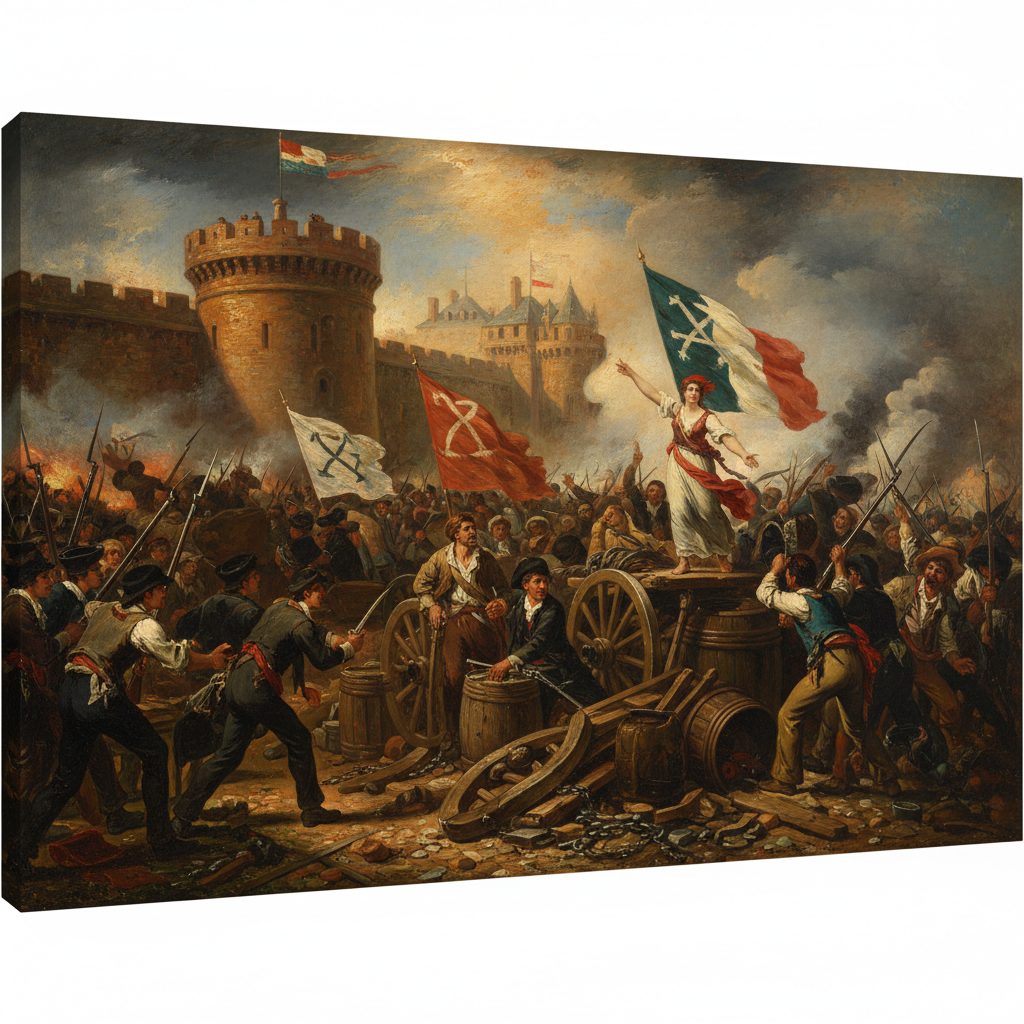
The Fall of the Bastille: How One Fortress Toppled a Kingdom
It was not the largest fortress in Europe, nor the most formidable. Its guns did not command an empire, and its walls were already losing their edge against modern artillery. Yet on a sweltering July afternoon in 1789, the Bastille—a hulking, gray medieval stronghold crouched on Paris’s eastern edge—became the stage for a drama that would echo across continents. As smoke unfurled above its eight towers and the Seine carried the sound of distant shouts, the people of Paris swept toward its gates. They did not come for glory or plunder alone. They came for gunpowder and a promise, to arm themselves against troops they feared the king would unleash and to shatter a symbol of arbitrary power that had haunted the French imagination for two centuries. By evening, the Bastille had fallen, and a kingdom would never be the same again.
The story of the Bastille’s fall is not tidy. There was no single mastermind, no impeccable plan that ran like clockwork. Confusion, negotiation, misfires, and desperate courage filled the hours. A governor weighed capitulation against catastrophe. Veteran soldiers faced a city boiling over with rumor and hunger. And on the cobblestones, artisans, laborers, shopkeepers, and mutinous soldiers pulled together cannons, hauled down bridges, and argued over a white flag. Thousands of individual decisions converged into a collective act that rewrote the political grammar of France: sovereignty was not a gift dispensed from a palace; it was a fact seized by citizens.
To understand why this fortress mattered so much, we must look beyond the day itself. The Bastille’s stonework seemed to entomb a past of lettres de cachet, secret arrests, and vanished men. But the myth also eclipsed mundane truths: by 1789 the prison was scarcely used, and the city had half-forgotten its medieval guardian. Still, when the crowd flocked to its shadow seeking the powder to prime their newly seized muskets, they lifted more than a portcullis—they lifted a veil. The events of July 14 exposed a monarchy that could not command its capital. The Revolution, stumbling and radiant, was now irreversibly underway.
Did you know? The fabled “iron mask” was likely velvet; the masked prisoner died at the Bastille in 1703, feeding a legend of secrecy that long outlived the fortress.
From Fortress to Symbol: The Bastille Before 1789
Long before it became a revolutionary icon, the Bastille was a medieval answer to medieval problems. Construction began in the 14th century under Charles V, when Paris, shaken by English incursions and internal uprisings, needed stout stone guardians at its gates. The Bastille rose first as a fortified gate along the city wall, then expanded into a full-fledged fortress with eight massive towers, a deep moat tied to the Seine, and layers of defensive courtyards. Architecture made its point: this was a place built to endure. Yet stone does more than resist projectiles—it collects meaning, and across the 16th and 17th centuries the Bastille’s role slowly turned from bulwark against foreign foes to a prison for the king’s domestic enemies.
By the reigns of Louis XIII and Louis XIV, the Bastille had become the primary address for state prisoners. The notorious lettres de cachet—sealed orders signed by the king—could consign a person to the fortress without trial. The practice touched a wide social range: pamphleteers whose verses cut too close, aristocrats whose families sought to smother scandal, and intellectuals who defied etiquette more than law. Voltaire, that quicksilver satirist, passed through the Bastille twice—first in 1717 for lampooning the Regent, and again briefly in 1726 before being packed off to England. Though conditions varied, elite detainees could furnish their cells, receive books, and dine reasonably well by prison standards. Yet the marbled veneer could not hide the arbitrary heart of the institution.
There was also the aura of mystery. In the late 17th century a prisoner known to history as the “Man in the Iron Mask” spent his final years under close guard, dying at the Bastille in 1703. Legend insists on an iron faceplate; records suggest a velvet mask. He emerged as a ghost that perfects the prison’s legend—nameless, faceless, a cipher of absolute secrecy. By the 18th century, the Bastille’s political significance far outstripped its penal function. Reform in the 1780s reduced the flow of detainees, and on the eve of revolution the prison held only a handful. But symbols do not scale with headcounts; they scale with stories. The Bastille had become the stage on which absolutism demonstrated its prerogatives.
Did you know? The crowd had armed itself at Les Invalides that morning, hauling off around 30,000 muskets and several cannon—enough firepower to turn a protest into a siege.

Paris on Edge: The Spark of July 1789
To grasp the storming, follow the fuse. France entered 1789 with its monarchy fiscally crippled after years of war and maladministration. The Estates-General met in May for the first time since 1614, gathering clergy, nobility, and commoners in Versailles to remedy the state’s finances. But the Third Estate, representing the majority of the nation, quickly collided with the privileges and procedure of the old order. On June 17, they declared themselves the National Assembly; three days later, locked out of their hall, they swore the Tennis Court Oath to draft a constitution. Paris, ever alert to shifts in courtly weather, buzzed with rumor. Troops massed on the city’s outskirts; bread prices, long a barometer of urban mood, crept higher.
On July 11, 1789, a shock arrived: the king’s popular finance minister, Jacques Necker, was dismissed. News flashed through the capital. At the Palais-Royal on July 12, the young journalist Camille Desmoulins leapt onto a table and called citizens to arms, shouting that “the tocsin has sounded.” Busts of Necker and the Duke of Orléans were paraded through the streets, clashes erupted with royal cavalry near the Tuileries, and the city’s nerves frayed to breaking. On July 13, Paris formed a makeshift municipal leadership at the Hôtel de Ville, soon to become the revolutionary Commune. Neighborhoods erected barricades; search parties scoured city convents and depots for grain and weapons.
The most decisive raid came on the morning of July 14 at the Hôtel des Invalides, the veterans’ hospital and arsenal. After tense standoffs and some quick work with tools and persuasion, the crowd seized tens of thousands of muskets and several cannon. What they lacked was gunpowder and shot. Rumor—accurate, in this case—pointed to large stores of powder recently moved to the Bastille. The fortress, with its towers looming over the Faubourg Saint-Antoine, suddenly became not merely a symbol to topple but a magazine to crack open. By late morning, streams of Parisians converged on the old prison, their path set by fear of royal troops and the new belief that the city’s safety lay in citizens’ hands.
Did you know? Only seven prisoners were freed that day; the Marquis de Sade, often associated with the Bastille, had been transferred out days earlier, missing the liberation entirely.

The Siege Unfolds: Negotiations, Smoke, and Surrender
When the first waves of Parisians reached the Bastille before noon on July 14, they did not immediately set it ablaze or blow the gates. Many demanded parley. The governor, Bernard-René de Launay, a man of ambiguous temperament and unenviable post, faced a restless city beyond his walls and an underwhelming garrison within: around eighty-odd invalides—veteran soldiers—supplemented by some thirty Swiss grenadiers of the Salis-Samade regiment. The Bastille’s artillery, while imposing to the eye, was ill-prepared for a prolonged defense. The governor allowed representatives, including the deputy Louis-Thérèse de Thuriot de la Rosière, to visit the courtyard and inspect the guns, which were reportedly angled away from the city to ease anxiety. Negotiations dragged; the crowd outside surged and ebbed like a tide against the drawbridges.
In the haze of shouted demands and assurances, a crucial misstep occurred. During one exchange, the outer drawbridge was lowered, then raised again in panic when armed men pushed forward. Shots cracked—whether by accident, misunderstanding, or fear remains contested. The defenders opened fire from the battlements; musket balls thudded into the crowd. The Bastille’s cannons boomed, and with that percussion the day transformed. Across the quarter, the mutinous Gardes Françaises—elite royal infantrymen who had sided with the people—brought up field pieces and trained them on the fortress’s gates and towers. Artillery duels in the narrow streets sent stone chips flying. The air grew thick with powder smoke and screams.
In the chaos, leadership emerged from below. Pierre-Augustin Hulin, a former soldier, helped rally and direct the assault; Jacob-Élie, a sergeant of the Gardes Françaises, organized the use of cannon. Hours passed in a terrible rhythm of fire and rush, retreat and re-approach. Around mid-afternoon, with casualties mounting and the prospect of relief troops uncertain, Governor de Launay considered detonating the powder magazine—a gesture of obliteration that would have killed attackers and defenders alike. At last, with the fortress teetering between massacre and surrender, he offered capitulation on the promise that lives would be spared. The white flag flew above the towers.
Did you know? In early July 1789, Sade was removed from the Bastille after alarming the neighborhood by bellowing warnings through an improvised megaphone; on July 14, he was miles away.
The gates opened in the late afternoon. The crowd surged in. Seven prisoners were found and freed—four forgers, two men held for mental illness, and one aristocrat confined by family intervention, the Comte de Solages. The discovery cut two ways, at once anticlimactic and emblematic: the Bastille’s terror lay more in symbol than in numbers, yet that symbol had been real enough to mobilize a city. As de Launay and several officers were escorted toward the Hôtel de Ville, fury boiled over; the governor was beaten and killed, his head carried on a pike. Near the same time, Jacques de Flesselles, the city’s royalist-aligned provost, was also slain by the crowd. Estimates vary, but nearly a hundred attackers may have died in the fighting, while defenders lost far fewer. By evening, the Bastille—once a cornerstone of royal authority—stood stripped, breached, and claimed in the people’s name.
Faces in the Crowd: Soldiers, Citizens, and the Prison Within
Revolutionary days are not cast by one star. The Siege of the Bastille was a convergence of actors, many of them ordinary and unnamed, but several figures stand out. Governor Bernard-René de Launay, born in the Bastille where his father had also served, was a bureaucrat of habit more than zeal. His dilemma on July 14 was genuine: a token garrison, ambiguous orders, and a city out of patience. His threat to blow the powder—reported by several witnesses—feels simultaneously desperate and theatrical, the last gambit of a man whose office had become a trap.
Among the attackers, Pierre-Augustin Hulin and Jacob-Élie became emblems of improvised leadership. Hulin, a Swiss-born milliner’s son and former soldier who worked in Paris’s textile trade, displayed a talent for stern persuasion when it mattered. Jacob-Élie, a noncommissioned officer alienated from the royal command, knew how to mount and site cannon in cramped streets and to keep a skittish crowd from falling apart under fire. Stanislas Maillard, another early revolutionary, had the audacity to carry the fortress’s captured keys through the streets, a tiny prelude to the more formal symbolism that would follow.
Did you know? Lafayette helped popularize the tricolor cockade, wedding Paris’s blue and red to the Bourbon white; the badge quickly became a wearable revolution.
As for the garrison, the invalides were veterans whose bodies carried the map of past campaigns. Loyal enough to hold at first, they lacked the appetite or numbers to withstand a determined city. The Swiss grenadiers, foreign professionals in French service, were out of place in a domestic urban battle. Inside the walls, the seven prisoners represented a cross-section of late absolutism’s margins: petty criminals whose paper sins had become durable sentences, the mentally ill swept by a punitive tide, and a nobleman damned by scandal and family ambition. The contrast between their small number and the fortress’s outsized reputation sharpened a crucial lesson of the day—political theater can be built of very human, very modest materials.
One near-prisoner has long overshadowed the rest in the public imagination: Donatien Alphonse François, the Marquis de Sade. In the weeks prior to the storming, Sade reportedly shouted from his window to passersby that prisoners were being murdered, amplifying tensions below. Whether as provocation or performance, the outcry helped seal his fate; he was transferred to the Charenton asylum in early July, removing a notorious voice from the Bastille’s stone throat just before the gates fell.
From Captured Fortress to Captured Power: Paris and the Kingdom Rewired
The fall of the Bastille was more than the collapse of a wall; it was the loudest political sentence of the summer. In Versailles, the shock landed fast. On July 15, the monarch’s will retreated from the capital. The king replaced his hardline ministers and, on July 16, recalled Necker to office. In Paris, a new municipal government asserted itself, and a citizen militia—the National Guard—took form under the command of the Marquis de Lafayette, a hero of the American War for Independence. The Guard’s cockade braided the city’s colors, blue and red, with the white of the Bourbons, a rosette pinned above the heart to advertise a novel alliance between people and crown.
Did you know? The famous Bastille key displayed at Mount Vernon today was a gift from Lafayette to Washington—a tangible link between the American and French Revolutions.
When Louis XVI rode into Paris on July 17, ceding optics if not yet sovereignty, he faced a sea of tricolor cockades. On the steps of the Hôtel de Ville, he donned one himself at Lafayette’s urging. That gesture mattered: in storming the Bastille, the people of Paris had mapped the limits of royal force in the capital. The city, once a chessboard for royal edicts and police raids, had become a citadel of its own, garrisoned by citizens. Meanwhile, in the countryside, rumors of brigands and plots—magnified by news from Paris—ignited the Great Fear, a wave of peasant uprisings that torched seigneurial records and rattled manor houses from Normandy to Dauphiné.
The National Assembly, jolted by the summer’s violence and opportunity, moved to dismantle the legal engines of the old order. On the night of August 4, 1789, deputies rose to renounce feudal dues, venal offices, and privileges in an extraordinary cascade. Before the month closed, the Assembly adopted the Declaration of the Rights of Man and of the Citizen on August 26, proclaiming liberty, equality before the law, and the sovereignty of the nation. None of these acts sprang mechanically from the Bastille’s rubble, but the siege furnished the rhythm and courage of a city ready to prove that power could be taken and remade.

Stones into Memory: Demolition, Souvenirs, and a National Day
Victories need monuments—or their ruins. In the days after July 14, crowds continued to flow through the Bastille’s courts, collecting mementos and gaping at the dungeon myth made visible. Demolition soon began under the energetic entrepreneur Pierre-François Palloy, who turned the work into a civic spectacle. Teams of laborers toppled towers and pried at stones; the moat began to empty; and from the wreckage arose an industry. Palloy fashioned the fortress’s stones—la pierre de la Bastille—into paperweights, medallions, and small-scale models of the Bastille itself. He distributed maquettes to the new departments of France as proof that the old regime’s keystones had been lifted out and carted away.
Did you know? The 1880 law establishing July 14 as a national holiday never actually says “Bastille Day”; it leaves room to honor both 1789’s uprising and 1790’s unity festival.
Symbols crossed oceans as readily as rivers. The Marquis de Lafayette sent a key of the Bastille to George Washington at Mount Vernon, a diplomatic relic twinned to a political ideal. The gift arrived by way of Thomas Paine and French friends of the American cause, a reminder that revolutions speak to one another, trading emblems and arguments. In Paris, the open wound where the fortress had stood became a canvas for new meanings. The Fête de la Fédération on July 14, 1790, celebrated unity between crown and citizens on the Champ de Mars, with Lafayette overseeing a massive oath-taking ceremony. A year after the siege, Paris staged not revenge but reconciliation—brief, fragile, but electric.
The Bastille’s memory would continue to evolve. Under the Third Republic, lawmakers searched for a national day that could knit the country together after the bruises of the 19th century. In 1880, they chose July 14. The law’s text did not specify whether it honored the 1789 storming or the 1790 federation fête, a deliberate ambiguity that allowed monarchists and radicals alike to read themselves into the calendar. The space the Bastille left behind became the Place de la Bastille, a traffic circle of modern Paris, where the July Column commemorates another revolution—the July Revolution of 1830—proof that the city collects turning points the way a tree collects rings.

Why the Bastille Fell: Myth, Mechanics, and the Power of Crowds
Why did the Bastille, which had weathered centuries of war and intrigue, fall to a crowd that morning-turned-afternoon? The answer lives at the crossroads of symbol and logistics. First, the garrison was small and psychologically isolated; many defenders were older veterans or foreign mercenaries unfamiliar with the city’s pulse. Second, the Bastille’s artillery was not marshaled for urban siege work. Even if the fortress could project lethal force outward, holding it against a city’s determination required supplies, reinforcements, and a strategy that the governor did not possess.
Third, and perhaps most decisive, Paris had transformed its own capacity for action that week. The seizure of muskets at Les Invalides, the coalescence of the National Guard, and the moral clarity of a cause—defending the capital against troops believed to be instruments of repression—generated momentum. When negotiations stalled and the first shots rang out, fear hardened into resolve. Crowd psychology mattered. The idea that one more symbol of arbitrariness could be undone by concerted pressure emboldened each hand on each rope, each body pushing against each bridge.
Myth, too, operated as a force multiplier. The Bastille’s reputation dwarfed its practical function by 1789. But reputations determine targets as much as strategy does; the fortress was less valuable as a prison than as a metonym for all that the Enlightenment had come to abhor in absolute monarchy. One cannot discount contingency—the ricochet of rumor, the misjudged lowering of a drawbridge, the arrival of a few cannons at just the right hour. Nor can one ignore the way that diverse motives braided together: workers who feared hunger, artisans who hated guard patrols, intellectuals enraged by censorship, and soldiers who chose their city over their paymaster. The Bastille fell because enough Parisians concluded that power had stopped listening, and because they were armed, organized enough, and united by a story about their own rights.
Conclusion: A Fortress, a Crowd, and the Birth of a New Politics
History’s pivots can look small at first: a gate buckling, a key changing hands, a cockade pinned to a hat. The fall of the Bastille was one such pivot—a day when a city’s fears and hopes resolved into action, and a medieval fortress became a modern omen. To contemporaries, the meaning was immediate. Aristocrats fled; the court wondered if the army would follow; foreign observers peered over the Channel and across the Atlantic to see whether France had entered a fever or found a cure. To the citizens who tore down the governor’s gate and shouldered cannon through crowded streets, the day meant something simpler and more combustible: that they could change the terms of obedience.
What followed was not simple. The French Revolution would whirl through constitutions, wars, and terrors. But the pattern the Bastille established—the people of the largest city in the realm acting as a political subject in their own right—proved durable. In its wake came the National Guard and the redefinition of civic space, the abolition of feudal privileges and the codification of rights, and a new recognition across Europe that sovereignty could shift in a heartbeat from palace to pavement. The memory of July 14 carried over borders and generations, furnishing a dictionary of images for later upheavals: crowds confronting symbols of state power, keys and flags passed hand to hand, monuments disassembled stone by stone.
There is a temptation, always, to sand down the contingencies. To say that the Bastille fell because history demanded it, or that its gates opened because a grand doctrine wedged them apart. That temptation misses the crowded reality. Paris on July 14 was a choreography of rumor and resolve, of missed signals and sudden courage. The fortress did not simply collapse under an idea; it collapsed under people—in all their contradictions—who acted on an idea. They did not yet share a map of the Revolution that was coming. They shared something more immediate: the pressure of the present and the sense that their city’s fate, and perhaps their own, could no longer be entrusted to others.
If the Bastille’s fall began as a scramble for gunpowder, it ended as the first full-throated declaration of a new politics. The old regime could not hold Paris by fear alone. That lesson, forged in smoke and argument, has outlasted every stone Palloy carted away. The Bastille’s towers are gone, their rubble absorbed into keepsakes and new foundations. But the space they left—an empty throne where arbitrary power once sat—remains. Each July 14, whether one celebrates the uprising of 1789 or the union pledged in 1790, one honors the same revelation: that a people can redraw the lines of authority in a day, and that the hardest fortress to topple is not built of stone but of habit, resignation, and silence.
How we verify this article
By the History Unlocked editorial team
This text is built on historical facts stored in our database and drafted with AI assistance. No signed human review is recorded for this article. Report any inaccuracy: we correct it and update the modified date.
Updated on
AI-assisted drafting.
Read our editorial standardsEnjoyed this? Discover more articles in the category Great Revolutions