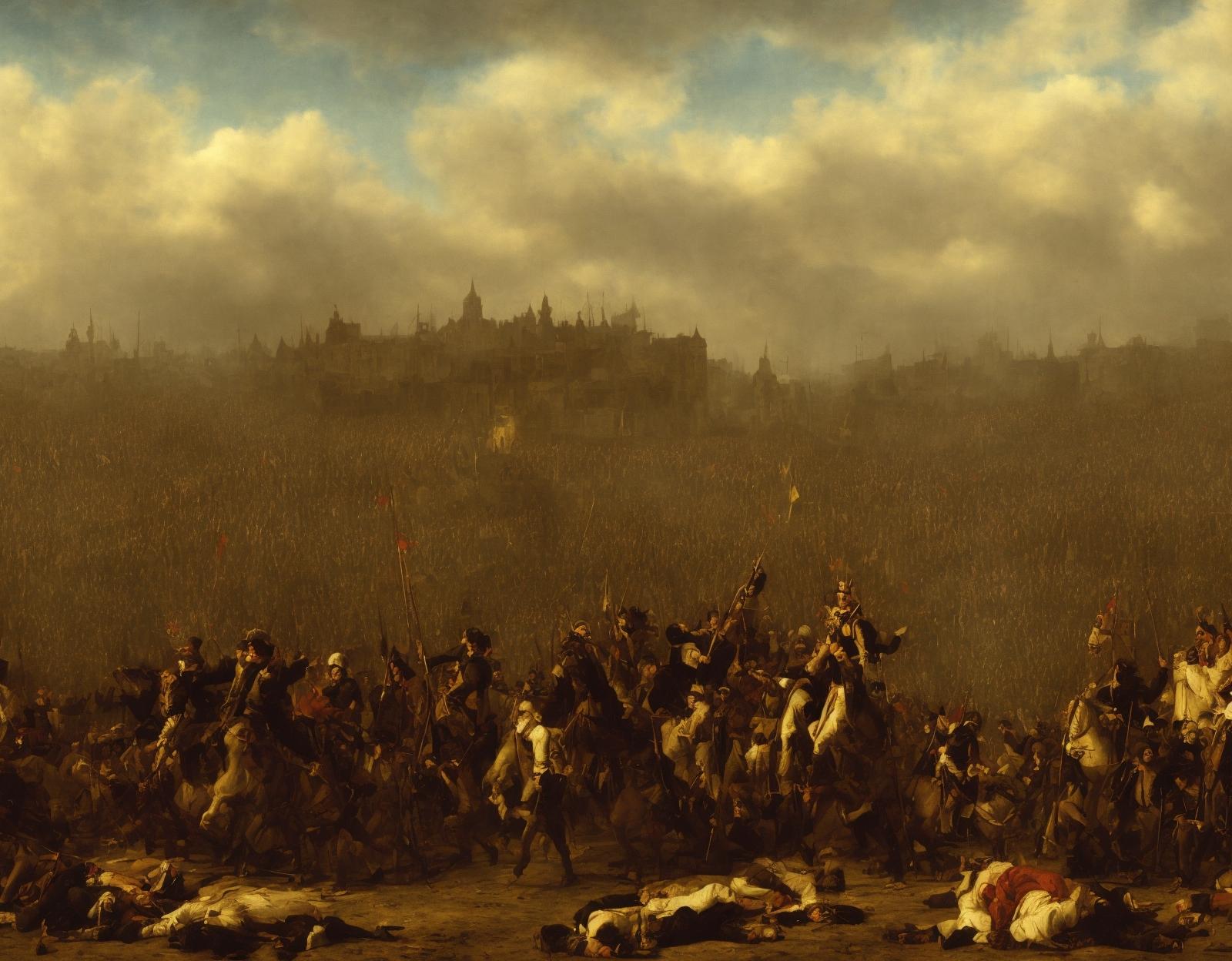
Spring of Nations 1848: Europe's Year of Revolt and Mystery
An invisible tension had been gathering across Europe for decades—like the low pressure that presages a storm, it manifested as debates in salons, petitions in municipal halls, strikes in nascent factories, and songs in the marketplace. By 1848 that pressure broke with a force that surprised contemporaries and later historians alike: a cascade of uprisings that rolled from Paris to Palermo, from Vienna to Budapest, carrying with them demands for representative government, national self-determination, and social relief for those left behind by industrial change. The Spring of Nations, as later generations named it, was not a single revolution but a constellation of linked crises. Each was local in its triggers and global in its resonance.
This narrative seeks to walk the reader through the labyrinth of 1848, to lift veils and trace the hidden threads connecting seemingly disparate events. You will meet ministers and cobblers, poets and generals, and encounter moments of improbable courage and tragic miscalculation. The voice of the era can be haunting: proclamations appealing to liberty, hurried proclamations written by trembling hands, the whisper of conspiratorial clubs in the night. Yet it is also an era of blunt, public confrontation—barricades erected in muddy streets, cannon pointed at palace gates, and journalists who learned that the pen can race ahead of policy.
Remember that 1848 is often framed as a failure, because liberal and nationalist hopes were largely suppressed within a few years. Yet the story is more complicated. The revolutions altered political vocabularies, accelerated social reforms in some states, and left behind seeding ideas that would germinate in later decades. In other words, their immediate suppression did not mean the death of their principles. Reading 1848 in full is to embrace ambiguity: the messy interplay of idealism and interest, sudden heroism and grim repression. In this article the mood will lean toward mystery—asking why certain events ignited and why, despite initial successes, the revolts faltered. Close attention to chronology, personalities, and structural pressures reveals an epoch where the future was uncertain and the past still heavy with traditions of monarchy and empire.
Did you know? Many of the street-fighters in 1848 were university students who had been inspired by nationalist poetry and secret clubs.

Europe on the Brink: Mood and Causes
To understand why 1848 felt like a continent caught at the edge of collapse, one must look beyond any single slogan. The causes were complex and intertwined: economic distress following the late 1840s harvest failures, the dislocations caused by early industrialization, the spread of political ideas energized by the Enlightenment and revolutionary memories, and the rise of nationalist sentiment among peoples incorporated into multiethnic empires. The agricultural crises of 1846–47—particularly the potato blight and poor harvests—had a real human cost. Bread prices rose; rural laborers and urban workers suddenly found themselves one bad season away from destitution. These material hardships made political promises of reform and relief sound not only attractive but urgent.
At the same time, industrialization had produced a new social grammar. Urban centers swelled with workers who labored under precarious conditions and lacked political voice. A growing bourgeoisie—merchants, lawyers, doctors, and journalists—sought constitutional protections, commercial freedoms, and a national market. They wanted the rule of law and representative institutions that would protect property and promote commerce. Educated elites circulated radical and liberal tracts; universities became incubators for nationalist and liberal agitation. Romantic nationalism had given cultural coherence to imagined nations—Poles, Hungarians, Italians, Germans—whose political existence was constrained by dynastic borders.
Moreover, there was a transnational circulation of ideas and precedents. The July Revolution of 1830 in France had shown that monarchy could be toppled with mass mobilization. Secret societies, student organizations, and proscribed journals knitted activists across borders; émigré networks shared tactical knowledge and revolutionary pamphlets. Communication, though slow by modern standards, was sufficient: newspapers and letters carried news of uprisings from one capital to another, inspiring imitators or panicked rulers. The phrase ‘‘spring’’ evokes a natural season of renewal, but the 1848 spring was also seasonal in the sense that famine and cold had weakened households and added urgency to political demands.
Did you know? The National Workshops in Paris were originally intended as a temporary relief measure but became a lightning rod for debates about state responsibility for employment.
Yet there were deeper structural tensions. The multiethnic empires of Central and Eastern Europe—most notably the Austrian and Ottoman—were ill-equipped to manage the rising claims of nationality. The Habsburg Empire contained Germans, Hungarians, Czechs, Poles, Italians, Croats, Slovaks, and Romanians; their competing claims could not be reconciled easily within existing imperial frameworks. In many instances, nationalist aspirations clashed with liberal ones: would political reform prioritize national self-determination or universal civil rights transcending ethnic divisions? This unresolved question would complicate the revolutions and their aftermath.
France: The Spark and the Aftershocks
France was the detonator that set the European powder keg alight. The revolution that began in Paris in February 1848 overthrew King Louis-Philippe and created the Second Republic. The July Monarchy had been increasingly unpopular: it favored the bourgeoisie, restricted broader electoral participation, and appeared indifferent to working-class suffering. In late February 1848, mass protests and clashes culminated in the king’s abdication on February 24; a provisional government declared the republic and moved quickly to introduce significant changes. Among the most consequential was the establishment of universal male suffrage—an unprecedented move in such a major European power that sent shivers through conservative capitals.
The atmosphere in Paris mixed exhilaration with chaos. Liberals and socialists—previously divergent political forces—found themselves briefly allied in their opposition to the monarchy. Workshops and political clubs proliferated. The provisional government included figures such as Alphonse de Lamartine, a poet-statesman, and Louis Blanc, a socialist advocate of workers’ rights who championed the idea of National Workshops—state-supported work programs for the unemployed. The creation of National Workshops in June sought to provide relief, but it became controversial. Conservatives worried about its cost and its perceived encouragement of dependence; moderate republicans were alarmed by the radicalism associated with organized labor.
Did you know? Prince Metternich’s resignation in March 1848 marked the symbolic end of the Congress of Vienna’s diplomatic order established in 1815.
This tension erupted in the June Days (June 23–26, 1848), when the closure of the National Workshops provoked a major uprising by Parisian workers. The army, under General Louis-Eugène Cavaignac, brutally suppressed the insurrection—thousands were killed, and thousands more were deported or imprisoned. The outcome marked a decisive shift: the republic leaned toward order and property rights rather than revolutionary social transformation. The June Days hardened political divisions and set the stage for the rise of conservative figures.
One of those figures was Louis-Napoléon Bonaparte, nephew of Napoleon I, who understood how to exploit the contradictions of the moment. He campaigned as the guarantor of social order and national glory, appealing both to rural conservatives and to those nostalgic for imperial stability. In December 1848 Louis-Napoléon won the presidential election by a landslide, and in 1851 he staged a coup d’état, later establishing the Second Empire in 1852. Thus, the French Revolution of 1848 paradoxically paved the way for authoritarian restoration by demonstrating the limits of coalition politics when class divisions turned violent.

The Habsburg Lands: Vienna, Hungary, and the Empire
The Habsburg Empire was perhaps the most fragile organism to face the Spring of Nations. It was a tapestry of languages and loyalties, and when revolutionary fervor spread to Vienna in March 1848 the imperial edifice trembled. On March 13, Prince Klemens von Metternich, the Austrian chancellor and architect of post-Napoleonic European order, resigned and fled. His departure symbolized the dramatic breakdown of conservative consensus across the continent. In Vienna, crowds demanded a constitution, freedom of the press, and an end to arbitrary arrests; similar pressures unfolded in provinces across the empire.
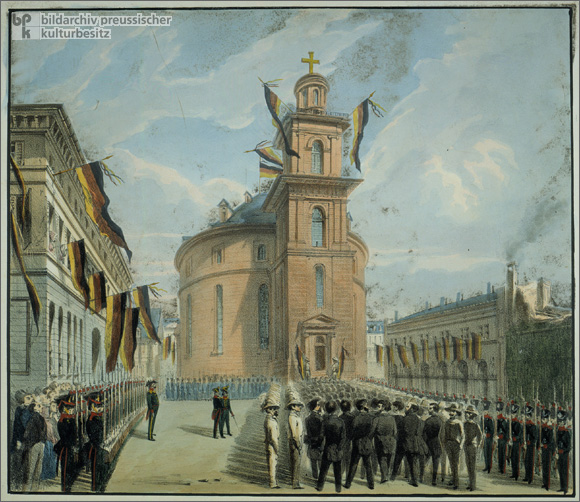
Did you know? The Paulskirche in Frankfurt, where the National Assembly met, became a potent symbol of liberal aspiration despite the Assembly’s political failure.
Yet Vienna’s initial success did not translate into a unified reform program for all its subjects. In the Kingdom of Hungary, national aspirations converged with liberal reformism. On March 15, 1848, in Pest (part of modern Budapest), Hungarian activists led by figures such as Lajos Kossuth and the poet Sándor Petőfi presented the April Laws—asserting Hungarian autonomy, establishing civil liberties, and reorganizing the administration. The Habsburg monarch Ferdinand V had to concede many demands under pressure. But the fragile alliance between Hungarian nationalists and other imperial minorities quickly unraveled: Hungarian leaders sought to consolidate a unitary national state often at the expense of non-Hungarian nationalities within the historical Hungarian lands, provoking conflict with Croats, Romanians, and Slovaks.
Meanwhile, the imperial center oscillated between concession and repression. After initial concessions, the court reasserted control; Emperor Ferdinand’s vacillations and the intervention of conservative military leaders led to violent confrontations, particularly in Vienna in October 1848, when imperial troops shelled parts of the city to restore order. The conflict escalated further when Hungary proclaimed its independence in 1849. Austria, unable to suppress the Hungarian forces alone, solicited help from the Russian Empire. Tsar Nicholas I sent a massive Russian intervention force that played a decisive role in crushing the Hungarian revolution by August 1849.
The Habsburg response had long-term implications. The empire survived, but the structure of imperial rule shifted toward a more centralized, militarized conservatism in the short term. Metternich’s old diplomatic order was gone; in its place emerged ad hoc authoritarian measures and a cautious conservatism that recognized the potency of nationalism and the need for administrative reforms. The revolutionary moment thus compelled the Habsburg rulers to adapt; in the longer term, these pressures contributed to the Austro-Hungarian Compromise of 1867, a reorganization that attempted to accommodate Hungarian demands within a dual monarchy. But in 1848–49 the immediate effect was a brutal, costly restoration enabled by foreign intervention and the willingness of monarchs to use military force against their own subjects.
Did you know? Giuseppe Mazzini’s Roman Republic (1849) was a short-lived experiment that drew volunteers from across Europe, including Garibaldi’s famed redshirts.

The German States and the Frankfurt Parliament
Germany in 1848 was not a nation-state but a patchwork of monarchies, grand duchies, and free cities. Yet German liberals and nationalists saw in the revolution an opportunity to craft a unified constitutional Germany. Mass demonstrations and uprisings spread through the German Confederation in the spring, from Berlin to Frankfurt, where delegates convened in what became the Frankfurt National Assembly. Opening on May 18, 1848, in the Paulskirche, the assembly represented a remarkable experiment: it was the first pan-German parliament elected by a broad male electorate and intent on drafting a constitution for a united Germany.
The Frankfurt Assembly faced enormous dilemmas. There was the fundamental question of whether a unified Germany would include Austria (the “Grossdeutsch” solution) or exclude it and be led by Prussia (the “Kleindeutsch” solution). Delegates wrestled with constitutional design, civil liberties, and the balance of powers, yet they confronted a structural problem: they had no executive authority or reliable army to enforce their decisions. Political legitimacy in the 19th century still depended heavily on the cooperation of monarchs and military power, which the assembly lacked.
Despite producing a liberal constitution that promised a hereditary constitutional monarchy and civil rights, the Assembly’s most dramatic act came in 1849 when it offered the imperial crown to King Frederick William IV of Prussia. The king, wary of accepting a crown from a popular assembly and anxious about antagonizing other German princes and Russia, refused the offer. This refusal was a blow that revealed the limits of parliamentary idealism in the face of entrenched dynastic authority. Berlin’s own revolution—initially promising—was repressed when King Frederick William IV and conservative forces reasserted control, using the army.
Did you know? Many governments that crushed 1848 uprisings later adopted reforms to undercut the appeal of radical movements and to modernize administration.
The conservative backlash across the German states was swift. The Prussian and other German rulers dissolved revolutionary committees and reestablished order. The legacy of the Frankfurt Parliament, however, endured in the form of constitutional ideas and a political vocabulary that future generations would reuse. Although its immediate political project failed, the parliament demonstrated the practical challenges of making constitutional democracy without the backing of military and monarchical power. It also clarified that unification might ultimately come through Bismarckian Realpolitik rather than liberal parliamentary consensus.
The Italian Peninsula: From Milan to Rome
Italy in 1848 was a mosaic of kingdoms and duchies under foreign domination or puppet regimes. The revolts in Italy combined nationalist ambition with liberal demands for constitutional government. Insurrections erupted across the peninsula, most notably the Five Days of Milan (March 18–22, 1848), when Milanese civilians and volunteers drove Austrian troops from the city. This success inspired efforts to eject foreign rule from other Italian territories and to push toward some form of national unification, though the lack of coordination among Italian states, and the rivalries among leaders, complicated these efforts.
In the Kingdom of Sardinia-Piedmont, King Charles Albert took up the mantle of war against Austria in hopes of expanding Italian influence; his troops achieved initial victories but were ultimately defeated by the Austrian army at the Battle of Custoza (July 1848) and again at Novara (March 1849), the latter leading Charles Albert to abdicate in favor of his son, Victor Emmanuel II. In the Papal States, Pope Pius IX initially seemed to embrace reform, a fact that gave hope to moderates; however, he soon recoiled from concessions to revolutionary forces. In November 1848 Pius IX fled Rome; in February 1849 a Roman Republic was declared under the leadership of Giuseppe Mazzini, with figures like Giuseppe Garibaldi defending the republic militarily. Garibaldi’s later attempt to hold Rome ended in defeat when French troops intervened to restore papal authority in 1849.
Did you know? The suppression of 1848 revolts drove many activists into exile, creating influential émigré communities in London, Paris, and New York.
Across Italy, the revolutionary coalition was fragile: it included liberal constitutionalists who sought a federated Italy and radical republicans who wanted immediate unity under democratic principles. The intervention of foreign powers—most notably Austria and France—was decisive. Austrian military power crushed uprisings in Lombardy and Venetia; French intervention in Rome restored the Pope. The immediate failure of 1848 to secure Italian unification did not extinguish nationalist aspirations: it taught Italian patriots valuable lessons about leadership, coordination, and the geopolitical realities they would later confront. These lessons would inform the Risorgimento that culminated in the 1860s and 1870s under different leadership and a different strategy—especially the rise of Piedmont-Sardinia as the engine of unification and the pragmatic statesmanship of figures such as Count Cavour.

Failures, Legacies, and the Shadow of Reaction
By late 1849 the immediate wave of revolts had been largely suppressed. Monarchs, aided by conservative coalitions and—in the case of Austria—intervention by Russia, had reimposed order. Yet it would be a mistake to conclude that 1848 was mere failure; its legacies are multiple and often subtle. First, the revolutions forced rulers to take public opinion more seriously. In many states, even after repression, rulers instituted incremental reforms: more modern bureaucracies, limited constitutions, and measures intended to placate urban elites and manage nationalist demands. The notion that governments must answer to some form of public legitimacy gained traction.
Second, 1848 accelerated the politicization of broad social groups. The emergence of mass politics—mobilized workers, artisans, and peasants—altered the terrain of political struggle. Political clubs, newspapers, and electoral movements grew in the wake of the revolutions, and the vocabulary of rights—national self-determination, civil liberties, social justice—entered mainstream discourse. This made later political mobilizations possible and created a generation for whom political activism was an accepted practice.
Did you know? The phrase ‘Spring of Nations’ was coined later; contemporaries used a variety of local labels and a sense of revolutionary contagion.
Third, the revolutions reshaped the strategies of conservative and nationalist leaders alike. Where the old diplomatic settlements of 1815 had sought to suppress nationalist stirrings through dynastic legitimacy, the mid-century crises taught pragmatic politicians—above all Otto von Bismarck in Prussia—that unification or reform might be achieved through a mixture of force, diplomacy, and selective concessions. The failure of liberal-nationalist coalitions in 1848 indirectly paved the way for later state-building projects that used authoritarian means to achieve national ends.
Finally, the emotional and cultural legacy of 1848 persisted. Poets like Sándor Petőfi in Hungary and intellectuals across Europe memorialized the period; their verses and laments kept the revolutionary memory alive. For those who sought immediate constitutional freedoms, the bitter disappointments of 1848 hardened resolve rather than extinguished it. Many of the institutions and legal ideas advanced in 1848—universal male suffrage in France, municipal reforms, and specific civil liberties—would reappear as demands and sometimes achievements in later decades.

Conclusion: Echoes that Refused to Die
The Spring of Nations remains a study in paradox. It was at once immediate and unfinished, dramatic and ambiguously consequential. The year 1848 witnessed heroic creativity—barricades erected overnight, constitutions drafted with high idealism, and cross-border solidarities—and grim repression carried out by trained armies. Statistically, most revolutionary projects of 1848 were suppressed in the short term. Politically, however, the continent had been transformed. New political vocabularies, expanded franchise demands, and the consolidation of nationalist ideas changed the possibilities for the next decades.
Did you know? Several later national leaders, including Bismarck and Cavour, learned from 1848 how to combine force with institutional reform to achieve state goals.
Perhaps the most telling lesson is about contingency. The revolutions might have succeeded in different configurations: coordinated leadership across social classes, a reliable revolutionary army, or a continental solidarity that compelled monarchs to yield more than they did. Instead, the mixture of divergent aims—liberals who prized order and rights, nationalists who sought unity sometimes at the expense of minorities, and social radicals who demanded redistribution—often prevented durable alliances. External interventions—particularly by Russia and Austria in Central Europe, and by Austria and France in Italy—reminded revolutionaries of the continuing power of established states to shape outcomes.
Yet history does not move only in triumphs and defeats. The ideas incubated in 1848 traveled and mutated. They altered expectations. They taught tactics to later generations who would, under different circumstances, achieve both national unifications and social reforms. The Spring of Nations therefore reads as both a warning about the perils of disunity and a testament to the persistence of ideals. When we walk through those year’s shadowy streets in imagination, we find not only ghosts of barricades but also seeds—quiet, resilient seeds—that would one day sprout in a reshaped Europe.


How we verify this article
By the History Unlocked editorial team
This text is built on historical facts stored in our database and drafted with AI assistance. No signed human review is recorded for this article. Report any inaccuracy: we correct it and update the modified date.
Updated on
AI-assisted drafting.
Read our editorial standardsEnjoyed this? Discover more articles in the category Great Revolutions