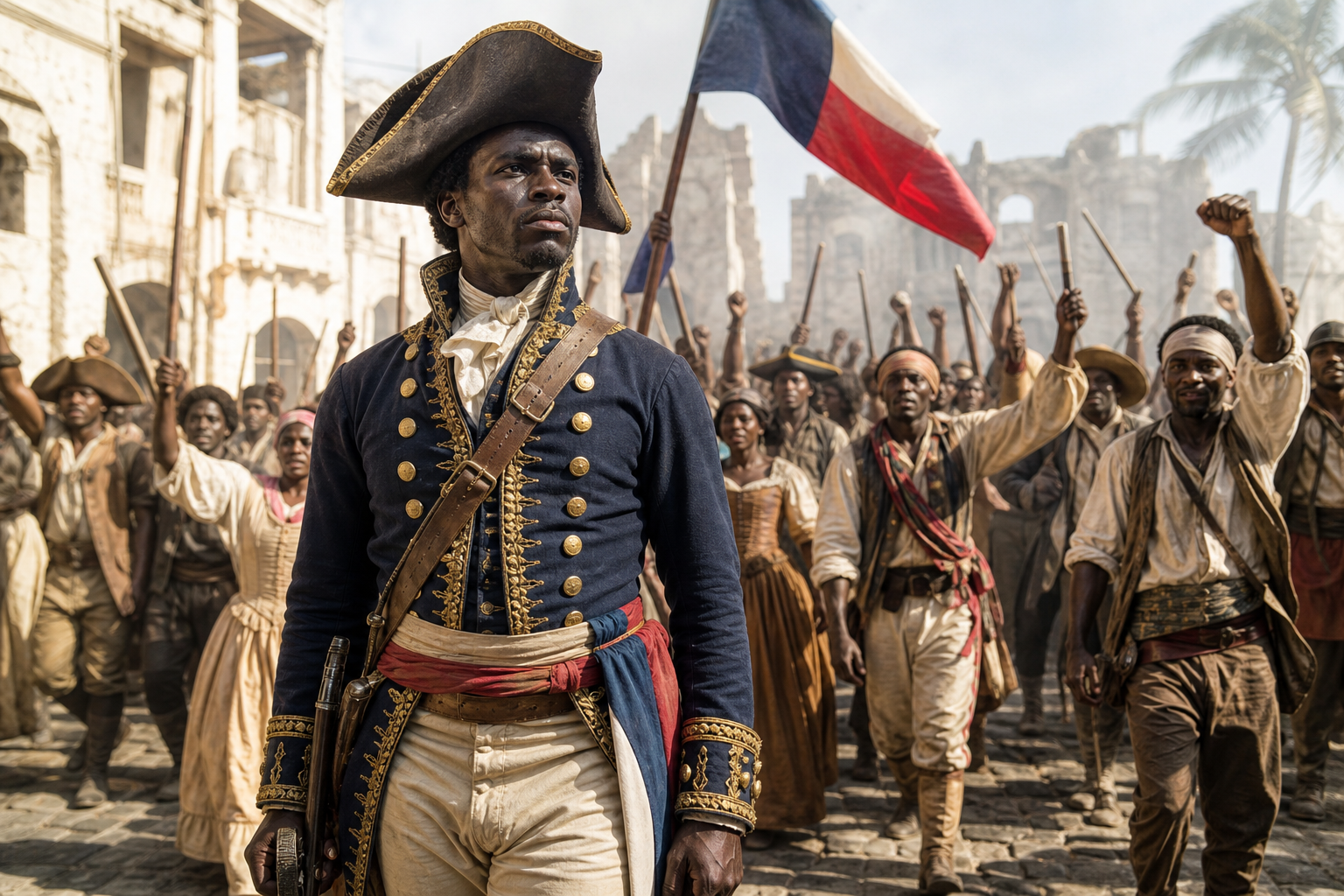
Shadowfires of Freedom: The Haitian Revolution Unveiled
In the predawn hours of August 22, 1791, in a sweltering valley of the French colony of Saint-Domingue, drums and whispered orders braided into something that would alter the Atlantic world. The plantation landscape of sugarcane fields, slave barracks and the elegant but brittle mansions of whites had been a place of profit and cruelty in equal measure. Yet within that brutality a simmering consciousness, fed by African traditions, the abuses of the plantation regime, and the intellectual tremors of the Enlightenment and the French Revolution, would erupt into a revolutionary conflagration. This was not a simple rebellion but a complex, multi-phased revolution with shifting alliances among enslaved people, free people of color, white planters, and foreign powers. It culminated in the first successful large-scale slave revolt that established an independent republic led by formerly enslaved people: Haiti in 1804.
To read the history of the Haitian Revolution is to move between scenes of moral horror and strategic genius. It is to trace how leaders born into bondage — and others who were free but discriminated against — navigated diplomacy and warfare, improvising strategies against the most powerful empire of the era. The revolution reshaped ideas about liberty and equality, exposed the hypocrisies of European freedom discourses, and forced economic and geopolitical recalibrations across the Americas and Europe. Yet it was also a human drama of betrayal, disease, and ideological conflict. Figures like Toussaint L'Ouverture, Jean-Jacques Dessalines, and Henri Christophe became embodiments of the paradoxes of revolutionary leadership: emancipators who became rulers, strategists who made pacts of convenience with former enemies, and nation-builders whose policy choices would haunt their people for generations.
This article will take a close, narrative-driven journey through the Haitian Revolution, emphasizing verifiable facts while also evoking the mystery and drama of an epoch in which enslaved men and women rewrote the rules of the modern world. We will explore the colonial structures that made Saint-Domingue the wealthiest and most brutal colony, the catalytic impact of the French Revolution, the outbreak and unfolding of the 1791 insurrection, the military and political genius that allowed the revolutionaries to endure, and the painful aftermath of independence that continues to shape Haitian society and global history. Expect close readings of pivotal moments, attention to lesser-known actors, and an account sensitive to both the moral urgency and tactical complexity of this watershed event.
Did you know? The demographic imbalance in Saint-Domingue in 1789 was stark — enslaved people outnumbered whites by more than ten to one, creating both the power base and the potential for mass resistance.
Origins: Saint-Domingue’s Plantation Society and the Making of a Revolution
Few colonial economies left such a stark imprint on human life as Saint-Domingue in the late eighteenth century. The colony, occupying the western third of the island of Hispaniola, produced more sugar and coffee than any other in the Americas; its plantations generated vast wealth for a small white and mixed-race elite and for metropolitan France. By the 1780s, Saint-Domingue supplied roughly one-quarter of all European sugar, sustaining a global trade network that enriched merchants and planters. Yet the colony’s prosperity rested on a system of extreme coercion. The enslaved African majority—numbering around 400,000 by the eve of rebellion—lived in a brutal regime of forced labor, malnutrition, and surveillance designed to extract maximal profit. Mortality rates on sugar plantations were devastating; the continual importation of new enslaved Africans was part of the system’s architecture. This demographic fact—an enormous population of enslaved people, vastly outnumbering the colonists—created both a risk for planters and a latent potential for revolt.
The social hierarchy of Saint-Domingue was complex. At the top stood the grands blancs, wealthy French plantation owners and colonial administrators with political ambitions and social conservatism. Below them were the petits blancs: artisan tradesmen, overseers, and less-wealthy whites who often resented the power of the grands blancs. Then came the free people of color (gens de couleur libres), many of whom were mixed-race and owned property and even slaves themselves. They occupied an ambivalent social position: wealthier and more educated than many whites yet legally and socially discriminated against. Freed free people of color pushed for civil rights, inspired partly by Enlightenment notions and partly by their own economic stakes.
These layers of society created a volatile lattice of competing interests. The enslaved population carried within it a matrix of African cultural and spiritual practices, runaway maroon communities in the mountains, and memories of resistance. Maroon communities, notably in the northern and central mountains, had established autonomous enclaves where escaped enslaved people preserved African languages, marital forms, and military organization. The plantation system also generated a flow of informal communication—rumors, songs, and the circulation of escaped people—that could and did crystallize into organized insurrection. Many planters assumed that slavery and discipline could be maintained through terror and legal strictures; they underestimated the degree to which the enslaved could coordinate and the intensity of their desire for freedom.
Did you know? Vincent Ogé, a free man of color, led an 1790 insurrection in Saint-Domingue to demand civil rights; after his capture he was executed in Paris in 1791, an event that galvanized tensions between whites and gens de couleur.
At the diplomatic level, Saint-Domingue’s value drew in external powers. Britain and Spain frequently competed for influence in the Caribbean, and both had colonies on the same island at various times. The geopolitical situation meant that revolts in Saint-Domingue could never remain merely local disturbances; they threatened the commercial and strategic interests of empires. As tensions rose in the 1780s and 1790s, the colony was poised at the intersection of revolutionary ideas and structural violence, making it a tinderbox where an ignition could produce an inferno.

The French Revolution’s Echoes: Rights, Race, and Radicalization
When the French Revolution erupted in 1789, its slogans of liberty, equality, and fraternity unfurled across the Atlantic in unpredictable ways. For many in France the declaration of the Rights of Man and the abolition of feudal privileges sparked a debate about political rights that reached the colonies. But revolutionary principles collided with entrenched colonial interests and racial hierarchies. The early revolutionary government wrestled with whether the legal equality it proclaimed would extend to the colonies' free people of color or to the enslaved. White planters in Saint-Domingue insisted that property rights and the plantation economy must be protected, while the gens de couleur demanded recognition of their civil and political rights — a contentious demand because it threatened the social order.
The ambiguous and often contradictory pronouncements from Paris helped create a political vacuum in which colonial groups maneuvered. In 1790-1791, commissioners and metropolitan decrees attempted to clarify the status of colonial subjects, but local elites resisted. The gens de couleur, led by figures like Vincent Ogé and Julien Raimond, staged their own uprisings and legal petitions after the National Assembly hesitated to extend full rights. Ogé’s failed 1790 revolt and subsequent brutal execution exposed the limits of revolutionary solidarity when filtered through racial prejudice and metropolitan delay. Meanwhile, enslaved people read the upheaval in France as a potential opening. News of debates about rights and the promulgation of reformist rhetoric reached the island via sailors, soldiers, and printed matter, and it fed the imagination of both free people of color and enslaved people.
Did you know? The Bois Caïman ceremony is often considered the spiritual and organizational prelude to the 1791 rebellion, and while contemporary sources vary, the event became a potent symbol of unified resistance in Haitian memory.
External actors complicated the picture. Spain and Britain, both at war with revolutionary France or eager to exploit opportunities, courted colonial groups. Spanish authorities in Santo Domingo (the Spanish-controlled eastern part of Hispaniola) offered freedom to enslaved people who took up arms against French authorities. Britain, which sought to cripple France’s economic base, saw Saint-Domingue as a prize and later intervened militarily. Such foreign involvement created shifting incentives for different factions and increased the strategic value of local alliances.
A crucial pivot came with the decrees of 1792–1794 in France. Initially, the revolutionary government moved slowly on extending rights. But the intensification of war and uprisings forced Paris to take bolder steps. In 1792, commissioners in the colonies wrestled with disorder; by 1793, amid escalating conflict and political necessity, the French Convention took the dramatic step of granting freedom to enslaved people who would fight for the Republic. Then, on February 4, 1794, the National Convention formally abolished slavery in all French colonies — a revolutionary decree that recognized the practical and moral impossibility of preserving slavery while fighting for the Republic.
This abolition had immediate and complex implications in Saint-Domingue. For rebel leaders and insurgent communities, it validated claims to freedom and shifted the calculus of alliances. For some white planters, abolition signaled an existential threat to their interests, prompting collaboration with foreign powers and internal counterinsurgency. For free people of color and freed insurgents, the decree offered legal recognition, but the reality on the ground remained tumultuous. Moreover, the decree did not extinguish tensions over land, labor, and governance. Emancipation was proclaimed, but how to organize production and political life in a land long structured by coercion remained an urgent question.
Did you know? Toussaint L’Ouverture learned to read and write during enslavement and later corresponded fluently with French officials, negotiating complex diplomatic arrangements while dressed in the uniform of a Republican general.
The 1791 Revolt: From Bois Caïman to a Nation’s Uprising
The immediate spark of the large-scale insurrection which began in August 1791 is often traced to a religious and military ceremony at Bois Caïman, led by a Vodou priest commonly known as Dutty Boukman. There, according to contemporary accounts and later retellings, leaders among the enslaved swore oaths of resistance and coordinated plans to unleash simultaneous attacks across plantations. In the days that followed, night attacks spread through the northern plains; plantations were burned, overseers killed, and the economy of the colony plunged into chaos. This was no random slaughter; it was a paneled and coordinated uprising with military tactics—ambushes, sieges of sugar works, and the destruction of economic infrastructure to deny planters the capacity to re-enslave the insurgents.
Leadership during this phase was plural and often localized. Charismatic local leaders emerged alongside itinerant leaders and maroon chiefs. Among them were figures like Boukman (who was soon killed), and later Toussaint L'Ouverture, who initially was one of many local commanders. The insurgents drew on a range of tactics: guerrilla warfare using intimate knowledge of the terrain, strikes against military outposts, and the building of alliances with free people of color and external enemies of France. The insurgent forces were heterogeneous: Africans brought diverse military traditions and languages, while mulatto leaders appealed to legal rights; some colonial soldiers defected to the insurgent cause. The ability of insurgents to mobilize large numbers while maintaining discipline in some theaters reflected deep organizational skills concealed beneath the apparent spontaneity of revolt.
Planters responded with alarm and brutality. Many fled, some attempted to negotiate, and others sought support from British or Spanish forces. The breakdown of the plantation economy inflamed famine and disease across the colony; epidemics of yellow fever and other maladies plagued both insurgents and colonists. Yet disease affected the armies of European powers perhaps more than the Afro-Creole insurgents, whose immune histories sometimes provided unexpected advantages. Moreover, as the conflict spread, it took on an international cast: Spain and Britain moved to exploit the disorder, recruiting black troops, and sometimes promising freedom in exchange for military service.
Did you know? Yellow fever and tropical diseases killed more French soldiers than combat during the Leclerc expedition; disease was a decisive factor that Napoleon's planners underestimated.
By 1793 the insurgency had transformed from a local rebellion into a revolution that threatened colonial rule itself. Parcelled-national commands and regional caudillos fought, negotiated, and made pacts with external powers. Toussaint L'Ouverture, who would later rival Napoleonic generals in strategic acumen, at this stage began to consolidate local power, using both diplomatic skill and battlefield cunning. He negotiated transient alliances, played European powers against one another, and learned to manage the challenges of supply, discipline, and political legitimacy in a colony whose institutions had been shattered. The revolutionaries' capacity to harness local knowledge and to adapt to changing alliances would prove decisive.

Toussaint’s Ascent: Strategy, Governance, and the Paradoxes of Power
Toussaint L’Ouverture’s rise is a study in adaptive leadership. Born into slavery in the mid-1740s and freed in the 1770s, Toussaint was literate, familiar with plantation economies, and possessed of a stern strategic temperament. He navigated a treacherous political landscape: aligning with the Spanish against the French at one moment, then with the French Republic after it abolished slavery, and later managing an uneasy relationship with Napoleon’s France. Toussaint’s genius lay in combining military competence with a capacity for administrative governance. He reorganized plantations to produce exportable crops and encouraged disciplined labor regimes, arguing that labor productivity was necessary to sustain the newly won freedom. This stance placed him at odds with some groups who favored land redistribution and smallholder autonomy.
As commander-in-chief of the revolutionary forces by the late 1790s, Toussaint reorganized the colony’s army into a disciplined force with regular units, supply lines, and engineering capabilities—building roads, fortifications, and an integrated logistics system. His military successes against British and Spanish forces won him wider recognition. Yet Toussaint’s governance was marked by tensions: he issued decrees abolishing slavery and promoted certain civil liberties, but he also retained elements of the plantation economy, compelling labor and sometimes punishing recalcitrant workers. His perspective was pragmatic—he feared that the collapse of export agriculture would invite European reoccupation and plunge the island into chaos.
Did you know? Haiti’s 1825 indemnity to France demanded payment of 150 million francs (later reduced) as compensation for lost property — a debt historians argue crippled Haiti’s economy for generations.
Toussaint’s domestic policies reflected a complex calculus. On the one hand, he sought to maintain economic output and stability; on the other, he attempted to create a functioning polity with a legal code and centralized authority. In 1801 he promulgated the Constitution of Saint-Domingue, a document that declared him governor for life while affirming the colony’s allegiance to France. This act raised questions in Paris and among his allies; Napoleon perceived Toussaint’s consolidation of power as a challenge to metropolitan sovereignty. The tension between Toussaint’s de facto autonomy and France’s imperial ambitions would be decisive. At the same time, Toussaint’s leadership embodied the paradox of revolutionary property relations: to protect emancipation, he often relied on economic and coercive instruments reminiscent of the old order.
Internationally, Toussaint was a formidable negotiator. He parried offers and threats from the British and Spanish and skillfully used diplomatic channels to buy time and recognition. His ability to maintain cohesion among a diverse military and social coalition—former enslaved people, free people of color, and some white allies—testifies to his political skill. Yet his consolidation of authority also alienated certain factions who expected more radical social transformation. The debate between a centralized, production-focused republicanism and a dispersed, landowning peasantry was not unique to Saint-Domingue but took on special urgency in a society rebuilt from slavery.

Napoleonic Reaction, Leclerc’s Expedition, and the Unmaking of a Compromise
Napoleon Bonaparte’s ambition to restore French imperial grandeur included regaining complete control over the Caribbean colonies. Fearing Toussaint’s autonomy and desirous of restoring France’s colonial wealth, Napoleon authorized a military expedition under his brother-in-law, General Charles Leclerc, in 1802. Leclerc’s mission was posed as an enforcement of metropolitan authority and a reestablishment of order. Initially, Leclerc succeeded in capturing Toussaint in 1802 by deceit: Toussaint surrendered under a promise of safe conduct, only to be arrested and sent to France, where he would die in captivity in 1803. The betrayal of Toussaint was emblematic of Napoleonic realpolitik.
Did you know? Simon Bolívar accepted refuge and support from Haiti in 1815; in gratitude he later offered to abolish slavery in areas he liberated, echoing Haiti’s revolutionary moral influence.
However, Leclerc’s forces encountered obstacles they had not fully anticipated. Disease—especially yellow fever—decimated European troops, often at rates far exceeding battlefield casualties. Additionally, the insurgent movement remained resilient; local commanders like Dessalines, Henri Christophe, and other black generals rebuilt resistance with renewed ferocity. The French strategy of reinstating plantation labor systems and re-enslaving populations encountered deep popular resistance and renewed determination to resist any form of bondage.
As the French resorted to draconian measures and returned to policies resembling slavery by pressuring labor, they eroded whatever local support they had secured. Resistance took both military and social forms: Dessalines and others sought to mobilize broad-based attacks, and the countryside became a theater of scorched-earth tactics, guerrilla ambushes, and pitched battles. By late 1803, French forces were overstretched, undermined by sickness, supply problems, and fierce, persistent resistance. The British, who had fought in the earlier phases and later withdrew, and the Spanish had their own agendas, but the decisive clash would be between the remaining French forces and the Haitian armies in battles that would determine the colony's fate.
The culmination of these conflicts occurred at the Battle of Vertières on November 18, 1803—one of the defining engagements of the revolution. Under Jean-Jacques Dessalines' leadership, Haitian forces defeated a French army commanded by General Rochambeau. The victory was not merely military but symbolic: it marked the effective end of French colonial rule in Saint-Domingue and opened the path to independence. France’s inability to reconquer the colony was a combination of determined Haitian resistance, environmental realities, and overextension of Napoleonic ambitions.
Did you know? Many of the Haitian revolutionaries were veterans of previous colonial wars and had military experience gained in other Caribbean theaters, contributing to their strategic proficiency.

Independence, Dessalines, and the Complicated Birth of Haiti
On January 1, 1804, Jean-Jacques Dessalines proclaimed the independence of Saint-Domingue and named the new nation Haiti—a word derived from the indigenous Taíno name for the island. The proclamation marked the first time in modern history that a slave population had successfully founded an independent state. Dessalines, once a lieutenant under Toussaint, emerged as a central figure in the post-revolutionary period. He faced enormous challenges: reorganizing society after protracted war, addressing land distribution, managing foreign economic isolation, and ensuring security against possible French attempts to reconquer or to re-enslave the population.
Dessalines' rule was characterized by firm, sometimes ruthless measures. In 1804 he ordered the 1804 massacre of remaining whites—a controversial and brutal decision that aimed to prevent any reconstitution of the planter class and to consolidate a social and political break from the colonial past. Historical estimates of the number of victims vary, but the massacres signaled a radical attempt to destroy the social base of white colonial authority. Dessalines crowned himself Emperor Jacques I in 1804, centralizing power and creating a new imperial court. His actions reflected the paradoxical pressures on leaders born of revolutionary violence: the need for security, the impulse for retribution, and the exigency of forging a functioning state amid isolation.
The new Haitian state immediately faced diplomatic ostracism. Major powers—feeling threatened by an independent republic founded by formerly enslaved people—were wary of recognition. France demanded reparations and, in 1825, under King Charles X, insisted that Haiti pay an indemnity to compensate former colonists for their ‘lost property’—a demand that imposed a crippling debt on the young nation and shaped its economic trajectory for more than a century. The United States and many European powers withheld recognition for years, fearing the spread of slave revolts. This diplomatic isolation hampered Haiti's access to trade and capital, forcing it into economically disadvantageous positions and contributing to long-term underdevelopment.
Did you know? The name "Haiti" was deliberately chosen from the island's indigenous Taíno language, reclaiming a precolonial identity erased by European colonization.
Internally, the question of land and labor remained thorny. Many formerly enslaved people seized lands or sought smallholdings, pursuing autonomy rather than returning to plantation labor. Others, constrained by economic necessity and political pressures from the emergent state, worked on reconstituted estates or state-led production. Political rivalries and regional divisions soon surfaced. In 1806 Dessalines was assassinated and Haiti split into rival polity forms: the north under Henri Christophe, who established a quasi-monarchical state, and the south under Alexandre Pétion, who moved toward a republican model favoring smallholders. These divisions shaped Haiti’s early institutional development and reflected the unresolved tensions between centralization and local autonomy, between productivity-focused policies and land redistribution.

Conclusion: Legacies, Misunderstandings, and the Long Shadow of Revolution
The Haitian Revolution remains a crucible of historical meaning. Its success discredited assumptions about racial hierarchies and the permanence of slavery; it demonstrated that enslaved people could organize, strategize, and found a sovereign nation. Yet the revolution’s aftermath was riddled with dilemmas. International isolation, punitive indemnities, the destructive legacies of warfare and disease, and internal political fragmentation constrained Haiti's capacity to develop in ways that mirrored Western European powers. The revolution nevertheless changed global politics: it heightened fears of slave revolts across the Americas, influenced abolitionist currents in Europe and the Americas, and reshaped colonial calculations in Latin America. Leaders and observers from Simón Bolívar—who accepted Haitian aid in his own liberation campaigns—to abolitionists in Britain drew lessons from Haiti’s example.
Did you know? Napoleon's decision to sell Louisiana to the United States in 1803 was influenced in part by the failure to restore French control over Saint-Domingue; the colony's loss reduced France's interest in maintaining a continental empire.
Misunderstandings and deliberate misrepresentations also stalk Haiti’s history. European and American elites often cast Haiti as a place of barbarism or instability, representations that served political ends—justifying diplomatic ostracism and economic exclusion. Historians have since worked to overturn these caricatures, recovering Haiti’s complex political culture, achievements in governance and diplomacy, and the moral clarity of its antislavery accomplishment. Contemporary scholarship emphasizes the revolution’s agency, multivalence, and long-term structural explanations: how external pressures and internal decisions intersected to produce a constrained, embattled independence.
The Haitian Revolution also invites reflection on the costs of freedom in a world ordered by inequality. The revolutionaries paid in blood and sacrifice to secure their emancipation, and the newly independent state paid further costs in reparations and isolation. Yet what they achieved was extraordinary: they overturned an entrenched racial slave order and produced the first Black republic in the modern world. Their victory reverberated through the nineteenth century and beyond, challenging assumptions and inspiring emancipatory movements.
Today Haiti’s contemporary struggles—political instability, economic hardship, and social upheaval—cannot be divorced from the historical legacies that began in this revolutionary era. Yet the story of 1791–1804 remains, at its heart, a testament to the human capacity to resist oppression, to reimagine political belonging, and to enact freedom against overwhelming odds. The Haitian Revolution is both a foundational event for the Atlantic world and a continuing source of moral and political lessons about the price of liberty, the hazards of geopolitical exclusion, and the enduring power of collective action.

How we verify this article
By the History Unlocked editorial team
This text is built on historical facts stored in our database and drafted with AI assistance. No signed human review is recorded for this article. Report any inaccuracy: we correct it and update the modified date.
Updated on
AI-assisted drafting.
Read our editorial standardsEnjoyed this? Discover more articles in the category Great Revolutions