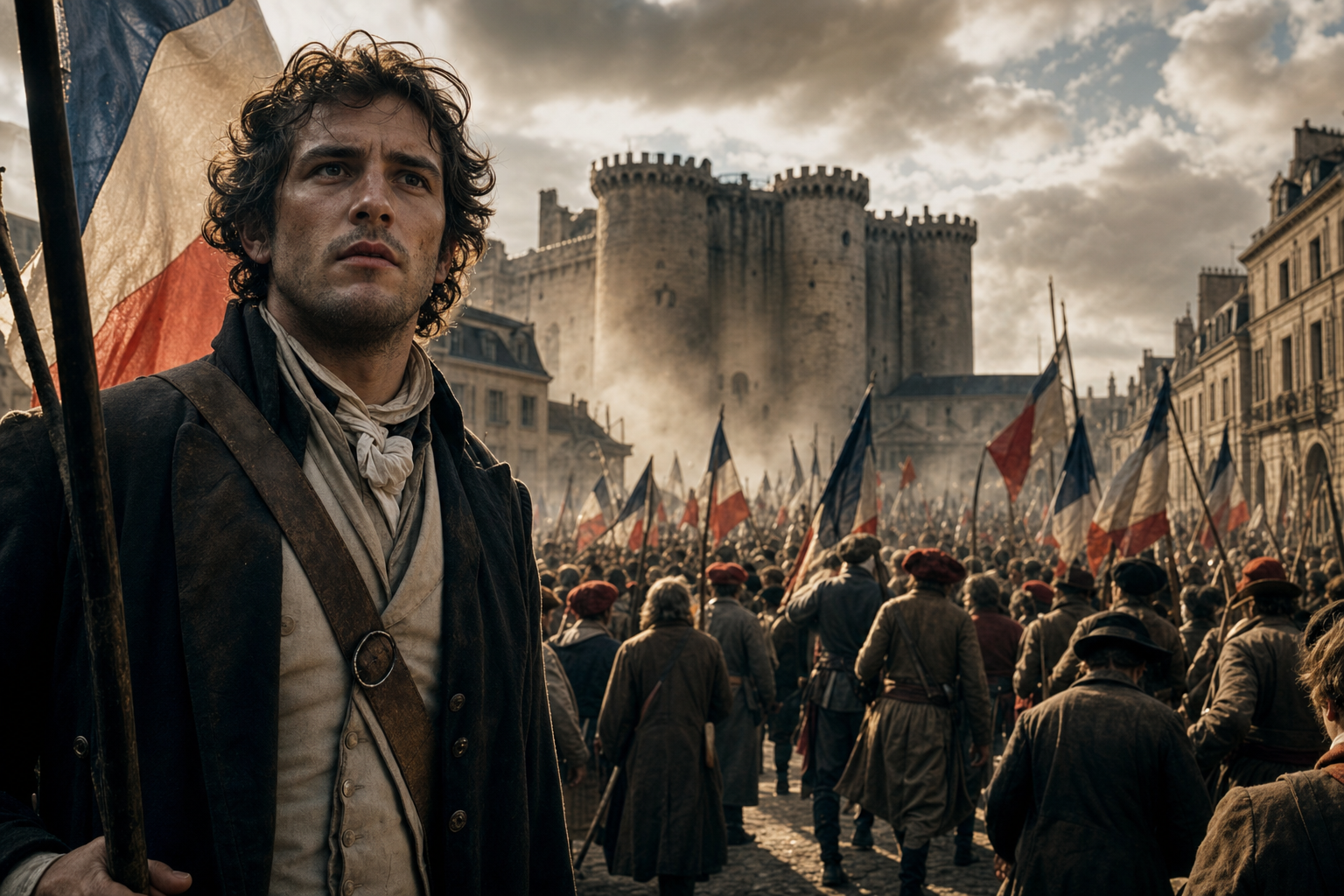
The Fall of the Bastille: Mystery, Memory, and Revolution
On a sultry morning of July 14, 1789, Paris held its breath as a crowd moved toward the Bastille, a hulking medieval fortress at the eastern end of the city that had quietly loomed over the Seine for centuries. For many Parisians the Bastille was not merely a work of stone and iron; it was the embodiment of arbitrary royal authority, the place where lettres de cachet could snatch a person from the streets and consign them to indefinite detention without trial. Yet on that day the fortress, long feared and little understood by ordinary citizens, would become the locus of an event that transformed rumor into history and fear into a new language of liberty.
This article follows that translation — the precise sequence of events, the human beings in its center, and the larger currents that made a crowd into a revolutionary act. We will trace the Bastille's identity before 1789, the political and economic triggers that sent Paris into the streets, the mechanics and chaos of the assault, the brutal and ambiguous aftermath, and the ways memory turned stones into relics and a violent episode into ritual. Along the way the story oscillates between the detective-like reconstruction of choices and movements, and the sense of prophecy that surrounded July 14 as if the city had been waiting for a narrative to begin.
The Fall of the Bastille is often presented as a clean break — a single conflagration from which modern France emerged. When examined closely, it is messier: a concatenation of misjudgments by royal officials, desperate improvisations by Parisians seeking arms and bread, and a violent cascade that produced both immediate gains and lasting ambiguities. The personalities involved — provincial merchants, discharged soldiers, artisans, deputies to the Estates-General, Governor Bernard-René de Launay, and even the king's wavering ministers — read like players in a drama, each with motives, errors, and tragic ends. This narrative will keep a mystery-driven tone, exploring not just what happened but how contemporaries and later generations read meaning into each act. We will highlight curiosities and visual anchors to help the reader imagine the scene: the graffiti of the city, the scrap of paper that promised safety or doom, and the broken gates that would be both demolished and revered.
Did you know? The dismissal of finance minister Jacques Necker on July 11, 1789, is often cited as the immediate political trigger that intensified popular anger in Paris.
Beneath the sensational imagery lies a series of verifiable facts: Jacques Necker's dismissal on July 11, 1789; the mobilization of crowds around Les Invalides for arms; the march on the Bastille beginning on July 14; the surrender and killing of Governor de Launay; the demolition of the fortress; and the rapid diffusion of the news that turned local combat into the national moment. Interpreting these facts requires attention to both documentary record and the surprising human details that the official reports sometimes obscure. As we move into the first section, we will reconstruct the Bastille itself and its social and political place in late-18th-century Paris.
The Bastille Before 1789
To make sense of the storming, it helps to understand what the Bastille was and what it was not. Built in the 14th century as part of the city’s medieval fortifications, the Bastille originally served as a defensive stronghold. Over centuries it evolved into a royal fortress and prison, its thick walls repurposed to detain enemies — real, imagined, or politically inconvenient. By the late 18th century, its outer silhouette — seven towers connected by curtain walls — had become a familiar, even grim, feature of the Parisian horizon. But the Bastille's administrative and symbolic roles were not identical: within the government apparatus it functioned as one of several prisons; in public imagination it was a potent icon of monarchical arbitrariness.
The Bastille was administered by a governor appointed by the crown. Its military garrison and its wards were relatively small by the standards of the city, yet the combination of strong armament and royal legal prerogative made it formidable. The prison housed a variety of detainees, commonly those detained under lettres de cachet — royal warrants that allowed imprisonment without trial — as well as debtors, forgers, and others. Notably by July 1789 the Bastille contained only a handful of prisoners, not the hundreds of victims romanticized later. Contemporary inventories and prison records suggest there were seven prisoners at the time of the assault, hardly a repository of the nation's greatest political dissidents. Nevertheless, to many citizens the sight of the fortress and knowledge that it could incarcerate on the sovereign's whim concentrated decades of accumulated resentment.
Did you know? Governor Bernard-René de Launay was killed by the crowd after surrendering; his death became a potent emblem of the day’s violence and the revenge of the populace.
Equally important was the fortress's visibility. Situated at the Place de la Bastille, a junction and gateway to the eastern quarter, it dominated an area of the city that was commercially vibrant and socially mixed. Urban rumors coursed rapidly along the flow of goods and people; the Bastille operated not only as a physical barrier but as an object of rumor. The prison's architectural features — narrow windows, reinforced doors, a moat and drawbridge in an earlier epoch — were less relevant to the crowd than the symbolic meaning attached to those features. Writers, pamphleteers, and theater troupes had long used the Bastille as shorthand for despotism. While the legal reality of imprisonment varied, the mythic presence of the Bastille amplified any crisis.
Moreover, the Bastille’s practical military strength had been eroded by the late 18th century. Advances in artillery and changes in urban warfare made castles and medieval fortresses less invulnerable; their chief strength lay in the psychological impact of walls. The governor, Bernard-René de Launay, commanded a garrison of invalides and a small detachment of Régiment de Flanders — enough to hold the place against disorderly mobs but not necessarily to withstand coordinated military actions. Yet neither the garrison nor the governor had full control over the narrative. In the days leading to July 14, reports circulated accusing officials of hoarding arms or plotting to massacre citizens. Whether those reports were accurate mattered less than their effect: they converted fear into urgency, and urgency into mobilization.
Thus, when crowds gathered for reasons that ranged from seeking arms at the Hôtel des Invalides to protesting bread shortages, the Bastille became a focal point. It was at once a practical obstacle to control and a symbolic target whose capture would signal the collapse of arbitrary royal power. The fortress's history as a prison for political prisoners decades earlier magnified its relevance: even if only a few detainees were inside, the very fact that the king could lock citizens away became the central grievance. This dissonance between a small number of actual prisoners and the massive symbolic load the Bastille carried is essential to understanding the event: what was attacked was as much a legend as a stone structure.
Did you know? Entrepreneur Pierre-François Palloy supervised the Bastille's demolition and turned stones into revolutionary souvenirs and symbols of liberty.
The Morning of July 14: Tensions and Triggers
The immediate antecedents of the storming are a weave of political missteps, economic distress, and the tinder of rumor. The dismissal of Jacques Necker on July 11, 1789 is often cited as the spark that set off the fireworks of mid-July. Necker, the popular finance minister whose reformist rhetoric and tacit support for the Third Estate had earned him public affection, was perceived by many Parisians as a protector of their interests. The king's decision to remove him fed the impression that the monarchy was reasserting an uncompromising authority at a moment when the Estates-General and the National Assembly were in volatile negotiation.
Food scarcity and soaring bread prices had already made urban crowds ready to explode. Bread composed the staple of working-class diet and, when grain speculation and poor harvests drove prices skyward, any political provocation risked igniting violent demonstrations. In the days after Necker's dismissal, crowds flooded Parisian streets. They gathered at Les Invalides — then a repository of arms — intent on acquiring weapons. It was there that a force of citizens obtained muskets and ammunition, a tactical shift that transformed a political demonstration into a potential military action. The image of ordinary Parisians arming themselves for battle captured a new reality: the population was no longer merely protesting words; it was preparing to seize instruments of force.
As the crowds moved toward the Bastille on the morning of July 14, rumor raced ahead of them. Some believed that the fortress held large caches of weapons and that a massacre might be imminent if royal troops were permitted to clear the streets. Others sought the liberation of prisoners said to be languishing there. The truth was more prosaic but no less compelling: reinforcements and prestige troops were being moved toward the capital, and the monarchy's partial withdrawal of constraints alarmed the Parisians. Municipal authorities in Paris were also in disarray. The Hôtel de Ville became a center of frantic negotiation and organization, with militants, artisans, and provincial deputies debating tactics and goals. The Amalgamation of motives — hunger, fury at perceived royal arrogance, the need to secure arms — made the crowd both heterogeneous and single-minded.
Did you know? The modern French national holiday on July 14th evolved from the fêtes and rituals that commemorated the Bastille's fall and the subsequent Fête de la Fédération in 1790.
By the time the crowd arrived, the Bastille's governor, de Launay, faced an impossible calculus. He had a small force and a duty to defend the fortress; retreating without orders could be treason, while firing on citizens could provoke a political crisis worse than the loss of the Bastille itself. Contemporary memoirs and police reports recount an initial parley: citizens demanded the surrender of arms and gunpowder. Negotiation stalled, and the first skirmishes began when some attackers fired upon the gates. Although accounts differ about whether the defenders fired first in any significant way, it is clear that the exchange of shot catalyzed a rapid escalation.
This was not the seizure of a lightly guarded government building but a chaotic urban combat where intention, rumor, and desperation shaped action. The city's topography — narrow streets funneling people toward the square, the fortress's imposing but singular access points, and the presence of latent weaponry in the hands of armed artisans — converted a protest into an assault. The choice of the Bastille as target was strategic and symbolic: it offered the chance to obtain arms and powder, while delivering a blow to royal prestige. The morning unfolded with the kind of unpredictability that often characterizes revolutions: small decisions by individuals — firing a musket at a window, letting the drawbridge fall, shouting a command — combined to create an irreversible trajectory toward violence.

The Assault: Actors, Weapons, and Strategy
The assault on the Bastille resembled an urban siege improvised by citizens rather than a professional military operation. The attackers were a motley assembly: artisans, journeymen, shopkeepers, and some provincial soldiers and National Guardsmen who had sided with the populace. Their armaments varied widely — from pikes and improvised clubs to muskets and a smattering of artillery pieces acquired from Les Invalides. Remarkably, a small number of cannons do appear in many eyewitness descriptions, and these provided the attackers with a psychological advantage even if their destructive efficacy was limited against the thick walls. The presence of arms and some organization — drums, leaders emerging from among the crowd — converted the spectators into combatants.
Did you know? Pieces of the Bastille’s stone were widely distributed as souvenirs; many Parisians kept fragments as tangible tokens of liberty.
Governor de Launay's defenders included invalides (veteran soldiers), a detachment of regiment troops, and the fortress's garrison. Their mission, by military code and royal directive, was to hold the site. But several factors undermined their position. The defenders were outnumbered and isolated in the urban maze; they were also subject to conflicting orders and the demoralization that accompanies sustained public pressure. It is critical to note that the defenders were not a faceless uniformed enemy but men with families and local ties, and many among them were reluctant participants in a confrontation that promised few clear rewards.
During the afternoon and into the early evening, fighting intensified at the gates and along the walls. Cannon fire — whether effective or more symbolic — created breaches in confidence more than in masonry. There were desperate attempts at negotiation and parley punctuated by outbursts of gunfire. At some moment in the evening, the defenders, recognizing the untenable situation, capitulated. Governor de Launay surrendered, perhaps believing that laying down arms would spare lives. The terms of surrender were contested: the attackers demanded the handing over of arms and ammunition, while de Launay expected quarter. What followed is among the most harrowing episodes of the day: de Launay, after surrendering, was seized by the crowd, subjected to a summary and brutal execution, and his mutilated body was paraded. Contemporary witnesses recorded with a kind of stunned horror how the governor's head was placed on a pike and carried through Paris — an image that would haunt royalists and become a revolutionary trophy for radicals.
The number of casualties remains debated, but contemporary records indicate dozens of the crowd were killed and wounded; the defenders also suffered losses. Crucially, the Bastille contained only a handful of prisoners at the time — seven by most contemporary counts — and the assault did not liberate a large body of political prisoners as popular stories would later claim. The release of these prisoners became part of the narrative performance of liberation, however, even if the prisoners themselves were of marginal political importance. What the assault accomplished beyond immediate victors and victims was theatrical: the fall of a hated symbol, the seizure of powder and arms, and the broadcast of a message about the monarchy's vulnerability.
Did you know? Despite its symbolic role, only seven prisoners were held in the Bastille at the time of its fall, not the large number later narratives sometimes imply.
It is worth noting the role of leadership in the attack: local notables and newly emergent patriots moved to channel the crowd's energy into something that could be wielded politically. Figures such as the Marquis de La Fayette would not yet dominate events in Paris on July 14, but in the days and weeks that followed, they would shape the revolutionary narrative and institutional responses. The crowd that had stormed the Bastille was heterogeneous, but immediately afterward, revolutionary committees and municipal actors began to consolidate authority, claiming credit and attempting to institutionalize the moment. The scene at the Bastille, therefore, was both an episode of raw violence and the prelude to administrative construction: the revolution and its leaders often followed the noise of the mob.
Aftermath: Casualties, Prisoners, and Political Shockwaves
The immediate aftermath of the Bastille's fall was a mixture of jubilation, confusion, and reprisals. News traveled rapidly across France and abroad, transformed and amplified by salons, pamphlets, and foreign newspapers. Paris celebrated; bells rang, tricolors were improvised, and crowds surged with an intoxicated sense of triumph. Municipal authorities in the city scrambled to fill the vacuum. The Hôtel de Ville and other civic institutions began to appear as loci of revolutionary power, while provincial towns sent delegates and arms to the capital in a gesture of solidarity that would expand the insurrection into a national movement.
Casualty figures were contested but significant enough to leave scars. Contemporary municipal registers counted several dozen dead among the attackers and a number of wounded; defenders' losses were also nontrivial. The execution and public humiliation of de Launay and other royal officials raised questions about legal authority and the nature of revolutionary justice. The killing of a governor after surrender provoked fear among moderates who feared anarchic reprisals, even as more radical voices glorified the act as fitting retribution. That tension between order and vengeance would echo through subsequent months and shape debates about the legitimacy of revolutionary violence.
Politically, the fall of the Bastille forced the monarchy into a series of concessions. Louis XVI, shaken by events and sensing the erosion of control in the capital, made cautious gestures: he recalled Necker, called troops back from the outskirts, and reacted with a mix of confusion and capitulation. These responses, ill-timed and inconsistent as they often were, only deepened the sense that the royal authority was no longer unassailable. Meanwhile, Parisian insurgents moved quickly to create institutions to govern and defend the city: the National Guard was formed, with the Marquis de La Fayette appointed to command; municipal committees began to assert control over public order; and deputies to the National Assembly watched closely as the locus of political power shifted.
Economically and socially, the storming had reverberations too. Grain speculators and landlords trembled as peasants' unrest, known as the Great Fear, spread through the countryside in the weeks after July. Rural communities, hearing news and rumors of aristocratic conspiracies, rose against perceived feudal abuses, burning records and seizing lands. The fall of the Bastille catalyzed a chain reaction: events in Paris created a sense of empowerment elsewhere, undermining feudal structures and accelerating the collapse of ancien régime institutions. The National Assembly, sensing both popular zeal and the need to respond, began to legislate reforms that would culminate in the Declaration of the Rights of Man and of the Citizen in August 1789.
Another tangible aftermath was the fate of the Bastille itself. Within days the fortress began to be dismantled, not by royal command but by private enterprise. Pierre-François Palloy, an entrepreneur with revolutionary sympathies, orchestrated the demolition and the sale of stones as souvenirs. He famously arranged for pieces of the fortress to be distributed as relics of liberty — portions of the gates and stones that would be repurposed into civic monuments and private mementos. The demolition was both practical — the fortress no longer served any military purpose — and symbolic: the physical erasure of the Bastille turned a site of oppression into a material narrative of liberation.
Symbols and Myths: How the Bastille Became a Revolution Icon
The way the Bastille entered historical memory is as revealing as the assault itself. In the immediate months after July 14, the event was narrated in many fashions: as a popular uprising against tyranny, as a spontaneous outpouring of pent-up rage, and as a carefully orchestrated seizure by revolutionary leaders. Pamphlets proliferated, artists depicted the siege and the parading of trophies, and politicians of various stripes sought to claim the symbol for their agendas. The result was a layering of memory: facts embedded within mythic frames that made the Bastille a pivot around which revolutionary identity could turn.
Symbol-making was manifest in ceremonial acts. Triumphal parades, new festivals, and civic ceremonies re-inscribed the site's meaning. The French tricolor, which would become the national flag, and other emblems were associated with the new revolutionary ethos. The public display of de Launay's head and the distribution of Bastille stones as relics created a form of sacramental memory: defeat of tyranny could be seen, touched, and enacted in ritual. Popular songs and theater recounted the events with embellishments, further embedding the Bastille into national lore.
The myth of the Bastille also served political ends beyond immediate celebration. Revolutionaries needed a foundational narrative to legitimize broad institutional change: by pointing to a concrete, dramatic moment of resistance, leaders could argue that the people had asserted a legitimate power that required recognition and integration into new governance structures. Conversely, royalists and conservatives depicted the Bastille's fall as evidence of anarchy and moral decline, a violent rupture that destabilized legitimate order. Both narratives had traction because the materiality of the Bastille — its stones, its moat, its very absence after demolition — provided a palpable reference point for otherwise abstract claims about sovereignty and rights.
Over time, the Bastille’s symbolic potency grew. July 14th, first celebrated in various local rituals, evolved into a national holiday by the late 1790s and was solidified as the Fête nationale in the 19th century. Commemorative practices transformed July 14 from a chaotic day of street fighting into a ritualized ceremony of republican identity. The language of liberty, fraternity, and equality would be repeated in civic performance, and the Bastille's memory would be woven into school curricula, monuments, and the rhetoric of politicians. The transformation from site of imprisonment to mythic icon demonstrates how revolutions do not only change laws and property but also reconfigure cultural memory.
Yet myths also obscure. The widely repeated claim that the Bastille housed hundreds of political prisoners in 1789, or that a single heroic attack freed a great mass of suffering souls, simplified a more ambiguous reality. Similarly, the spectacle of the governor's head on a pike became shorthand for popular justice, obscuring the legal and moral quandaries that such violence raised. Memory crafted heroes and martyrs, often at the expense of the complex social and material conditions that produced the events. Recognizing the gap between myth and documented reality allows historians to appreciate both the power of symbolism and the often messy truth beneath it.
Memory and Commemoration: From 1790 to Modern France
The decades after 1789 show the Bastille shifting from a recent ruin to a fulcrum of national memory. In 1790, the Fête de la Fédération celebrated unity and popular sovereignty on the anniversary of the Bastille, marking a critical moment when revolutionary ritual sought to replace royal liturgy. The festival, attended by thousands including the king and queen, was meant to heal political wounds and assert the new social order. Yet even as authorities tried to domesticate the revolutionary energies into rituals and official holidays, grassroots memory persisted in its more violent and iconoclastic forms.
Napoleon's rise and subsequent regimes used and reshaped revolutionary memory for political ends. The Bastille, as an object, had been physically dismantled, but its symbolic resonance remained a resource that successive governments could mobilize. Republican governments embraced July 14 as a touchstone of popular sovereignty, while monarchists pointed to the day's lawlessness as a cautionary tale. In each period, cultural representations — paintings, plays, and later history textbooks — selected among the available images and themes to fashion a usable past.
The 19th century saw an intensified mythologizing of the Bastille. Romantic artists and historians emphasized heroism and tragedy, often privileging narrative coherence over documentary complexity. Yet the material afterlife of the Bastille was also concrete: many citizens prized fragments of the fortress as relics; stones embedded in private homes and municipal buildings carried the aura of revolutionary authenticity. Museums and commemorative plaques would later formalize these links between object and meaning, making the Bastille an artifact of national identity even in its physical absence.
In modern France, July 14 remains the principal national holiday, a day of ceremonies, parades (most famously the military parade on the Champs-Élysées in Paris), and regional commemorations. The Bastille itself has been reimagined in urban form: the Place de la Bastille is now a roundabout and a public square with the July Column (Colonne de Juillet) commemorating the Revolution of 1830. The demolition of the fortress and the subsequent urban interventions illustrate how cities rework traumatic sites. Memory studies reveal that the fall of the Bastille endures not merely because of the facts of the siege but because it offered a dramatic, visible moment around which a national story of liberation could be told.
Yet the memory is also contested. Different political movements have attempted to appropriate July 14 to their ends — whether as a celebration of civic unity, a warning about mob rule, or a symbol of popular sovereignty against all forms of oppression. Museums now present the Bastille with critical nuance, balancing the spectacle with archival materials that show the small number of prisoners, the chaotic violence, and the larger social forces. This critical retelling does not diminish the event's power; rather it enriches our understanding of how revolutions create both empirical change and enduring myths.

Conclusion: The Bastille as Mirror and Mystery
The Fall of the Bastille resists a single interpretation. It was a violent episode of urban combat, a political crisis with immediate tactical consequences, and a symbolic rupture that allowed new forms of authority to emerge. The fortress's physical demolition after July 14 is almost a metaphor for the revolution's attempt to dismantle ancient structures of power — not only in brick and mortar, but in law and habit. At the same time, the day’s events reveal the paradoxes of revolutionary politics: the pursuit of liberty can produce images of brutality, and the seizure of power by popular movement can generate its own instruments of discipline.
What keeps the Bastille alive in collective memory is precisely this tension between reality and representation. The documented facts — Necker’s dismissal, the arming of crowds at Les Invalides, the assault on July 14, de Launay’s death, the demolition and souvenir trade — are stable points of reference. Around them swirl interpretations that have been refashioned by pamphleteers, politicians, artists, and ordinary citizens. The Bastille tells us about the dynamics of rumor and rumor’s capacity to propel action; about how small institutions can carry outsized symbolic weight; and about how societies convert trauma into ritual and meaning.
For historians, July 14, 1789 is both a subject for factual reconstruction and a case study in cultural formation. The day demonstrates that revolutions are not just sudden overturnings of authority but processes in which memory, myth, and material practices interact. The stones of the Bastille were transformed from instruments of confinement into tokens of liberty; the image of the governor's head on a pike became both a warning and a revolutionary trophy; and a chaotic urban riot became the foundational myth of a republic.
In the end, the Bastille remains a mirror: it reflects enduring human themes — fear, vengeance, hope, and the desire for dignity — and it presents a mystery about how ordinary moments become extraordinary. The storming invites us to consider how people make political meaning under stress and how symbols can outlive their original contexts to shape national identity for centuries. To walk the Place de la Bastille today is to confront absence and presence at once: the missing fortress and the persistent idea that the people can, in certain historical junctures, upend an ancient order and announce a new era of political possibility.
How we verify this article
By the History Unlocked editorial team
This text is built on historical facts stored in our database and drafted with AI assistance. No signed human review is recorded for this article. Report any inaccuracy: we correct it and update the modified date.
Updated on
AI-assisted drafting.
Read our editorial standardsEnjoyed this? Discover more articles in the category Great Revolutions