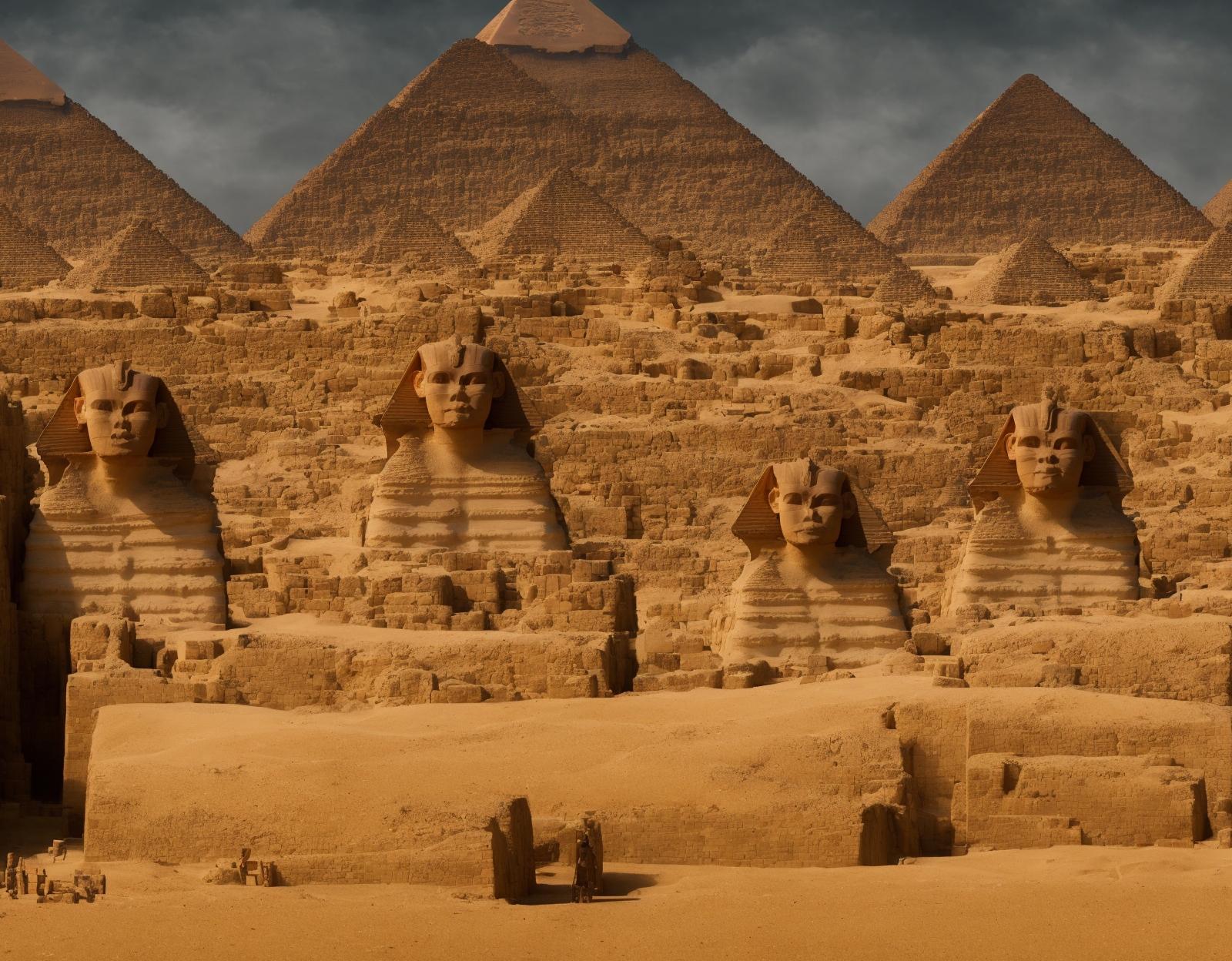
Secrets of Pyramid Construction: How the Egyptians Built Giza
The Great Pyramid of Giza stands like a frozen comet on the western horizon of ancient Memphis — a monolith of limestone and story that has compelled travelers, priests, conquerors and modern engineers for millennia. To approach its shadow is to breathe centuries of dust, ritual, labor and mathematics. Yet the question that has animated scholarship, speculation and popular imagination remains urgent: how did the ancient Egyptians, more than four and a half thousand years ago, move millions of tons of stone to build structures of monumental precision without iron cranes or motorized engines? This article traces the most credible historical evidence, the breakthroughs of modern archaeology, and the best-informed technical reconstructions to present a coherent, mystery-driven narrative of pyramid construction at Giza.
We begin with the era of the builders: the Fourth Dynasty, a concentrated flowering of royal ambition under men like Khufu (also known by the Greek name Cheops), Khafre and Menkaure. The Great Pyramid, attributed to Khufu and completed around 2560 BCE, was not an isolated act but the apex of a sophisticated royal ideology that fused theology, administration, and economic capacity. Recent finds — the diary fragments of a Nile official, the Merer papyri, the remains of organized workers’ villages, and the quarry marks of Tura limestone — have shifted the debate away from fanciful slave narratives toward a nuanced model of state-organized, seasonal labor and professional craftsmen operating within a vast logistical network. In the chapters that follow, I will reconstruct the materials, tools, human organization, transport routes, and building methods that created these stone cathedrals. Alongside the hard evidence, I will linger over the unanswered questions and the experiments that test competing hypotheses: whether ramps of earth were dragged along a southward slope, whether cedar sledges moved the stones on wet sand, or whether an internal ramp worked its way up the structure’s spine.
This narrative embraces the mystery rather than dismissing it. The pyramids are architectural puzzles that were also, in their time, metaphysical instruments: the pharaoh’s path to eternity etched in stone. To understand how they were made is also to understand the worldview that made such a feat imaginable and achievable. Each section below is rooted in verifiable archaeological data or documented historical sources, avoiding speculation unmoored from evidence. Yet where the evidence allows multiple reconstructions, I present the leading theories and the experiments that have attempted to replicate ancient techniques.
Did you know? The Merer papyri, dated to Khufu's reign, record shipments of Tura limestone to Giza and document the daily activities of a Nile harbor supervisor, establishing direct logistical evidence from the period.
The Pharaohs, the State, and the Age of Monumental Ambition
The decades of the Fourth Dynasty (c. 2613–2494 BCE) were defined by a concentration of state power and administrative capacity that allowed successive pharaohs to marshal resources for unprecedented building projects. Khufu (reign conventionally dated c. 2589–2566 BCE) set the tone with his complex at Giza, which included the Great Pyramid, a mortuary temple, subsidiary pyramids, workers’ settlements and the enigmatic boat pits. Khafre and Menkaure followed, leaving their own pyramids and complexes that demonstrate both continuity and refinement in royal funerary architecture.
The pharaoh was both a religious and a political center; monumental building was a deliberate public expression of divine kingship. Administrative texts and archaeological contexts suggest that the state organized labor in rotating contingents — not a permanent army of unfree laborers, but teams of skilled workers, seasonal recruits and specialists who were supported, housed and fed. The discovery of the village at Heit el-Ghurab (often called the 'Giza Workers' Village') and the cemetery for workers near the plateau provided crucial evidence that the workforce included well-fed artisans and laborers whose graves show care and provisions — indicating social status and organization inconsistent with slave labor.
Herodotus, writing in the fifth century BCE, furnished early but often unreliable narratives about pyramid building, describing enormous working gangs and elaborate machinery. Modern archaeology treats such accounts cautiously, but they are valuable as early attempts to grapple with the scale of construction. More compelling are the contemporary Egyptian records, like the administrative ostraca and, crucially, the papyri discovered at Wadi al-Jarf in 2013 — the Merer documents — which provide first-hand logistics details linked directly to Khufu’s building projects. These fragments list shipments of Tura limestone and describe harbor operations, offering a rare window into how centralized control and riverine transport accomplished massive material movement.
Did you know? Archaeological analysis shows that the white Tura limestone casing would have shone brilliantly under the sun; early travelers reported a dazzling gleam, consistent with the polished finish of casing stones.
Understanding the political and economic backdrop is essential: the Nile’s predictable inundation cycle freed male labor from agricultural duties for months each year, while the state could requisition grain, timber and copper and direct specialized workers to royal projects. This interplay of resources, seasonal cycles and centralized bureaucracy is the scaffolding upon which the pyramids were erected.

Stone, Tool, and Quarry: The Materials of Monumentality
A careful reading of the pyramids begins with their constituent stones. The Great Pyramid’s core is largely made from locally quarried limestone, but the finest casing stones were of white Tura limestone, quarried across the Nile on the eastern bank near modern-day Helwan and Tura. The inner chambers and some architectural features used massive blocks of Aswan granite, a harder and denser stone quarried near the First Cataract at Aswan, roughly 800 kilometers upriver. Transporting these heavier stones downriver was an achievement in logistics as stunning as the erection itself.
The tools recorded or recovered from Old Kingdom contexts were principally copper chisels and stone dolerite pounders. Copper, though softer than bronze or iron, can be hardened and maintained effectively and was supplemented by heavy stone hammers and abrasives for splitting and shaping. Quarry marks on blocks, tool impressions and the geometry of cut faces provide archaeologists with information on how stones were detached and roughly dressed. In quarries like those at Tura and Aswan, workers used channels and wedges to separate blocks; they exploited natural bedding planes in sedimentary limestone and used pounding and levering where needed.
Did you know? Excavations of Giza’s workers’ cemeteries yielded evidence of purposeful burial treatments and offerings, indicating that many workers held status and were not expendable, undermining narratives of slave-driven construction.
Experimental archaeology has shown that precise finishing, like the polished surfaces of casing stones, could be achieved with simple tools and persistent effort. The casing received a mirror-like finish using finer abrasives and polishing techniques, which would have reflected sunlight brilliantly when intact. This shining exterior may have contributed to the pyramids’ celestial symbolism — a mountain of light leading the deceased king to the heavens.
Rope is another unsung material; made from papyrus or flax, it was strong, flexible and essential for hauling. Rope marks found on some stones and depictions in tomb scenes corroborate its centrality. The use of sledges, sometimes depicted in tomb reliefs with men pulling a sled carrying a statue or a block, indicates a widespread hauling technology probably assisted by runners and lubrication.
Workforce, Organization, and Daily Life on the Plateau
The image of slaves straining under whips is a romantic and persistent myth from older historiography and literature. Contemporary evidence points to a more complex labor regime: seasonal laborers, skilled masons, support staff, and administrators working in a coordinated system. Excavations of the workers’ village at Giza revealed barracks, bakeries, breweries, and cemeteries. The diet, osteological evidence and grave goods identified in burial contexts demonstrate that those who worked on the pyramids were relatively well-provisioned and respected.
Did you know? Experimental archaeology has demonstrated that applying water to sand in front of a sledge reduces friction enough to explain hauling heavy blocks with comparatively small teams — consistent with Old Kingdom depictions.
The village layout indicates organization into crews, sometimes referred to by modern archaeologists as ‘gangs’. These groups may have had names and hierarchies, with skilled master masons overseeing quarters of the workforce and a logistical backbone ensuring supply of food, water, copper, ropes and linen. Inscribed graffiti on worker blocks — often containing crew names and occasional dates — supports the idea of organized labor units. Medical evidence from skeletal remains shows injuries consistent with heavy manual labor but also care and healing that signal community and medical provisioning.
The seasonal rhythm of the Nile was crucial. At high water, fields lay fallow and labourers could be mobilized for state projects. Boats and barges carried heavy materials from quarries along the Nile; the Papyrus of Merer mentions the movement of large quantities of limestone from the Tura quarries to Giza by means of the Nile and an organized harbor system. The harbor remains, canals and dock facilities that fed the Giza plateau were part of a sophisticated supply chain enabling bulk transport at relatively low energy cost.
Beyond manpower, the workforce included skilled artisans who carved chambers and installed complex fittings. The Great Pyramid’s internal architecture — precise passageways, corbelled ceilings and the King’s Chamber built from enormous granite blocks — required masonry skills of the highest order. Craftsmen would have operated in circumscribed teams, following plans that combined empirical tradition and architectural knowledge passed down through guild-like structures.
Did you know? The Great Pyramid’s sides are aligned to true north with an error of only a few arcminutes — a degree of accuracy implying sophisticated observational astronomy and careful surveying techniques.

Moving the Monoliths: Transport, Ramps and Mechanical Theories
Transport and emplacement of heavy blocks are the two technical problems that attract the most debate. River transport appears straightforward in principle: the Nile connected quarries to the Giza plateau, and ramps or sledges moved stones onto the plateau from landing sites. The Papyrus of Merer documents the use of boats and a harbor system to bring Tura limestone across the Nile, and archaeological traces of canals and basin works on the Giza side support the idea of a constructed approach for landing blocks.
Once on land, blocks were hauled on sledges. A method supported by tomb reliefs and experimental archaeology involves wooden sledges pulled by teams of men over lubricated sand; experiments have shown that wetting the sand in front of a sledge reduces friction substantially — a physics result that aligns with an Old Kingdom scene depicting someone pouring water in front of a sled. That single visual corroborates experimental findings dating from the late 20th and early 21st centuries, revealing a pragmatic solution to hauling enormous weights with limited friction.
However, how the blocks rose from the plateau to ascending courses on the pyramid’s faces is where theories multiply. The classic model posits massive external ramps made of mudbrick and rubble that wrapped the pyramid or ran straight up one face. This model explains the basic mechanics but raises serious issues of scale: temporary ramps would have needed to be enormous and would require as much material and labor as parts of the pyramid itself. Archaeologists find limited evidence for such colossal ramps in the local stratigraphy.
Did you know? The "Khufu ship," discovered disassembled in a pit near the Great Pyramid, was a full-size cedar vessel likely intended for ritual use in the pharaoh’s afterlife voyage.
Alternatives include zigzagging ramps along a face, spiral ramps built around the pyramid’s exterior, or internal ramp hypotheses. The internal ramp theory, most prominently proposed in modern times by architect Jean-Pierre Houdin, posits that an internal spiral ramp within the pyramid's mass allowed construction to rise without the need for gargantuan external works. This theory is supported in part by microgravity surveys and by Houdin’s reconstructions explaining certain anomalous features in the pyramid’s geometry, though it remains contested.
Counterweight systems have also been proposed — using seesaw-like levers or balanced weights to lift blocks incrementally — and simple levering techniques would have been available and effective at placing stones with fine tolerances. Likely, the builders employed a combination of methods tailored to material size and the phase of construction rather than a single monolithic technique.

Precision, Alignment, and the Science of the Builders
One of the Great Pyramid’s most arresting features is its precision. The base is level to within a few centimeters over 230 meters per side; the sides are aligned to true north with an error of only a few arcminutes. Achieving this in the late third millennium BCE required not only brute force but practical astronomy, surveying skills and careful planning.
Did you know? An earthquake in 1303 CE and later stone robbing for Cairo construction significantly damaged the pyramids’ casing and contributed to their current appearance, explaining why they lack their original polished white exterior.
Archaeologists point to several plausible instruments and techniques. The merkhet, an ancient Egyptian timekeeping and astronomical device akin to an alignment tool, could be used with star observations to establish north-south lines. The circumpolar stars, the so-called "imperishable" stars that never set, would have provided reliable references for alignment at night. During the day, the builders could have used shadow-casting gnomons and sighting poles. The leveling of the base likely combined simple but meticulous procedures: channels filled with water to establish level baselines, repeated measurements and corrections, and skilled stonemasons to execute precise placements.
Mathematical knowledge is evident in the pyramid’s proportions and in the geometry evident throughout Old Kingdom monuments. While we must be cautious about attributing modern formulas to ancient builders, the practical geometry of triangulation, right angles and slope ratios would have been empirically derived and taught within the craft tradition. The pyramids’ angles — roughly 51° 50′ for the Great Pyramid — and the regularity of courses imply conventions and standards that were rigorously enforced.
Even the internal architecture required extraordinary precision. The King’s Chamber’s granite beams and the corbelled relieving chambers above it were not mere aesthetic choices but structural solutions to distribute weight away from the chamber. Scribing, measuring rods, and square tools made from wood or stakes allowed craftsmen to translate plans into three-dimensional reality with remarkable fidelity.
Did you know? Inscribed graffiti left by worker gangs on the backs of blocks at Giza include crew names and occasional notes, providing direct evidence of organized teams involved in construction.
Ritual, Symbolism, and the Pyramid as Cosmic Machine
Beyond engineering, the pyramids were theological instruments. They embodied an ideology of kingship in which the deceased pharaoh ascended to the heavens, joining the gods and the sun’s cycle. The pyramid’s shape has been interpreted as a stylized benben — the primeval mound in Egyptian cosmogony — or as a ray of the solar disk, tying the king’s fate to the sun god Ra. This symbolic program deepened over time, and by the end of the Old Kingdom the funerary texts carved into later pyramids crystallized a complex religious vocabulary around the afterlife.
The arrangement of mortuary temples, causeways and subsidiary structures reinforced the ritual pathway for offerings, purification, and the king’s funerary cult. Finds such as the reconstructed Khufu ship — a full-size cedar boat buried in a pit beside the Great Pyramid — suggest beliefs about ritual transport to the afterlife. Boat pits and subsidiary burials encoded the idea that the dead king needed vehicles and provisions for his journey.
Architectural choices also had symbolic dimensions: the orientation to cardinal points tied the monument to cosmic order; the smooth polished casing suggested a solar brilliance; and the interrelationship between pyramid and temple connected the terrestrial cult with celestial destiny. The pyramids thus operate on two levels simultaneously: as feats of engineering and as designed, ritualized centers for the renewal of cosmic order under royal aegis.
Did you know? The Aswan granite used in the Great Pyramid's internal chambers had to be transported hundreds of kilometers down the Nile, a logistical feat documented in both archaeological finds and riverine engineering remains.

Conclusion: The Enduring Mystery and the Weight of Evidence
The pyramids at Giza are at once the most studied and the most enigmatic artifacts of ancient human civilization. Modern archaeology has dismantled many earlier myths — the notion of slave labor, crude stones piled by brute force, sudden inspirations divorced from bureaucratic reality — replacing them with a picture of organized labor, logistical ingenuity, material knowledge and ritual purpose. The discovery of administrative papyri like those at Wadi al-Jarf, the study of workers’ cemeteries and villages, quarry analyses and experimental archaeology combine to form a consistent account: the pyramids were state-sponsored projects, achieved through coordinated manpower, clever mechanical solutions and riverborne logistics.
Yet mystery remains. The precise balance of methods used for lifting and placing the heaviest stones is still disputed; competing models (external ramps, internal ramps, levering and counterweights) each solve some problems and create others. Debates about workforce size, project duration and the precise role of professional craftsmen versus seasonal labor will continue as new finds are published and new technologies — such as ground-penetrating radar and microgravity surveys — test old assumptions. What is undeniable is that the builders of Giza succeeded in combining a political economy with technical skill and cosmological intent to craft monuments that still ask questions of us.
Did you know? The Great Pyramid remained the tallest man-made structure in the world for nearly 3,800 years, a testament to the durability and ambition of Old Kingdom engineering.
Standing before the Great Pyramid, one feels the presence of those ancient hands: masons, sailors, quarrymen, administrators and priests who acted together to transform stone into a poem about eternity. The fascination persists not because we can answer every question, but because every answer opens new lines of inquiry — new clues in a story that has been unfolding for more than four thousand years.

How we verify this article
By the History Unlocked editorial team
This text is built on historical facts stored in our database and drafted with AI assistance. No signed human review is recorded for this article. Report any inaccuracy: we correct it and update the modified date.
Updated on
AI-assisted drafting.
Read our editorial standardsEnjoyed this? Discover more articles in the category Egypt & Lost Civilizations