Secrets of Celtic Symbols: Origins, Art, and Meaning
The Celtic visual language speaks in curves, knots and spirals that seem to move beneath the surface of stone and metal. For centuries these motifs have been treated as riddles: do they encode cosmology, status, tribal identity, or mere decoration? The narrative that follows does not attempt to resolve every debate, but it does walk through the archaeological, historical and artistic evidence that anchors many of the most persistent claims about Celtic symbols. Beginning with the continental La Tène tradition and stretching across millennia to medieval Insular art and modern revival, the story of Celtic symbols is as much about transformation as continuity. Symbols did not spring fully formed from a single people called "the Celts"; rather, they emerged within networks of artisans, patrons and religious practitioners across Iron Age and early medieval Europe.
Archaeologists and historians have had to piece together this visual vocabulary from fragments: coins, torcs, cauldrons, monumental stones, and illuminated manuscripts. Each object carries context — a burial, a hoard deposit, a sacred mound — that constrains plausible interpretations. Meanwhile, classical authors such as Julius Caesar, Strabo and Diodorus Siculus recorded ethnographic impressions of peoples they called Gauls or Keltoi, giving glimpses of ritual behavior but little reliable detail on symbolic systems. In the absence of direct texts from Iron Age Celtic societies, material culture and later medieval sources become the principal threads for reconstructing meaning. Yet it is precisely their materiality — the way a spiral is carved on a stone, the manner a knot is chased into silver, the placement of a symbol on ceremonial gear — that allows us to make historically defensible inferences.
This article is organized as a guided excavation: we will examine the archaeological evidence that anchors many symbols to specific times and places, then trace the internal lexicon of the art itself, look at how symbols functioned in religious and social life, follow their appearance in metalwork and manuscript illumination, and finally consider how modern reinterpretations have both rescued and reshaped them. Along the way we will pay particular attention to famous artifacts and sites — Newgrange, the Turoe Stone, the Broighter Torc, the Gundestrup Cauldron, the Book of Kells — and to how those objects have been read in different eras. Rather than present a single definitive reading, the account highlights competing theories and the evidence that supports them, inviting readers to weigh the balance between archaeology and imaginative reconstruction.
Did you know? The Broighter Hoard's gold torc is often modernly displayed as an emblem of Irish identity, but it originally sat within a votive deposit, likely offered in a bog or river as part of Iron Age ritual practice.
Origins and Archaeological Evidence
The visual forms conventionally called "Celtic" have deep and varied roots across Iron Age Europe. Two archaeological horizons are central to scholarly discussion: the Hallstatt culture (circa 800–450 BCE) and the La Tène culture (circa 450 BCE to the Roman conquest). Hallstatt material shows increasing complexity in metalwork and iconography — crested helmets, torque ornaments, and geometric decorations — which, over generations and regions, evolved into the more fluid and curvilinear motifs that define La Tène style. La Tène art is often characterized by sinuous spirals, trumpet-shaped motifs, and stylized vegetal and zoomorphic forms. The style appears across a broad swathe of central and western Europe, from the Danube valley to the Atlantic seaboard, indicating a shared aesthetic language transmitted by mobile craftspeople and trade networks rather than a single ethnic or political identity.
Crucial archaeological finds anchor these stylistic observations to specific objects and dates. The Turoe and Castlestrange stones in Ireland, carved with flowing La Tène-style spirals, are typically dated to the Iron Age and are often cited as evidence of continental-style La Tène motifs reaching the Atlantic edge. The Broighter Hoard (discovered 1896, County Derry, Northern Ireland) contains a remarkable gold torc and miniature boat and is generally dated to the late Iron Age (1st century BCE to 1st century CE), showing how elite metalwork carried motifs across the sea. In continental contexts, the Gundestrup Cauldron, found in Denmark in 1891 but often attributed on stylistic grounds to Celtic craftsmen in southeastern Europe or a north-western production influenced by Thracian and Hellenistic traditions, contains panels depicting deities, animals and ritual scenes in a highly narrative form that reveals the symbolic potential of metalwork beyond pure ornament.
Archaeological context — where an item was found and how it was deposited — informs interpretation. Torcs and weapons often appear in hoards or votive deposits, frequently in watery places or bogs, which classical authors and later archaeology associate with offerings to divine powers. The deposition of high-value objects suggests that items bearing particular motifs could have been used in ritual exchange with supernatural agencies, rather than only as elite display. Funerary contexts add another layer: certain motifs recur on grave goods of high-status burials, suggesting that symbols could announce lineage, office, or transformative roles in death and afterlife concepts. Yet caution is essential: motifs reused over centuries can acquire new meanings, and a spiral motif on a votive offering does not automatically encode a single cosmological message — it may express lineage prestige as much as cosmology.
Did you know? The triple spiral at Newgrange predates the Iron Age Celts by millennia (circa 3200 BCE), yet its later cultural resonance made it a focal point for Celtic revivalists who linked it to pan-Celtic symbolism.
Beyond the Iron Age, medieval Insular art (British Isles, 6th–9th centuries CE) preserves and reinterprets earlier motifs in manuscripts, metalwork, and stone sculpture. Knotwork, interlace and spiral forms reach sublime complexity in the Book of Kells and on high crosses. While Christian contexts reframed imagery for theological concerns, the persistence of certain forms suggests continuity of craftsmen traditions and symbolic resonances. Importantly, not every spiral or knot used in medieval contexts traces back to a single unbroken Iron Age meaning; rather, these forms were mutable, adapted by Christian iconographers for new narratives but shaped by networks of artisans trained in regional workshops. The archaeological record thus reveals both persistence and fluidity: motifs move across crafts, regions and centuries, taking on layered associations that a careful historical approach must untangle.

The Lexicon of Forms: Triskelion, Spirals, Knots, and More
Among the catalog of motifs commonly labeled Celtic, a handful stand out for their ubiquity and interpretive cachet. The triskelion or triple spiral, simple spiral motifs, interlaced knotwork, and stylized animal forms recur in contexts ranging from metalwork and stone carving to manuscript illumination. Each carries its own history and webs of meaning, and none should be treated as monolithic in time or place. The triskelion — three-armed spiral or running legs motif — has parallels well beyond the Celtic world, appearing on coins and pottery across the Mediterranean, but in Iron Age Europe it became a favored compositional device. At sites such as Newgrange (although the Newgrange triple spiral predates Iron Age Celts, later audiences associated the motif with Celtic aesthetics), triple spirals carved into passage tomb stones are famously ancient, prompting debates about continuity and adoption. Where they appear on Iron Age stones, triskelions may serve as emblems of triplicity — whether of realms, deities, or cycles — but such interpretations must be tethered to context.
Simple spirals and S-curves are fundamental to La Tène ornament. These forms showcase the technical virtuosity of metalworkers and carvers: spirals can be incised with a burin on stone or chased in sheet metal to create shimmering surface patterns that catch light and suggest movement. Spirals also occur in sequences and paired motifs that seem to generate rhythm across a shield boss, sword scabbard, or stone slab. The visual dynamism of these motifs may have had aesthetic appeal, but archaeologists note their repeated association with ritual deposits and elite objects. This patterning suggests that spirals functioned in symbolic registers as much as decorative ones, perhaps marking boundaries between worlds, indicating status, or serving as mnemonic devices in oral cultures.
Did you know? Many high-status Iron Age objects with La Tène motifs were offered in watery places; archaeologists interpret these deposits as ritual offerings to deities or ancestors rather than accidental losses.
Knotwork and interlace achieve their highest development in Insular Christian manuscripts of the early medieval period. Interlace can be purely decorative, but the Book of Kells and Lindisfarne Gospels deploy complex knotwork to articulate sacred text, bounding evangelist portraits and illuminating initials with patterns that both fascinate the eye and encourage contemplation. While the knotwork of the medieval period often reflects Christian aesthetic choices — the endless knot as a metaphor for eternity or God's unending nature — the technique likely evolved from earlier metalworking practices where artisans wrapped metal strips or applied plaited motifs, later translating such forms into ink on vellum. The continuity of technique is plausible: metalworkers taught patterning to scribes and stone carvers across centuries, even as meanings shifted.
Zoomorphic motifs — stylized birds, serpents and mythical hybrids — populate both La Tène artifacts and Insular works. Animals sometimes appear in energetic, ribbon-like forms that intertwine with spirals and scrolls. These creatures can signal specific attributes associated with animal symbolism in Celtic and neighboring cultures: birds linked to the Otherworld, serpents to renewal and gnosis, and stags to sovereignty. Yet assigning fixed symbolic values to each zoomorph risks overreach. Instead, animals should be read in context: a boar on a shield might connote martial prowess, whereas the same animal on a ritual cauldron could carry mythic connotations from sagas preserved in early medieval literature.

Symbols in Religious and Social Life
Understanding how symbols functioned in Celtic societies requires attention to social context: public display, ritual deposition, burial rites, and the roles of specialist craftsmen and religious figures (often described in medieval sources as druids). Classical authors describe druids as a learned class responsible for law, ritual and mediation, though their accounts are partial and colored by Roman perspectives. Archaeological patterns complement ancient accounts: high-status burials, ritual hoards and votive offerings suggest that certain objects — and the motifs that adorned them — played active roles in social and religious life rather than existing only as personal ornament.
Did you know? The Gundestrup Cauldron, though found in Denmark, likely originated in a Celtic cultural sphere to the south-east and is decorated with narrative panels showing deities, animals, and ritual scenes in silver repoussé.
Water and bog deposits are particularly revealing: rivers, lakes and bogs across Ireland, Britain and continental Europe receive repeated offerings of weapons, jewelry and ceramics during the Iron Age. These are not mere losses; their deliberate placement indicates ritual action. Metals and decorated objects with spiral and La Tène motifs appear in such contexts, suggesting that motifs might help constitute an object's ritual efficacy or identity. A torc decorated with spirals might be offered to secure favor, to mark an oath, or as part of funerary provisioning for an elite individual transitioning into the Otherworld.
Funerary and commemorative use of symbols complicates reading because burial contexts often blend personal identity with broader social claims. The presence of certain motifs on shields, helmets and torcs at princely graves suggests that symbols functioned as badges of office or lineage insignia. For example, high-status Iron Age burials in central Europe — sometimes dubbed "princely" — include elaborate ornament and weaponry whose decoration can be tied to regional stylistic traditions. These visual markers would help contemporaries recognize the social role or affiliation of the deceased, performing a communicative role in addition to any cosmological meaning.
Medieval literary sources, collected centuries after the pagan past, provide mythic narratives that sometimes illuminate how later societies understood earlier symbols. Irish and Welsh texts preserve myths of warriors, sovereign goddesses and Otherworldly journeys where objects and animals carry symbolic weight. While these texts should not be treated as direct reportage on Iron Age beliefs, they preserve motifs that could reflect long-lived narrative patterns: cauldrons of abundance, transformative animals, and sacred trees. In this way, symbols function both as immediate material signs on objects and as nodes within longer narrative traditions that medieval audiences recognized and repurposed.
Did you know? The standardized Awen symbol popularized in modern neo-Druidry owes much to Iolo Morganwg, an eighteenth-century Welsh antiquarian who both forged documents and created rituals later mistaken for ancient practice.

Metalwork, Stone Carving and Manuscript Illumination: Media of Transmission
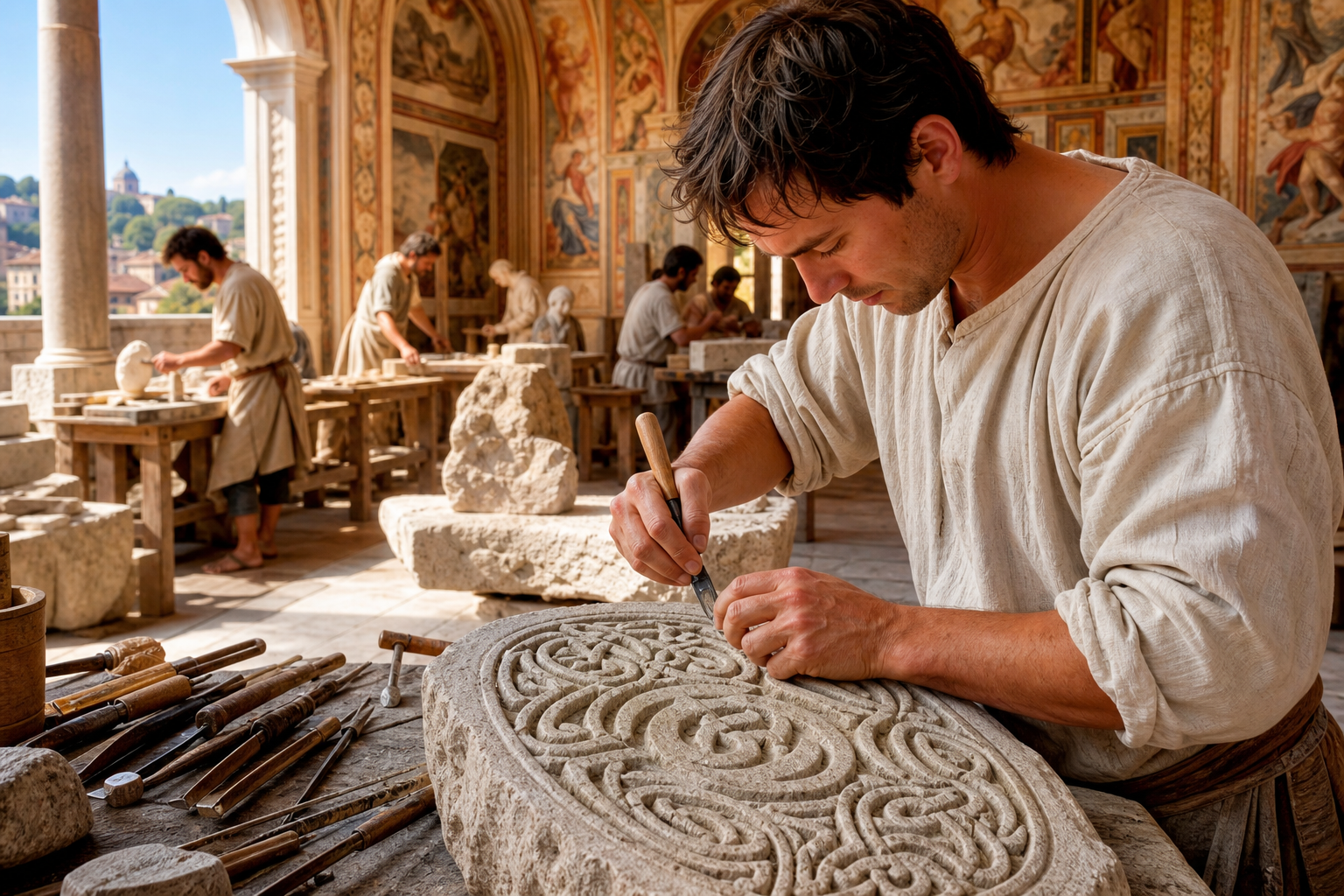
The tactile technologies that produced Celtic symbols — metallurgy, stone carving and manuscript illumination — shaped both form and meaning. Metalworkers used techniques such as repoussé, chasing, and inlay to create luminous surfaces whose motifs exploited light and shadow. In particular, gold and bronze torcs, helmets and shields served as canvases where curvilinear La Tène motifs could be rendered with high fidelity. The technical demands of metalwork likely fostered pattern repositories among workshops: templates, apprenticeships and shared visual repertoires ensured stylistic coherence across regions. Stone carving, from standing stones to ringfort slabs, demanded a different approach: tools and weathering influenced how spirals, key patterns and interlace were executed, but successful stone motifs achieved a monumental permanence that metal could not match.
The migration of motifs into manuscript illumination in the early medieval period involved translation across media. A scribe or illuminator translating knotwork into pen strokes on vellum adopted schemes originally conceived for metal or stone. The Book of Kells and Lindisfarne Gospels demonstrate how interlace and spirals could be elaborated into dense, theological compositions framing sacred text. Monastic centers acted as hubs for this visual transmission. Christian scriptoria often worked within networks that included itinerant craftsmen and regional patrons; the aesthetic vocabulary of the past was reinterpreted to suit new symbolic frameworks — for instance, endless knotwork could be read allegorically in Christian exegesis, while animal interlace served as apotropaic imagery.
The Ardagh Hoard and the Ardagh Chalice (8th–9th centuries CE) exemplify this continuity and transformation. The chalice's complex ornamentation, now associated with Insular Christian liturgy, also preserves curvilinear patterns rooted in earlier metalworking traditions. Similarly, stone high crosses of the later early medieval period incorporate both biblical scenes and geometric patterns, embedding older motifs within Christian iconography. These objects illustrate a dialogic process: ancient forms are neither erased nor frozen; they are reworked into new meanings that speak to both lineage and theology.
Did you know? Many contemporary festivals and tourist interpretations around megalithic sites blend folklore, archaeological fact, and modern invention, illustrating how material heritage becomes part of living culture.
Technological change also influenced symbol distribution. The Roman conquest and subsequent political reconfigurations shifted patronage and networks of craft. In some regions, Roman tastes suppressed indigenous styles, while in others, Roman and Celtic elements fused, producing hybrid motifs visible on coinage and rural artifacts. Later, during the so-called Dark Ages and the rise of Insular Christianity, monastic learning preserved and transformed motifs, ensuring that certain forms survived into medieval memory and beyond.
Medieval Reception, Revival, and Modern Myth
The story of Celtic symbols does not end with the medieval period; rather, it enters a series of reinterpretations in early modern and modern centuries. Antiquarian interest in the seventeenth to nineteenth centuries, fueled by nationalism and Romanticism, revived attention to ancient monuments and artifacts. Figures such as O'Conor, the Celtic Revivalists, and antiquarians across Europe read the visual repertoire through lenses that often conflated prehistoric monuments with Iron Age Celts and medieval Gaelic culture. The cultural politics of the nineteenth century — particularly in Ireland and Scotland — embraced certain symbols as emblems of national identity. The triple spiral, spirals from passage tombs, and stylized knots were selectively elevated as markers of Celtic continuity and distinctiveness.
This revivalist enthusiasm was not without distortion. Nineteenth-century forgers and imaginative antiquarians sometimes invented "ancient" inscriptions or ascribed uniform meanings to motifs that in fact varied regionally and temporally. The self-styled druidic revival, which borrowed names and constructs from medieval and antiquarian sources, introduced modern inventions like widely used neo-Druid symbols (for example, the standardized Awen motif popularized by Iolo Morganwg in the late eighteenth and early nineteenth centuries). Iolo’s forgeries and creative reconstructions complicated attempts to trace authentic ancient meanings, even as they contributed to a renewed cultural interest that preserved many artifacts and generated scholarship.
The twentieth and twenty-first centuries have seen both scholarly refinement and popular appropriation. Archaeologists employ stratigraphic excavation, radiocarbon dating and metallurgical analysis to anchor symbols in time and place with far greater precision than earlier antiquarians could. Meanwhile, designers, neo-pagans, and national movements continue to adopt Celtic motifs for jewelry, tattoos, and branding, often without attention to archaeological nuance. This modern diffusion reflects the powerful visual appeal of these motifs but also raises ethical questions about cultural commodification and anachronistic claims. Yet scholarly work has also benefited from public interest: museum exhibitions and interdisciplinary studies have generated accessible syntheses that reconnect artifacts to their social worlds.
An important corrective in modern scholarship has been to emphasize plurality: ‘Celtic’ does not mean a single, unified visual language, but rather a set of overlapping styles and practices across regions and centuries. The La Tène tradition is not identical to Insular knotwork; the triple spiral of passage tombs is not equivalent to the triskelion of later Iron Age art. By tracing continuities and interruptions, scholars can better understand how symbols functioned historically — as material signs of identity, as ritual tools, and as aesthetic practices embedded in technological systems.
Legacy and Contemporary Resonance
The living afterlife of Celtic symbols is visible in everything from global fashion to the identities of local communities near archaeological sites. Museums in Dublin, Edinburgh and London display La Tène metalwork and Insular manuscripts, shaping public perceptions of what Celtic art looks like. Festivals, literature, and film recycle motifs such as spirals and knots to evoke mystery, antiquity, and continuity. Tattoo artists and graphic designers reinterpret these patterns for contemporary tastes, often emphasizing the aesthetic dynamism that originally made such motifs striking: flowing lines, rhythmic repetition, and the illusion of perpetual motion.
This contemporary resonance has two edges. On one hand, popular use keeps the visual lexicon alive, encouraging amateur interest and sometimes funding archaeological work; public enthusiasm has led to conservation projects and new displays that make artifacts accessible to broader audiences. On the other hand, detached from archaeological context, motifs can become depoliticized or rebranded in ways that erase local histories and specificities. For example, the image of a generic "Celtic knot" on mass-market jewelry seldom conveys the knot's lineage to Insular monastic scriptoria or to metalworking practices of early medieval artisans.
Scholars and curators therefore advocate for interpretive storytelling that restores context and complexity. Exhibitions that present the Broighter Hoard alongside explanatory panels about votive deposition, or that pair Book of Kells folios with La Tène metalwork, help visitors understand continuity and change. Educational initiatives that explain technique — how repoussé or stone carving was done — give materiality to symbolic interpretation. In communities near megalithic sites such as Newgrange, local narratives about the triple spiral are often layered: archaeological findings, local folklore, religious significance and tourism economies all intersect, producing living traditions that are both historical and novel.
Finally, the study of Celtic symbols models how historians and archaeologists negotiate fragmentary evidence. By integrating material analysis, comparative iconography, ancient literary sources and medieval continuities, researchers build arguments that are provisional yet grounded. Symbols endure not because they have a single, immutable meaning, but because their forms proved adaptable: they could be inscribed on torcs and chalices, carved on stones, drawn in manuscripts, and reproduced on posters. Such plasticity allowed motifs to travel between ritual and display, between pagan and Christian settings, and between the archaeologist's trench and the designer's studio.

Conclusion: Reading Curves Across Time
To read Celtic symbols responsibly is to attend to both form and context. The spirals, triskelions, knots, and zoomorphic curves that have fascinated generations are not sealed messages from a single people but dynamic motifs that moved through workshops, rituals and texts. Archaeology anchors these motifs in place and time — La Tène stylistic horizons, ritual hoards, and Insular manuscript traditions — offering a scaffolding for interpretation. Literary sources, from classical observers to medieval mythographers, provide supplementary perspectives but must be used critically. Modern receptions, from Romantic nationalism to neo-pagan adoption, reveal as much about our times as they do about the past.
Historians and archaeologists today work with a layered record: objects that survive, texts that remember, and landscapes that retain traces of action. Each spiral incised on metal or stone is an invitation to ask who made it, for whom, and why. Sometimes the evidence points toward ritual deposition or elite display; other times it gestures toward aesthetic innovation and cross-cultural exchange. The most fruitful interpretations combine attention to technology (how a motif was made), context (where it was used and deposited) and reception (how later audiences understood it). In doing so, they honor the mystery inherent in motifs that still move the eye and the imagination.
Ultimately, Celtic symbols remind us that images are not inert. They participate in social life, binding communities to ancestors, animating sacred acts, and later serving as emblems for modern identities. Their lasting power lies in their capacity for renewal: an Iron Age spiral carved into a stone may have meant something very specific to its original maker, but its later reincarnations — in manuscripts, in nationalist iconographies, and in contemporary design — testify to forms that continue to be read, remade and loved. That continuity, with all its transformations, is the real secret of Celtic symbolics: a vocabulary of curves that has proven extraordinarily adept at speaking across centuries.

How we verify this article
By the History Unlocked editorial team
This text is built on historical facts stored in our database and drafted with AI assistance. No signed human review is recorded for this article. Report any inaccuracy: we correct it and update the modified date.
Updated on
AI-assisted drafting.
Read our editorial standardsEnjoyed this? Discover more articles in the category Art & Symbolism