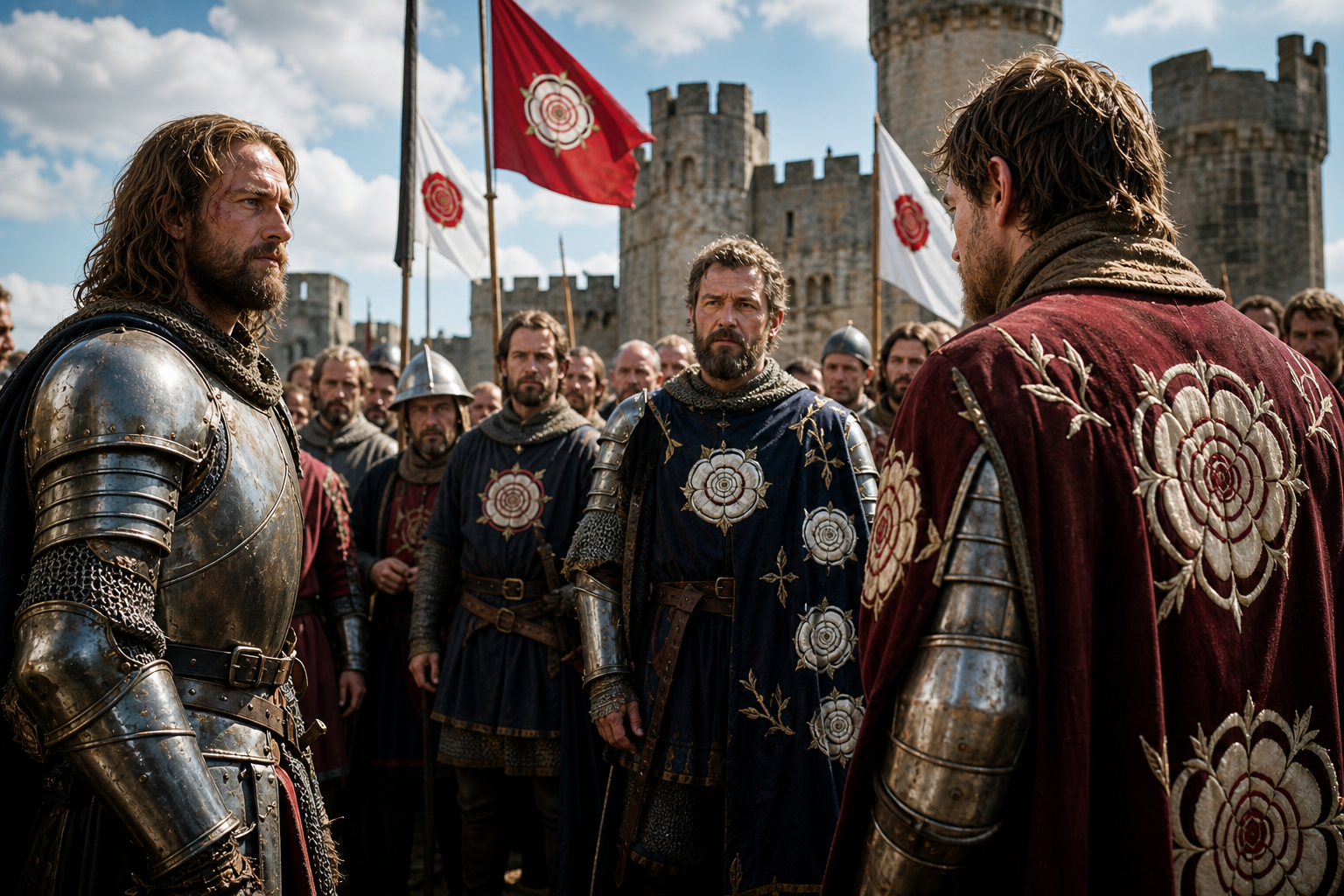
The Real Game of Thrones: Betrayal and Blood in the Wars of the Roses
The iconic emblem of the Wars of the Roses—a flower blending the red of Lancaster with the white of York—is a clever piece of Tudor propaganda, a symbol of unity forged only after the slaughter had ceased. For the thirty years the conflict raged, from 1455 to 1485, there was no hybrid rose. There was only the visceral, tribal loyalty to one of two competing houses, a dynastic struggle that tore the kingdom of England apart at its seams, pitting cousin against cousin and father against son. This was not a simple war between two clear-cut factions, but a messy, brutal, and deeply personal series of conflicts fueled by ambition, mental illness, and the fatal weaknesses of a ruling class that had grown too powerful. It was a saga of dizzying reversals of fortune, where kings became prisoners and prisoners became kings, often within the span of a single year. The roots of this bloody feud burrowed deep into the complex family tree of King Edward III, whose many sons created a web of competing claims that would only require a moment of weakness to unravel into open warfare. That moment arrived with the reign of his great-grandson, the pious but ineffectual King Henry VI of the House of Lancaster. His reign was a perfect storm of disaster: catastrophic military defeat in France, economic collapse at home, and, most critically, the king’s own fragile mental state, which would eventually plunge him and his kingdom into a chasm of madness from which only blood could emerge. Into this power vacuum stepped Richard, Duke of York, a man with a claim to the throne arguably stronger than the king’s own. The Wars of the Roses were not just a war for a crown; they were a war for the very soul of England, a violent pruning of the medieval aristocracy that would ultimately pave the way for a new dynasty and a new era. But before the Tudor rose could bloom, the soil of England would first be drenched in the blood of its own princes.
The Seeds of Conflict: A Mad King and an Ambitious Duke The cataclysm that would become the Wars of the Roses was not born from a single event, but from a slow-burning fuse of dynastic entitlement, political incompetence, and personal animosity, all centered around the disastrous reign of King Henry VI. Crowned as an infant, Henry grew into a man more suited to a monastery than a throne. He was gentle, deeply religious, and utterly uninterested in the brutal statecraft and martial prowess expected of a medieval monarch. His catastrophic failure was most keenly felt in France. Where his father, the warrior-king Henry V, had conquered, Henry VI lost. By 1453, the Hundred Years' War was over, and all of England's vast continental possessions, save for Calais, had been lost. This national humiliation was not just a blow to English pride; it created a crisis. A generation of nobles and their retainers, raised for war and enriched by plunder, returned home discontented, unemployed, and ready to attach themselves to any powerful lord who could promise them renewed status and wealth. At the heart of the royal court was a gaping void of leadership. Henry VI was easily manipulated, and his court was dominated by grasping favorites, most notably the Duke of Somerset, Edmund Beaufort. This faction excluded and alienated other powerful magnates, none more so than Richard, Duke of York.
Richard was, in many ways, everything Henry was not. He was a competent administrator, a proven military leader, and possessed a claim to the throne that was, by the complex laws of primogeniture, arguably superior to Henry’s. While Henry was descended from Edward III's fourth son, John of Gaunt, Duke of Lancaster, Richard was descended from both the third son (Lionel, Duke of Clarence) and the fifth son (Edmund, Duke of York). This potent lineage made him a natural alternative to the failing Lancastrian king. For years, York was the foremost critic of the court’s corruption and the disastrous war policy. His rivalry with Somerset was both political and deeply personal, a constant struggle for influence over the pliable king. The breaking point came in 1453. Already reeling from the final loss of Gascony, King Henry VI received the news and collapsed into a complete catatonic stupor. He was utterly unresponsive, unable to speak, move, or recognize anyone, including his own newborn son, Edward of Westminster. With the king effectively a living corpse, a regent was needed. After a protracted power struggle, Parliament appointed Richard of York as Lord Protector of the Realm. York governed effectively, imprisoning his rival Somerset in the Tower of London and attempting to reform the government’s finances. But his authority was temporary. On Christmas Day 1454, the king suddenly recovered his senses as inexplicably as he had lost them. His first thought was for his son, and his second was for his favorite, Somerset, who was promptly released and restored to power under the influence of Henry’s formidable wife, Queen Margaret of Anjou. For York, this was the ultimate threat. Excluded from court and fearing an accusation of treason, he was cornered. He responded by gathering his retainers and marching, not against the king, but against his "evil councilors." The fuse had reached the powder keg.
The First Blood and the Rise of the Kingmaker The point of no return arrived on May 22, 1455. Richard of York and his allies, including the powerful and wealthy Neville family—led by the Earl of Salisbury and his even more formidable son, Richard Neville, Earl of Warwick—intercepted the king’s party at the town of St Albans. Their stated goal was to arrest and punish the Duke of Somerset. Negotiations failed, and the Yorkists stormed the town. The First Battle of St Albans was less a battle and more a brutal street fight, a targeted assassination of York’s key rivals. Somerset, the primary target, was cornered and hacked to death. The king himself was wounded by an arrow in the neck and found cowering in a local tanner’s shop. York and the Nevilles approached him, knelt, and reaffirmed their loyalty, blaming the violence on the dead men. They had destroyed their enemies while maintaining the fiction of loyalty to the Crown. York was reappointed Lord Protector, but the charade could not last. The blood spilled at St Albans created a vendetta. The sons of the men killed that day, including the new Duke of Somerset, were now sworn enemies of York and Warwick, biding their time and waiting for the queen to lead their cause.
Queen Margaret of Anjou became the unyielding heart of the Lancastrian faction. While her husband drifted in and out of sanity, she fought ferociously to protect the inheritance of her son, Prince Edward. She saw York’s ambition for what it was—a direct threat to her child’s birthright. The next few years were marked by an escalating cold war. An attempt at formal reconciliation in 1458, known as the "Loveday," saw the rival factions walk arm-in-arm to St Paul’s Cathedral, a public performance of unity that fooled no one. The real power broker in these years was the Earl of Warwick. Immensely rich through both inheritance and a strategic marriage, he was the wealthiest man in England after the king himself. His charisma, military reputation, and vast network of retainers made him the true powerhouse of the Yorkist cause, earning him the later moniker "The Kingmaker." He was a master of propaganda, using his position as Captain of Calais to build a power base outside the queen’s control. The conflict reignited in 1459. When the queen summoned York and Warwick to a council they knew to be a trap, they once again raised their armies. After a series of skirmishes, the Yorkist leaders were routed at the Battle of Ludford Bridge, forced to flee England—York to Ireland, and his son Edward, Earl of March, with Warwick to Calais. The queen had triumphed, and a vengeful Lancastrian parliament disinherited them all. But Warwick’s control of Calais gave him a critical advantage: a professional army and the English navy. In 1460, he launched a stunning counter-invasion, landing in Kent and capturing London. He then marched north, defeating and capturing King Henry VI at the Battle of Northampton. Richard of York returned from Ireland in triumph. He marched into Parliament, placed his hand on the empty throne, and made his play for the crown itself. The move shocked even his own supporters. A compromise was hastily brokered: the Act of Accord, which decreed that Henry VI would remain king for life, but that Richard of York and his heirs would succeed him, disinheriting Queen Margaret’s son. For the queen, this was an abomination. In the north, she raised a massive army, not to save her husband, but to destroy the man who would steal her son’s crown.
Did you know? King Henry VI's mental illness was likely inherited from his maternal grandfather, King Charles VI of France, who suffered from recurring bouts of madness where he believed he was made of glass.

The Bloody Turning Point: Towton and the Yorkist Triumph Margaret of Anjou’s response to the Act of Accord was swift and brutal. She refused to accept the disinheritance of her son and her army, a force driven by fierce loyalty to the House of Lancaster, met Richard of York’s smaller force outside his castle at Sandal, near Wakefield. On December 30, 1460, York, for reasons still debated by historians, was lured out of his stronghold and into a devastating trap. The Battle of Wakefield was a catastrophe for the House of York. The Duke himself was slain in the fighting. His seventeen-year-old son, Edmund, Earl of Rutland, was captured and murdered. The Lancastrians, in a calculated act of mockery, placed a paper crown on York’s severed head and displayed it, along with those of his son and the Earl of Salisbury (captured and executed a day later), a gruesome warning to all rebels. The Yorkist cause seemed broken, its leaders dead. But in killing Richard of York, the Lancastrians had unleashed his son: Edward, Earl of March. At just eighteen, Edward was everything his father was not. He was tall, handsome, charismatic, and a military prodigy. He inherited his father’s claim, but added a burning desire for vengeance.
While Margaret’s army marched south, plundering as it went, Edward was in the west, where he won a crushing victory against a Lancastrian force at Mortimer’s Cross. On the morning of the battle, his troops were supposedly heartened by the meteorological phenomenon of a parhelion, the appearance of three suns in the sky, which Edward interpreted as a sign of the Holy Trinity and a promise of victory. He would later adopt the "Sun in Splendour" as his personal badge. Meanwhile, Warwick, marching to block Queen Margaret’s advance on London, was outmaneuvered and defeated at the Second Battle of St Albans. The Lancastrians recaptured the meek Henry VI, who was supposedly found sitting under a tree, smiling serenely amidst the carnage. Yet, Margaret hesitated. The city of London, fearful of her northern army’s reputation for pillaging, barred its gates to her. This delay allowed Edward of March and Warwick to join forces and enter the capital to a hero’s welcome. In a brilliant political move, Edward was hastily proclaimed King Edward IV. England now had two kings, and only a decisive, final battle could settle the matter.
That battle took place on Palm Sunday, March 29, 1461, in the middle of a blinding snowstorm near the village of Towton in Yorkshire. The Battle of Towton was, and remains, the largest and bloodiest battle ever fought on English soil. An estimated 75,000 men, a staggering percentage of the country’s entire male population, fought for ten hours in horrific conditions. The fighting was a brutal, hand-to-hand slog in the snow and mud. A key moment came when the Yorkist archers, with the wind at their backs, were able to shoot further than their Lancastrian counterparts. They loosed a volley and then stepped back, tricking the Lancastrians into wasting most of their arrows, which fell short. The Yorkists then advanced, picking up the enemy’s arrows and firing them back. The battle descended into a desperate melee, until the late arrival of Yorkist reinforcements under the Duke of Norfolk shattered the Lancastrian flank. The Lancastrian line collapsed, and the retreat became a slaughter. Thousands fled towards the River Cock, which was swollen by the storm. A bridge collapsed under the weight of men and armor, and the river was said to have been choked with bodies, with men crossing over the corpses of their comrades. The killing continued for miles. No quarter was given. An estimated 28,000 men died at Towton and in the rout that followed, a truly apocalyptic figure. The Lancastrian cause was utterly annihilated, its leadership dead or in exile. Margaret, her son, and the broken Henry VI fled to Scotland. Edward IV, having waded through a river of blood, was now the undisputed King of England.

The Reign of Edward IV and the Kingmaker
How we verify this article
By the History Unlocked editorial team
This text is built on historical facts stored in our database and drafted with AI assistance. No signed human review is recorded for this article. Report any inaccuracy: we correct it and update the modified date.
Updated on
AI-assisted drafting.
Read our editorial standardsEnjoyed this? Discover more articles in the category Middle Ages