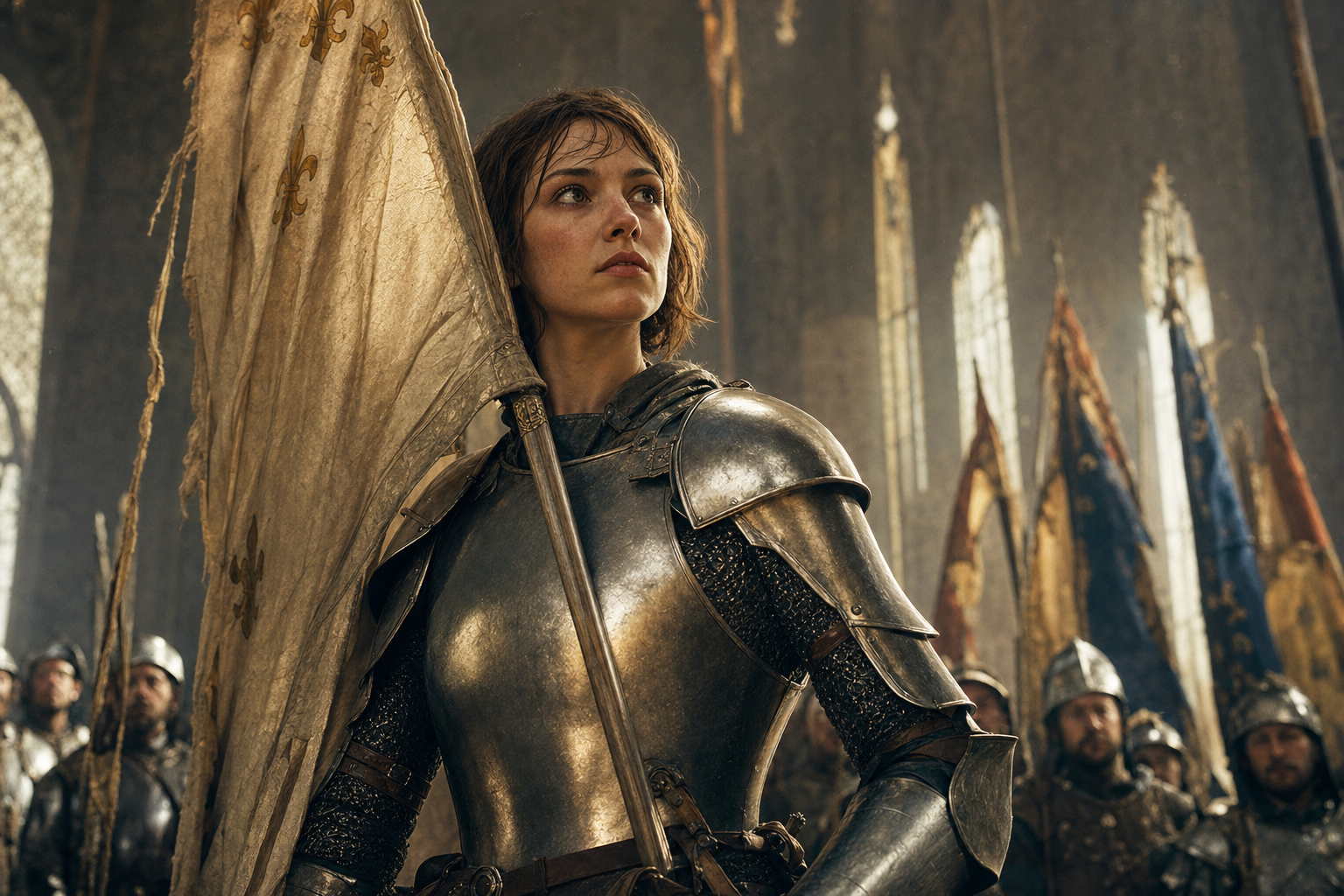
Joan of Arc: The Maid Who Forged a Nation from Fire and Faith
In the grand, often brutal, tapestry of the 15th century, where kings and nobles played a bloody game of thrones across the fields of Europe, few stories are as improbable, as miraculous, or as ultimately tragic as that of a young peasant girl from the obscure village of Domrémy. Her name was Jeanne d'Arc, known to the English-speaking world as Joan of Arc. She enters the historical record not with a noble title or a vast inheritance, but with a claim so audacious it bordered on madness: that she was a messenger of God, sent to save a nation on its knees. At a time when women were property, when peasants were fodder for aristocratic wars, and when the notion of a unified France was little more than a fading dream, Joan emerged as a paradox. She was an illiterate teenager who would counsel a king, a pious virgin who would don the armor of a knight, and a visionary who would command armies with a strategic acumen that baffled seasoned generals. Her story is a whirlwind, a meteoric rise from pastoral obscurity to the very pinnacle of military and political influence, followed by a fall just as swift and brutal. To understand Joan, one must first understand the world that forged her—a world of profound faith and profound violence, where the divine and the diabolical were seen as active forces in everyday life. France in the early 1420s was not a kingdom but a fractured battleground, a prize being torn apart by the English and their powerful Burgundian allies in the seemingly endless conflict we now call the Hundred Years' War. The legitimate heir to the throne, the Dauphin Charles, was a disinherited, fearful figure, ruling a rump state south of the Loire River, his legitimacy questioned and his armies demoralized. The great city of Orléans, a strategic linchpin and a symbol of French resistance, was under siege and on the verge of collapse. Its fall would have signaled the end. Into this vortex of despair stepped Joan, armed with nothing but her unwavering faith and the celestial voices she claimed guided her every move. This is not simply a tale of battles and politics; it is the story of how a single individual’s conviction can reshape the destiny of a nation, and the terrible price that is often paid for such a legacy.
A Land in Despair: France During the Hundred Years' War
The early 15th century was one of the darkest periods in French history. The Hundred Years' War, a dynastic struggle initiated in 1337 over English claims to the French throne, had devolved into a multi-generational nightmare. By the 1420s, the conflict had left vast swathes of the French countryside ravaged by decades of warfare, plague, and brutal raids from "écorcheurs," bands of mercenary soldiers who pillaged the land when not formally employed. The kingdom was politically and geographically fractured. The 1420 Treaty of Troyes, a document born of French defeat and internal division, stands as a testament to the nation's desperation. Signed after the crushing French loss at the Battle of Agincourt, the treaty disinherited the Dauphin Charles (the future Charles VII) and named King Henry V of England and his heirs as the rightful successors to the French throne. This created a bizarre and untenable dual monarchy, with the infant English king Henry VI acclaimed as "King of France and England." France was split into three warring factions: the English-controlled territories in the north and west, including Paris itself; the lands of the powerful Duke of Burgundy, Philip the Good, who was formally allied with the English; and the beleaguered territories still loyal to the Dauphin, mockingly called the "King of Bourges," centered south of the Loire River. This internal division was perhaps more venomous than the English invasion itself, stemming from the assassination of John the Fearless, Duke of Burgundy, by the Dauphin's partisans in 1419. This act drove his son, Philip the Good, into a firm alliance with England, bringing the vast wealth and military might of Burgundy to bear against the Dauphin's cause, known as the Armagnac faction. For the common people, life was a precarious and brutal affair. They bore the brunt of the endless conflict, suffering under oppressive taxes levied by all sides, the constant threat of roving armies, and the destruction of their farms and livelihoods. The morale of the Armagnac forces was at rock bottom. Decades of defeats had cultivated a deep-seated inferiority complex; the English soldiers, particularly their longbowmen, seemed invincible. It was in this climate of political chaos and existential dread that the Siege of Orléans began in October 1428. Orléans was not just another city; it was the strategic key to the entire war. Located on the Loire River, it was the northernmost stronghold remaining loyal to the Dauphin. If it fell, the English would have a clear path to invade the south and extinguish the last embers of Armagnac resistance. The English, under the command of the Earl of Salisbury, constructed a series of fortifications, or "bastilles," to encircle the city and starve it into submission. The situation seemed utterly hopeless. The French defenders were outnumbered, outgunned, and, most importantly, out of hope. It was into this bleak and desperate theater that Joan of Arc would make her entrance, not just as a soldier, but as a symbol of divine intervention, a living prophecy of deliverance for a kingdom that had forgotten how to believe in itself.

The Voices of God: Joan's Divine Mission In the small, pastoral village of Domrémy, nestled in the Meuse valley on the borderlands of France and the Holy Roman Empire, Joan of Arc lived an unremarkable childhood. Born around 1412 to Jacques d'Arc and Isabelle Romée, she was a pious and kind-hearted girl, known for her devotion to prayer and her compassion for the poor. She never learned to read or write, a common reality for a peasant girl of her time, but her mother instilled in her a deep knowledge of Catholic prayers and the stories of the saints. Her world was one of church bells, seasonal farm work, and the ever-present shadow of the war. Though her village was in a region that remained loyal to the Dauphin, it was surrounded by Burgundian territory, and she witnessed firsthand the fear and destruction of the conflict, having to flee with her family during at least one raid. The extraordinary chapter of her life began around the age of thirteen. While standing in her father's garden, she was suddenly enveloped by a brilliant light and heard a voice. She would later identify this primary voice as belonging to Saint Michael the Archangel, the celestial warrior and protector of France. Soon, he was joined by two female saints: Saint Catherine of Alexandria, the patron saint of virgins and scholars, and Saint Margaret of Antioch, a martyr who had famously escaped from a dragon. These were not fleeting whispers; they were a consistent, guiding presence in her life for years. Initially, their messages were simple: be a good and pious girl, and attend church often. But as Joan grew into her late teens, and as the military situation in France grew more dire, the voices became more specific, more urgent, and more astounding. They commanded her to undertake a two-fold mission of impossible proportions: first, she was to travel to the nearby fortress of Vaucouleurs, secure an escort, and go to the Dauphin Charles; second, she was to lift the English siege of Orléans; and third, she was to lead the Dauphin to the city of Reims to be crowned and anointed as the rightful king of France. For a teenage peasant girl to even conceive of such a plan was unthinkable. She resisted for a time, protesting to her voices that she was just a poor girl who knew nothing of riding or fighting. But their commands were relentless. In 1428, at the age of sixteen, she finally acted. She journeyed to Vaucouleurs and sought an audience with the local commander, Robert de Baudricourt. Predictably, he dismissed her with ridicule, telling her cousin to take her home and have her father give her a whipping. But Joan was unyielding. She returned again months later, her conviction unshaken. This time, she began to win over the local townspeople with her earnest piety and determination. Her breakthrough came when she made a stunningly accurate "prediction" of a French defeat near Orléans, which was later confirmed as the "Battle of the Herrings." Shaken and impressed, Baudricourt finally relented. He granted her an escort of six men-at-arms to make the perilous 11-day journey across 300 miles of enemy-held territory to the Dauphin's court at Chinon. To protect herself on the journey, she cut her hair short and dressed in men's clothing, a practical decision that would later form a central, and fatal, charge against her.
From Peasant Girl to Commander: The Siege of Orléans Joan's arrival at the Dauphin's court in the royal castle of Chinon in February 1429 is an event steeped in legend. The Dauphin Charles, a cautious and deeply insecure man, was skeptical. To test this supposed holy messenger, he allegedly disguised himself amongst his courtiers. Yet, Joan, who had never seen him before, walked through the crowded hall and immediately identified him, bowing before him and declaring her divine mission to save France. This feat, whether a miracle or a piece of clever stagecraft by the Armagnac court, was the first of many moments that bolstered her credibility. Before entrusting an army to a teenage girl, however, Charles needed to be certain she was not a heretic or a sorceress. He sent her to the city of Poitiers to be examined by a panel of a dozen eminent theologians and doctors of law. For three weeks, they interrogated her, questioning her about her voices, her faith, and her intentions. Joan, despite being uneducated, answered their complex theological questions with a simple, disarming wit and unwavering conviction. When one examiner asked for a sign to prove her mission was from God, she famously retorted, "I have not come to Poitiers to give signs. But take me to Orléans, and I will show you the sign for which I have been sent." Convinced of her sincerity and orthodoxy, the examiners gave their approval. Joan was equipped for war. A suit of custom-made white armor was fashioned for her, and she was given a magnificent banner that she would carry into battle. Her arrival at the besieged city of Orléans on April 29, 1429, was like a lightning bolt. The city’s defenders and citizens, pushed to the brink of surrender, saw her as a living saint, a sign that God had not abandoned them. Their morale soared. Joan’s military style was a radical departure from the cautious, defensive strategy of the French commanders, like the "Bastard of Orléans," Jean de Dunois. While they favored protracted sieges and skirmishes, Joan advocated for direct, aggressive assaults. She was not a commander in the modern sense of drawing up complex plans, but an inspirational leader who led from the front, banner in hand. She first sent defiant messages to the English commanders, demanding they leave France or face the wrath of God. They responded with insults, calling her a "cow-girl" and a witch. She then turned her attention to the English "tourelles," the stone-and-earth forts that choked the city. Over the next week, she led and inspired a series of stunning attacks. On May 4th, the fortress of Saint-Loup was taken. Then came the assault on the Augustins fortress. The decisive moment came on May 7th, during the attack on the main English stronghold, Les Tourelles, which guarded the city's vital bridge. During the intense fighting, Joan was wounded, struck by an crossbow bolt that entered her shoulder. She was carried from the field, and for a moment, French morale wavered. But she pulled the arrow out herself, had the wound dressed, and, after a period of prayer, returned to the fray. Her reappearance galvanized the French soldiers, who launched a final, furious assault and overwhelmed the fortress. The English were stunned. On May 8th, just nine days after her arrival, the English army abandoned their other positions and lifted the siege. Joan of Arc, the peasant girl from Domrémy, had accomplished the impossible.

The Road to Reims: The Coronation of a King With Orléans liberated, Joan of Arc was hailed as a heroine throughout loyalist France. The victory was a massive psychological blow to the English, shattering their aura of invincibility. For Joan, however, lifting the siege was only the first part of her divine mission. Her voices were adamant about the second, and arguably more important, objective: the coronation of Charles VII at Reims Cathedral. This was a move of pure political genius, rooted in centuries of tradition. Since the baptism of King Clovis in 496, Reims had been the sacred site where French monarchs were crowned and anointed with holy oil said to have been brought from heaven by a dove. A coronation at Reims would not just make Charles a king in name, but would legitimize him in the eyes of his people and of God, elevating him far above the English pretender, Henry VI. It would erase the stain of the Treaty of Troyes and affirm that he, not the English king, was God’s chosen ruler for France. The path to Reims, however, was a dangerous one, running deep into territory controlled by the English and their Burgundian allies. The French commanders, still cautious despite the victory at Orléans, were hesitant. Joan, propelled by her divine mandate, insisted. To clear the way, she embarked on what became known as the Loire Campaign. In a series of swift and stunning victories in June 1429, Joan and the royal army, under the command of the Duke of Alençon, recaptured key bridges and towns along the Loire River. They took the heavily fortified town of Jargeau, where Joan survived a stone cannonball striking her helmet. They moved on to Meung-sur-Loire and Beaugency, forcing their English garrisons to surrender. The campaign culminated on June 18th at the Battle of Patay. Here, the French vanguard executed a brilliant surprise attack, catching the elite English army and their feared longbowmen unprepared in an open field. The result was a massacre. The English army was shattered, its leadership killed or captured. Patay was the reverse of Agincourt, a complete and total French victory that broke the back of English military power in the region. With the English army in disarray, the road to Reims was open. The royal army began its march on June 29th. The journey itself was a testament to Joan’s now-legendary status. The Burgundian-held city of Auxerre negotiated a peaceful withdrawal. The more defiant city of Troyes, where the treaty disinheriting Charles had been signed, initially refused entry. After a brief siege where Joan prepared for an assault, the terrified city fathers capitulated and opened their gates. On July 16, the army reached Reims, which also opened its gates without a fight. The very next day, July 17, 1429, Charles VII was formally crowned King of France in Reims Cathedral. Joan of Arc stood proudly near the altar, her battle banner in hand. She had fulfilled the most crucial part of her mission. The disinherited "King of Bourges" was no more; in his place stood the anointed King Charles VII, and it was a simple girl from Domrémy who had led him there.

Capture, Trial, and Martyrdom Following the coronation at Reims, the tide of the war had decisively turned. Joan was at the apex of her influence and fame, ennobled by the king along with her family. For her, the mission was simple: the voices commanded her to drive the English completely out of France, and the next logical target was Paris itself. However, the newly crowned King Charles VII and his influential counselors, particularly Georges de la Trémoïlle, favored a different strategy. Flush with the legitimacy of his anointing, Charles was more inclined towards diplomacy, seeking to negotiate a truce with the Duke of Burgundy and peel him away from his English alliance. This hesitation and political maneuvering frustrated Joan, who believed in swift, decisive military action. In September 1429, a half-hearted assault on Paris was finally permitted. During the attack on the Porte Saint-Honoré, Joan was again wounded, this time by a crossbow bolt to the thigh. She refused to retreat, urging the soldiers on until she was carried away from the battle line against her will. The assault failed, and Charles ordered a retreat, squandering the momentum Joan had built. The following spring, after a winter of frustrating inactivity, Joan grew restless. Hearing that the Burgundians were besieging the loyalist town of Compiègne, she rode off with a small company of volunteers to help defend it. On May 23, 1430, during a sortie to attack a Burgundian camp, she was cut off when the town
How we verify this article
By the History Unlocked editorial team
This text is built on historical facts stored in our database and drafted with AI assistance. No signed human review is recorded for this article. Report any inaccuracy: we correct it and update the modified date.
Updated on
AI-assisted drafting.
Read our editorial standardsEnjoyed this? Discover more articles in the category Middle Ages