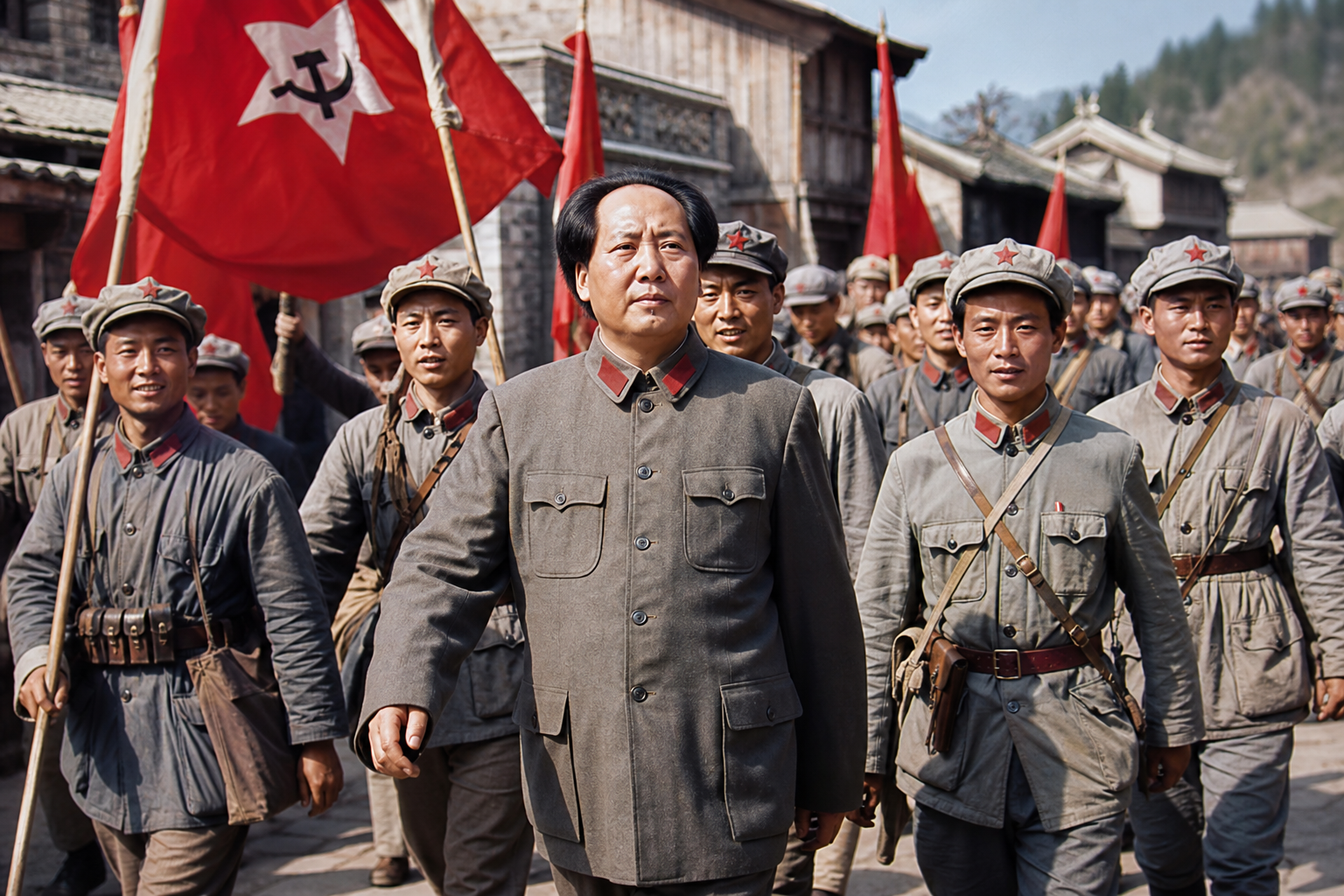
Mao and the Long March: Myth, Survival, and Revolution
Intro
The Long March sits at the crossroad where myth and history meet, where human endurance carved a political destiny out of hardship and chance. For the Chinese Communist Party (CCP), the retreat from Jiangxi in 1934–35 is less a mere military withdrawal than a foundational pilgrimage: a trial by fire that would refine leadership, doctrine, and identity. For Mao Zedong, who had been only one of several contenders for authority within the Party and the Red Army, the Long March would become the crucible that forged his preeminence. Yet the road was neither straight nor inevitable. It was a sequence of desperate decisions, contested strategies, geographically brutal passages, and moments of improvisation that read like a thriller: ambushes on mountain paths, river crossings under fire, negotiations with wary ethnic minorities, and political intrigues played out in cramped tents and smoke-filled teahouses.
This article follows the march not as a propagandistic march of inevitability, but as a human story populated by generals, peasants, couriers, and women fighters who navigated landscapes at once hostile and beautiful. We will track the forces that forced the retreat—the encirclement campaigns launched by Chiang Kai-shek's Nationalist government—and the leadership struggles inside the CCP that led, at Zunyi, to a dramatic reorientation of command toward Mao's strategic judgment. We will detail the decisive episodes on the road: the harrowing crossing of the Dadu River at Luding Bridge, the crossing of snowbound mountain passes and high grasslands, and the thousands of small encounters and decisions that are easily lost in the popular narrative.
Did you know? The breakout officially began on October 16, 1934, a date commemorated in Communist historiography as the start of the Long March.
The Long March is also a mirror of the international context of the time. The Comintern's influence, Soviet advisors such as Otto Braun (Li De), and the tense truce of the Nationalists with foreign powers all shaped the field of options available to Communist commanders. The result was a migration of ideas as well as people—a movement that reoriented the CCP from urban insurrections toward rural-based guerrilla strategy, an orientation that would define the Party's approach for decades.
But beyond the strategy and politics there is memory: how the Party crafted the Long March into a sustaining myth, how individuals remembered it differently, and how historians have, for the last half-century, peeled back layers of storytelling to find both truth and invention. The march concluded in Yan'an, a place of cave dwellings and ideological rehearsal where a battered but resolute core of the Red Army prepared to rebuild. The story of how they arrived, and what that arrival meant, is the subject of the chapters that follow.
The Beginning: Retreat from Jiangxi and the Decision to March
The decision to abandon the Jiangxi Soviet was a product of unrelenting pressure from Chiang Kai-shek’s Nationalist Government. From 1930 onward, the Nationalists had launched successive encirclement campaigns designed to annihilate Communist base areas. By 1934 they had adopted German-trained tactics—static blockhouses, fortified nodes, and slowly tightening lines of control—that exhausted the mobility of Communist forces defending fixed positions. The Jiangxi Soviet, a sprawling territory where the CCP had experimented with land reform and civil administration, became increasingly untenable as Nationalist forces applied a war of attrition. The First, Second, and subsequent encirclement campaigns had already inflicted costly losses. In late 1934, the futility of holding the soviet became apparent to many in the Communist leadership.
Did you know? The Zunyi Conference occurred in January 1935 and is often marked as the point at which Mao gained decisive political influence within the CCP.
On October 16, 1934, under pressure and surrounded on multiple fronts, the Red Army began its breakout. Estimates vary, but contemporary records suggest that somewhere in the tens of thousands—often cited as around 86,000 men and women in the First Red Army—set out from the Jiangxi region. The plan was not a single, well-coordinated march to a prearranged destination; rather it was an improvised set of maneuvers and linkups designed to escape encirclement and preserve a core force for future operations. This improvisational character would define many of the Long March’s episodes. Marching in columns, the Red Army threaded through river valleys, mountain passes, and hostile countryside.
The combination of military pressure and internal politics made the march as much a test of political coherence as of military endurance. Leadership at that time was not monopolized by Mao; figures such as Bo Gu, Zhou Enlai, and Comintern advisor Otto Braun shared or contested authority. The Party’s failure to adapt initially to the blockhouse-and-attrition tactics of the Nationalists had roots in a doctrinal optimism about urban uprisings and conventional tactics that the Comintern and certain CCP leaders favored. The move away from fixed soviets to a mobile strategic retreat marked a turning point in the Party's operational thinking. It revealed the limitations of externally-driven orthodoxy and the need for more flexible, localized leadership responsive to Chinese conditions.
The breakout was chaotic. Supply lines collapsed, cavalry and artillery were often abandoned, and small units became isolated. Disease, malnutrition, and desertions thinned the ranks as the column encountered not just enemy forces but inhospitable terrain and indifferent or hostile villagers. Yet within this chaos lay the seeds of the Party’s later narrative: the capacity to endure, to adapt, and ultimately to reforge a cadre of resilient leaders and fighters.
Did you know? The Long March is commonly described by Communist sources as covering roughly 25,000 li (around 12,500 kilometers), a figure that has become symbolic of its epic nature.

The Zunyi Conference: Politics, Power, and Mao's Ascendancy
The Zunyi Conference (January 1935) stands as the political pivot of the Long March and often of subsequent CCP history. Held in the precarious town of Zunyi in Guizhou province, the conference was ostensibly a military meeting called to review the disasters that had befallen Red Army columns. In reality it became a harsh reckoning with leadership failures and doctrinal disputes. The conference occurred in a context of catastrophic losses. Courtesy of a combination of faulty strategy—particularly the insistence on large-scale, conventional set-piece engagements—and the rigid application of Comintern guidance, the Red Army had repeatedly been put at disadvantage.
At Zunyi, Mao Zedong, who had been marginalized by more orthodox military thinkers within the party, delivered a critique of operational strategy and called for flexible, guerrilla-based tactics adapted to Chinese rural conditions. Mao’s opponents at the time included Bo Gu, a de facto leader among the CCP’s central committee, and Otto Braun, the Comintern advisor whose strategies had favored direct engagements. What made Zunyi decisive was not only Mao’s critique but the broader realization by several influential commanders that the Comintern-oriented strategies were bankrupt under Chinese conditions. Gradually, the balance of authority shifted. While Zunyi did not create Mao’s unchallenged supremacy overnight, it allowed him to accumulate military and political influence that would grow over the subsequent years.
Zunyi also displayed the complex relationship between Chinese Communists and international Communist institutions. The Comintern’s role—through men like Otto Braun—had been to guide revolutionary movements according to a global strategy, often privileging orthodox Marxist-Leninist prescriptions for urban insurrection. But China’s geography, social fabric, and sheer scale required adaptations that the Comintern failed to appreciate fully. The conference thus symbolized a partial emancipation of the Chinese Communist movement from external tutelage and a turn toward indigenous solutions, led increasingly by Mao.
Did you know? Many of the Red Army commanders who survived the Long March—like Zhu De and Peng Dehuai—later became leading marshals of the People’s Republic of China.
The human drama at Zunyi is essential. It was not merely a technocratic debate; it was a contest of reputations and political survival. For Mao, the conference was the moment he began to be seen not only as a competent military mind but as the ideological soul of a party that needed a new kind of strategic imagination. For those who would later oppose him, each concession at Zunyi was a step that widened the gulf between Beijing-bound providence and the realities of rural-based revolution.
Trials on the Road: Geography, Weather, and the Human Cost
Geography tested the Red Army in ways that transcend simple military calculus. The Long March was not a single straight route; it was a series of treks across some of China's most forbidding landscapes: river gorges, snowbound mountain passes, and the high grasslands of what we would now call western Sichuan and eastern Tibet. Among the iconic episodes often recounted is the crossing of the Dadu River at Luding Bridge in May 1935. The dramatic account—hand-to-hand combat over a narrow, chain-suspended bridge while cables were cut and beams slick with blood—became a staple of Communist hagiography. Historians debate particulars of the Luding Bridge incident, and some eyewitness accounts vary, but its symbolic power as a test of sacrifice and daring is undeniable.
Less cinematic, but equally deadly, were the long stretches across snow and alpine terrain. The column had to cross passes that rose above 4,000 meters under winter conditions; frostbite, pneumonia, and avalanches took thousands of lives. In the high grasslands the Red Army confronted shortages of oxygen and forage; animals died, and those who could not keep pace were left behind. Disease was often as lethal as bullets. Dysentery, typhus, and malaria spread in the cramped camps; medical supplies were meager, and supply trains had long since been abandoned or destroyed.
Did you know? Yan'an became synonymous with CCP renewal; it was the site where many future leaders studied and where Mao consolidated ideological influence.
Interactions with local populations also shaped outcomes. Some communities aided the marchers with food, shelter, and intelligence; others resisted, attacked, or alarmed nearby Nationalist units. The Red Army sometimes resorted to requisitioning supplies, and this could provoke hostility. In several regions the complexity of local ethnic dynamics—among Miao, Yi, Tibetan, and other groups—added layers of negotiation and confrontation. Red Army cadres often had to adapt politically as well as militarily, promising land reform and protection to win over sympathetic peasants; but such promises were difficult to deliver amid continuous movement.
The human cost extended beyond immediate casualties. The Long March fractured families, produced a generation of veterans scarred by trauma, and left many who survived physically weakened for years. Yet the very extremity of suffering also forged intense bonds. Survivors recounted episodes of mutual care: comrades sharing scarce rations, bearers carrying injured fighters on rudimentary stretchers, and the quick improvisation of medical treatments under all but impossible conditions. These stories of solidarity fed back into the communist narrative of a specially constituted people dedicated to a larger cause.

Strategy and Leadership: Mao, Zhu De, and the Red Army's Evolution
The Long March transformed the Red Army’s strategy in ways that would be decisive for later success. Prior to the retreat, the Party's strategy had often emphasized urban insurrections and the seizure of cities in imitation of European revolutionary models. This approach had relied heavily on Comintern guidance and on leaders who believed that mass uprisings in industrial centers would be the lever of revolution. But the realities encountered in the 1920s and early 1930s in China—an overwhelmingly rural population, limited industrialization, and an authoritarian Nationalist regime—required a different approach.
Did you know? The widely cited figure of 25,000 li for the Long March derives from an early Communist calculation and became a part of the march’s symbolic language rather than a precise measurement.
Mao’s contribution was the articulation of a revolutionary strategy grounded in the countryside: protracted people's war, guerrilla tactics, and the focus on winning peasant support through land reform and cadres embedded in rural life. During the Long March, these ideas were tested in extremis. Tactical flexibility—raiding, dispersal into small mobile forces, feints, and an emphasis on political work among peasants—allowed the Red Army to survive where conventional armies might have been crushed.
But leadership after Zunyi was not a single-handed affair. Military competence rested with figures such as Zhu De and Peng Dehuai, both of whom were experienced commanders. Zhou Enlai retained significant organizational authority, managing logistics, diplomacy with local powers, and political cohesion. The interplay between Mao’s strategic intuition and Zhu De’s military command created a synthesis that would carry the Party forward. Mao brought an understanding of psychological and political dimensions of war—how to tie military efforts to peasant mobilization—while Zhu provided practical experience in battlefield command.
Importantly, the Long March also screened leadership by experience. Those who emerged with reputations intact had proven their capacities under the harshest circumstances. This reality shaped CCP personnel decisions in the 1930s and 1940s and contributed to a leadership culture that valued loyalty forged in catastrophe. The routinization of guerrilla tactics, the emphasis on small-unit autonomy, and the integration of political commissars into military hierarchies all grew out of lessons learned on the road.
Did you know? Approximately 8,000 to 10,000 survivors of the original Red Army forces are often estimated to have reached the final destinations, though figures vary by source.
The End Point: Yan'an, Reconstruction, and the Making of a New Center
The Red Army's arrival in Yan'an in late 1935 (and into 1936 as various detachments trickled in) was less a triumphant parade than a weary consolidation. Yan'an, a rugged region of cave dwellings in Shaanxi province, offered the Communists a defensible base but one that required enormous reconstruction. The immediate military threat from Chiang Kai-shek had not disappeared, and the forces that reached Yan'an were exhausted and depleted. Yet the location offered an environment in which the Party could rebuild its forces, reconstitute training institutions, and refine ideological education.
In Yan'an the CCP carried out significant internal work: land reform was rehearsed and, in some cases, implemented; political education and rectification movements (notably the Yan'an Rectification Movement beginning in 1942) would later deepen party discipline and ideological conformity. The wartime alliance with the Kuomintang against Japan, which began after the Xi'an Incident in December 1936 and the Second United Front, would temporarily alter the CCP's military posture, but Yan'an remained the crucible where Mao's leadership and the Party's rural strategy were honed.
Yan'an also became a site of myth-making. The Party cultivated the narrative of the Long March as a unifying epic in speeches, songs, and visual culture. Stories of sacrifice and heroism—real though often stylized—helped to create a coherent identity for a party that had been a loose coalition of activists, soldiers, and intellectuals. The experience of survival in hostile territory, and the subsequent rebuilding in a remote base, reinforced a self-image of resilience that would be central to Communist legitimacy in the decades to come.
Did you know? The Xi'an Incident (December 1936) indirectly affected the legacy of the Long March by altering the political alignment between the CCP and the Kuomintang.
At the same time, historians and participants alike have emphasized that Yan'an was not the end of the story but a new phase. Rebuilding required forging administrative capacities, improving logistics, and continuing political struggle. The Party’s eventual success in 1949 owed much to lessons learned in Yan'an about organization, propaganda, and rural mobilization—lessons that were incubated in the aftermath of the Long March.
Myth, Memory, and Historiography: Separating Legend from Record
The Long March occupies an ambiguous place between history and mythology. For the CCP, it became a foundational narrative on which to build legitimacy: a story of sacrifice, unity, and moral superiority. Official accounts emphasized heroism, ideological clarity, and the inevitability of victory. This narrative served political purposes: it established a sacred past, legitimized current leadership, and provided exemplars for communist education.
Yet historians working with archival records, eyewitness testimony, and comparative scholarship have nuanced that narrative, revealing complexity and contingency. Debates surround specifics—such as the exact number of marchers who started from Jiangxi, the true scale and nature of battles like Luding Bridge, and the veracity of certain individual heroics recounted in memoirs and propaganda. Scholars have argued that the Long March was less a single march of destiny than a series of retreats and reshufflings, in which smaller units experienced wildly different fortunes.
Did you know? Many Long March veterans later occupied senior positions in the People's Republic of China, influencing policy and the memory of the march itself.
Important recent work has emphasized local dynamics: the responses of ethnic minorities who encountered the Red Army, the variable willingness of peasants to offer support, and the sometimes brutal requisitions that undermined Communist claims to moral superiority. Other studies have highlighted the role of chance—a mountain range in winter, an unexpected truce, or a miscommunication that allowed a column to evade encirclement. Chance, alongside deliberate strategy, shaped outcomes.
Yet the persistence of the Long March as myth matters because myth acts upon politics. The heroic image helped the CCP recruit cadres, raise morale, and justify policies that demanded sacrifice. It sustained a narrative of continuity that could be appealed to during later crises, from the Sino-Japanese War to the civil war against the Nationalists and beyond. Understanding the Long March therefore requires attuning to both archival detail and the power of collective memory.
Conclusion: The Long March as History and as Destiny
The Long March cannot be reduced to a single meaning. It was a strategic retreat, a sequence of tragedies and improvisations, a crucible in which leadership was tested and remade, and a narrative resource carefully cultivated by the CCP in the decades that followed. For Mao, the march was the ladder by which he climbed to authority; for the Party, it provided a set of experiences and stories that knit together disparate cadres into a coherent movement. For the countless individuals who walked, carried the sick, fought in skirmishes, and buried comrades along the route, it was an ordeal of suffering and endurance whose human costs continue to ripple across generations.
Did you know? The Long March has inspired novels, films, and songs that shaped both domestic and international perceptions of the event.
Historically, the Long March taught the CCP invaluable lessons about the necessity of flexible tactics, the importance of political work among peasants, and the value of a leadership that could adapt to local realities. Politically, it became a founding myth that justified authority and cultivated a sense of destiny. Culturally, it produced songs, poems, and memories that embedded the march in Chinese popular consciousness.
To study the Long March is to embrace complexity: to appreciate the grit of soldiers and commanders alike, to recognize the contingent nature of historical outcomes, and to interrogate the ways in which stories are told, retold, and instrumentalized. It remains one of the twentieth century's most evocative migrations—an odyssey that fused geography, ideology, and human endurance into a single, unforgettable saga.
How we verify this article
By the History Unlocked editorial team
This text is built on historical facts stored in our database and drafted with AI assistance. No signed human review is recorded for this article. Report any inaccuracy: we correct it and update the modified date.
Updated on
AI-assisted drafting.
Read our editorial standardsEnjoyed this? Discover more articles in the category Great Revolutions