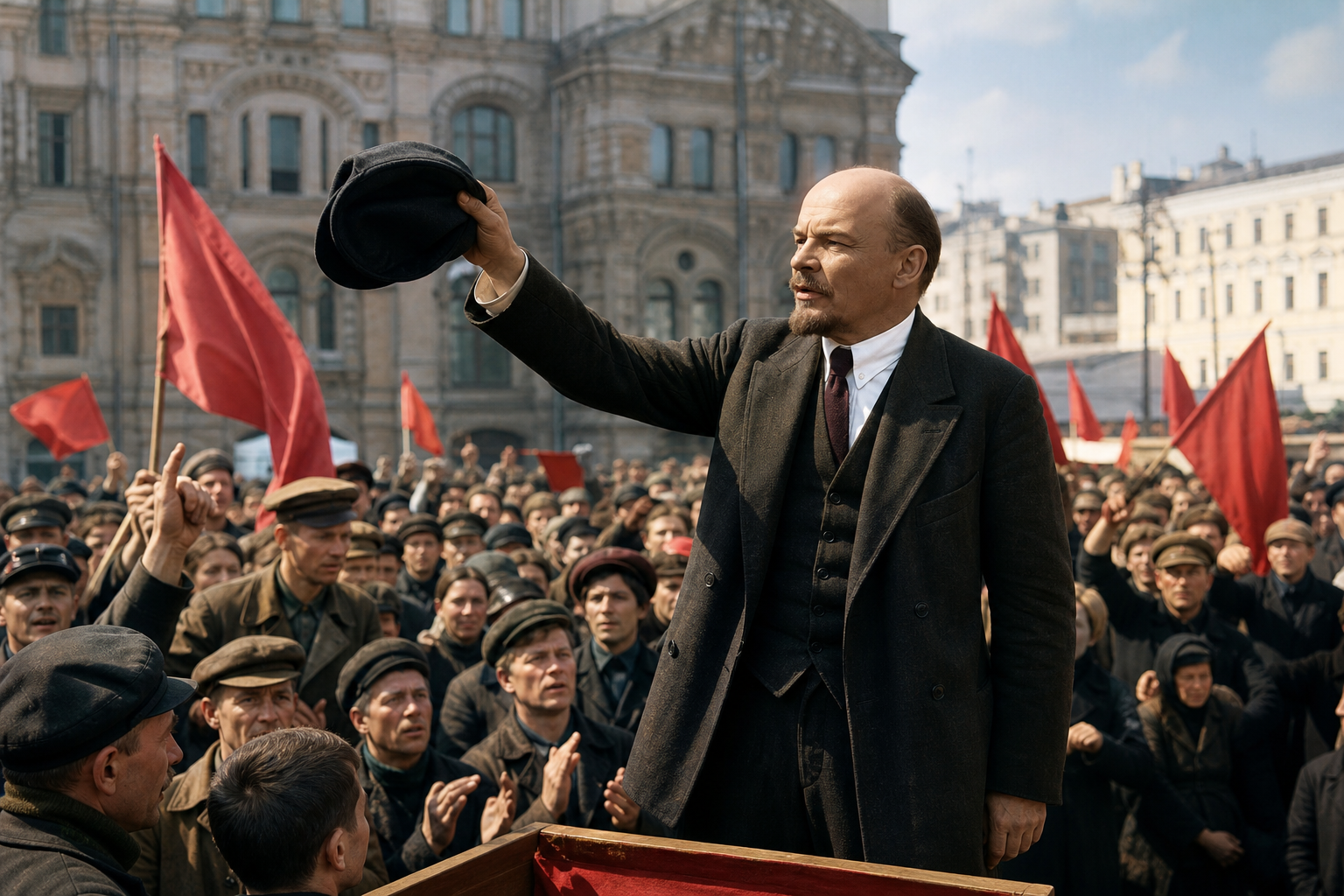
Lenin and the Revolution: The Shadow that Remade Russia
Vladimir Ilyich Ulyanov—known to history as Lenin—moves across the pages of the twentieth century like a figure lit from beneath, half seen and half imagined. To call him merely a politician is to understimate the way his life became a palimpsest of radical theory, personal tragedy, and clandestine operations. He was both testament and cipher: a man forged in the crucible of Tsarist repression, tempered by exile and pamphleteering, and returned to Russia in 1917 to steer an exhausted empire into a new and violent future.
This article traces Lenin’s journey in measured, evidence-based strokes: from the household that shaped his early convictions to the conspiratorial rooms of Petrograd where the Bolsheviks plotted. It will examine the April Theses and the logic by which Lenin judged the provisional government illegitimate; outline the precise steps by which Bolshevik cadres seized key points in Petrograd; and then widen the frame to the crushing decisions that followed in the corridors of power—Brest-Litovsk, War Communism, the suppression of rival socialist currents, and the eventual tactical retreat that was the New Economic Policy.
But beyond instruction and policy, the story is also one of perception. Lenin’s implacable will and rhetorical virtuosity became the nucleus of a myth that outlived him. Even in his lifetime, his declining health and searing political clarity created a mythic tension: the architect who would be incapacitated and then canonized. The final chapters of this article explore that very transformation—from living revolutionary to the embalmed emblem of a regime—while returning to cold facts: dates, decrees, and the institutional decisions that shaped the Soviet state.
Did you know? Lenin’s older brother, Aleksandr Ulyanov, was executed in 1887 for a plot to assassinate Tsar Alexander III; this event decisively shaped Vladimir’s revolutionary trajectory.
Read as a narrative and a mystery, the tale opens questions rather than answers. How much of the October uprising was the result of careful, top-down planning, and how much was opportunism shaped by the failures of other actors—Kerensky’s miscalculations, Kornilov’s threat, or the indifference of soldiers exhausted by war? How do we parse Lenin’s mix of ruthless pragmatism and doctrinal purity? The following sections attempt to answer these questions with a steady reliance on primary events and reliable secondary scholarship, while preserving the strange, often eerie quality of political transformation that surrounded Lenin and his comrades.
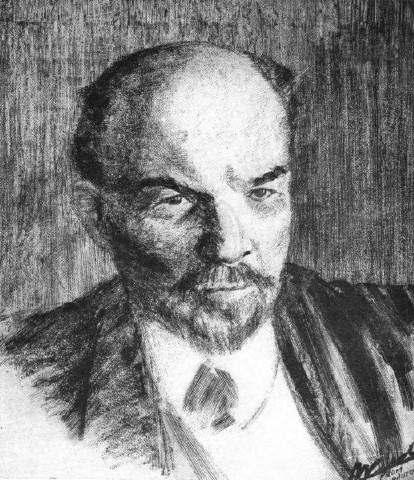
Origins and the Making of Lenin
Vladimir Ilyich Ulyanov was born on April 22, 1870, in the town of Simbirsk on the Volga. The social and intellectual milieu in which he grew up was hardly unusual for provincial Russian intelligentsia: a devoutly moral mother, a schoolteacher father, and a household punctuated by conversations about literature, law, and increasingly radical politics. Yet the family’s fate was altered irrevocably in 1887 when his eldest brother, Aleksandr, was implicated in an assassination plot against Tsar Alexander III. Aleksandr’s execution was a moment of private catastrophe and public politicization; it placed Lenin on a path in which the state’s capacity for violence became not a distant abstraction but an intimate reality. The psychological and ideological consequences of that event—widely documented in Lenin’s own recollections and those of contemporaries—were foundational.
By the 1890s, Lenin had emerged as a committed Marxist, a scholar of political economy, and an organizer. He studied law at Kazan University, where he encountered radical circles and soon after was expelled for student agitation. The decades leading up to 1917 saw him alternate between clandestine organizational work in Russia and long exiles abroad, where he produced polemical works—What Is to Be Done? (1902) being the most famous—that argued for a disciplined vanguard party rather than a loose collection of intellectuals and workers. The RSDLP’s split in 1903, into Bolsheviks and Mensheviks, was a decisive moment. Lenin urged a compact, centralized party that could withstand police infiltration and ensure decisive action. His critics argued this model would encourage authoritarian leadership; his supporters saw it as necessary for revolutionary survival in an autocratic empire.
Did you know? Lenin’s April Theses were initially met with incredulity by many Bolshevik leaders; Kamenev and Zinoviev publicly opposed immediate insurrectional slogans for months after Lenin’s return.
In constructing Lenin’s biography one must avoid mythic collapses: he was not simply a solitary mastermind; he was part of networks, dependent on financiers, comrades, and the shifting politics of the time. He was, however, unique in his combination of theoretical rigor and willingness to employ conspiratorial methods. His writing and organizational leadership made him the recognizable pole around which Bolshevik identity coalesced. Importantly, his politics evolved in response to concrete circumstances. The 1905 Revolution, though ultimately failed to topple the Tsar, served as a laboratory for tactics and experience. Bolshevik involvement in factory committees, workers’ soviets, and street-level agitation provided practical knowledge that would later prove essential.
The First World War was an accelerant. For Lenin, the war exposed the imperialist character of the conflict—a theme he emphasized in his pamphlets and in party debates. Russian soldiers’ mutinies, the collapse of military morale, food shortages, and the strain on the economy created a volatile setting by 1917. Yet the personal story—exile, underground organization, and a doctrinal insistence on a disciplined revolutionary party—remained central. This is why, when the February 1917 revolution removed the Tsar, Lenin was both a returning prophet and a figure out of time: a leader who understood the theatrical stage of revolution and who sought to convert chaotic popular energy into disciplined seizure of power.

Return to Russia and the April Theses: Strategy and Shock
Lenin returned to Russia from exile in Petrograd in April 1917, traveling in what would later be described as a ‘sealed train’ through Germany. The circumstances of his return were dramatic and consequential. Germany’s decision to facilitate his transit was a calculated gamble designed to exacerbate Russia’s instability, since Berlin believed Lenin’s presence would undercut Russia’s war effort. Lenin disembarked not as a stolid exile but as a striker of a new and radical line. His April Theses—announced within days—called in uncompromising terms for “no support” to the Provisional Government, a soviet takeover, and an immediate transfer of power to the workers’ and peasants’ Soviets. He repudiated cooperation with other socialist factions in the short term and urged the Bolsheviks to focus on slogans that would resonate with a war-weary populace: “Peace, Land, and Bread.”
Did you know? The cruiser Aurora’s firing became a powerful symbol of the revolution, though contemporary witnesses differ on whether it was planned as a signal or seized opportunistically by Bolshevik sailors.
Lenin’s theses arrived as both a shock and a clarifying force. Many within the Petrograd Bolshevik committee, including figures like Kamenev and Zinoviev, were skeptical; they thought Lenin’s program was premature or reckless. Yet Lenin’s timing was not arbitrary. The Provisional Government under Aleksandr Kerensky was vulnerable: it continued the war, struggled to address the collapsing supply of food, and faced the Kornilov Affair in August 1917—a failed coup by General Lavr Kornilov which exposed the fragility of Kerensky’s authority and increased popular distrust of moderate socialists. Lenin’s arguments were also rooted in the objective weakness of Russia’s political institutions and the accelerating radicalization of soldiers and urban workers.
The April Theses were more than a set of demands; they were a strategic blueprint. Lenin argued for immediate transfer of state power to soviets, nationalization of land, and placing factory control in the hands of workers’ committees. He also insisted on a centralized party capable of decisive action. The rhetoric served a practical purpose: to reorient Bolshevik propaganda, to draw in soldiers and sailors disillusioned with the war, and to prepare cadres for insurrectionary activity. Lenin’s leadership at this moment shows both his rhetorical acuity and his tactical insistence: he sought to make the Bolsheviks the only party that could channel radical sentiment into disciplined revolutionary action.
The October Revolution: Planning and Execution
The question of how the October Revolution actually happened continues to fascinate historians because its success combined careful planning with opportunistic exploitation of rivals’ errors. By the autumn of 1917, the Provisional Government’s legitimacy had been hollowed out: food riots persisted, the front lines remained unstable, and political fragmentation weakened any centrist or moderate alternative. Lenin’s faction had a plan that balanced legality with force. The Central Committee debated timing, while the Military Revolutionary Committee, led informally by Leon Trotsky and other Bolsheviks, handled the operational elements. Trotsky, in particular, played the role of a pragmatic organizer, coordinating sailors, soldiers, and Red Guards who occupied key points in Petrograd—the telegraph office, bridges, railway stations, and the Winter Palace.
Did you know? Lenin argued for accepting the harsh terms of Brest-Litovsk, famously saying that it was better to lose territory than to lose power in Petrograd—an illustration of his prioritization of political survival over territorial integrity.
On the night of October 25 (Old Style; November 7 New Style), Bolshevik forces moved decisively. The cruiser Aurora’s symbolic shot marked the beginning of operations, and by dawn, the Winter Palace—where the Provisional Government still gathered—was surrounded and taken with relatively little bloodshed. The formal argument that Lenin had engineered a tightly controlled coup is partially true; yet it is also critical to emphasize that the Provisional Government had been socially and politically abandoned. Units deserted or refused orders; the Bolsheviks were able to insert themselves into vacuums of authority. Lenin’s presence, issuing orders and reassuring militants, was itself a decisive psychological factor. The seizure was rapid, and the Bolsheviks moved quickly to issue decrees: an immediate peace, land to the peasants, and workers’ control of factories.
The October insurrection demonstrated Lenin’s strategic logic: seize key state instruments swiftly, announce popular measures to consolidate mass support, and neutralize rival socialist institutions that might counter-revolution. After the seizure, Lenin and the Bolsheviks moved to delegitimize other channels of authority. The Constituent Assembly, elected in November 1917, was dissolved in January 1918 when it failed to comply with Bolshevik interests; Lenin justified the move by arguing the soviets, not a parliamentary assembly, expressed the true will of the workers and peasants. Critics would label this the root of one-party rule and provide ammunition for lifelong debates about the nature of Lenin’s commitment to democratic socialism.

Consolidation of Power: Policies, Peace, and War
After the October seizure, the Bolshevik leadership faced immediate and existential challenges. The state apparatus was fragmented; the former imperial bureaucracy was hostile or absent. Lenin’s government moved quickly to make decisions that would affirm its survival but also generate intense controversy. Two of the earliest and most consequential moves were the Decree on Peace and the Decree on Land. The Decree on Peace proclaimed an immediate end to hostilities and proposed an immediate armistice without annexations or indemnities—an attempt to exploit war weariness and undercut the Provisional Government’s narrative. The Decree on Land, meanwhile, legalized peasants’ land seizures—an attempt to win rural support by recognizing the factual agrarian revolution already underway.
Did you know? The Kronstadt sailors who rebelled in 1921 were once staunch supporters of the Bolsheviks in 1917; their rebellion signaled to Lenin that a policy shift was necessary and justified the introduction of the NEP.
However, the need to secure peace and the reality of the war’s disintegration led directly to the Treaty of Brest-Litovsk in March 1918, negotiated under Lenin’s leadership. The treaty ceded vast territories to Germany and its allies but extricated Russia from a war that threatened to destroy the nascent regime. Lenin’s calculations were stark: better to accept harsh terms and consolidate internal power than to continue a conflict that might doom the revolution. This decision split the Bolsheviks and alienated many socialists at home and abroad. It also provided a pretext for a broader coalition against the Bolsheviks, leading to the Russian Civil War.
Civil War (1918–1921) proved to be the crucible of Bolshevik consolidation. Opposition came in many forms—White armies under various generals, national independence movements, peasant uprisings, and allied interventionist forces. Lenin and his leaders were ruthless in defense. Institutions like the Cheka (created in December 1917) were entrusted with suppressing counter-revolutionary activity. The Red Army, organized and led by Trotsky, drew on strict discipline and political commissars to create a fighting force that could outmaneuver more loosely organized White forces. War Communism—an array of measures including requisition of grain, nationalization of industry, and centralized control—was imposed to keep the armies fed and industry functioning. The human cost was staggering: famine, repression, and loss of life across many fronts.

From War Communism to the NEP: Pragmatism and Retreat
The policies adopted during the Civil War were born of necessity but became enduring political choices. War Communism centralized the economy, abolished private trade in many areas, and imposed forced requisitions of grain from peasants. These measures allowed the Bolsheviks to provision cities and the Red Army, but they also alienated large swathes of the rural population, leading to resistance and even revolts (the Tambov Rebellion being the most notable). By 1921, the economy was in ruins, industrial production had crashed, and social unrest had mounted. The Kronstadt Rebellion in March 1921—a revolt of sailors who had been key supporters of the Bolsheviks in 1917—was especially shocking to the leadership. They responded with force, crushing the uprising, but the episode underscored the need for policy change.
Did you know? Lenin’s testamentary warning about Stalin was suppressed by party leaders after his death; Stalin’s rise continued unabated, in part because many within the leadership found the testament politically inconvenient.
Lenin’s response was strikingly pragmatic. At the Tenth Party Congress in March 1921, he and other leaders introduced the New Economic Policy (NEP), a partial reversal of War Communism that permitted private trade, small-scale private enterprise, and a degree of market mechanisms, while retaining state control of “commanding heights” like heavy industry, banking, and foreign trade. The NEP was intended to stabilize the economy, soothe peasants so they would produce more grain, and restore a degree of normalcy. Ideologically, Lenin justified it as a tactical retreat—a “step back” to consolidate the revolution’s longer-term gains.
This willingness to retreat from doctrinaire measures reveals a pattern in Lenin’s political thinking: an underlying pragmatism that, when necessary, overrode ideological purity. He was willing to adopt measures he had previously denounced when faced with the stark realities of governance and survival. The NEP would create a new set of contradictions and debates within the party about the nature of socialist construction, and after Lenin’s death, these debates would become grounds for factional struggle. But in the immediate sense, the NEP did what Lenin intended: it arrested the economic hemorrhage and restored a degree of popular calm.

Illness, Death, and the Making of a Revolutionary Icon
From 1921 onwards, Lenin’s health declined. He suffered a series of strokes—most historians date the first serious cerebrovascular event to May 1922—and his capacity for sustained leadership diminished. During these years, he wrote less but left a series of testamentary notes and private letters that revealed both his political anxieties and his personal disillusionments, particularly concerning the concentration of power in the hands of Joseph Stalin. Lenin’s last political will—often referred to as the "Lenin Testament"—is a striking document: it warned the party about Stalin’s accumulation of power and suggested that Stalin be removed from the position of General Secretary. Whether Lenin expected this warning to have teeth is unclear; what matters is that after his death in January 1924, the document’s impact was blunted by those who would benefit from ignoring it.
Did you know? Lenin was a prolific writer and pamphleteer; his works and collected writings were used throughout the Soviet period as primary instruments of political education.
Lenin’s death itself became an event of political theater. He was embalmed and placed on public display, a process that ensured his place as icon as much as it did preserve his body. The mausoleum on Red Square became a focal point for Soviet veneration. The transformation from living leader to sacralized symbol served later political ends, particularly under Stalin, who curated Lenin’s image to legitimize his own rule. That Lenin had been a tactical, sometimes ruthless politician was reworked into an image of infallible foresight. Mythmaking is a common endgame in revolutionary regimes; Lenin’s case is unsurprising in its intensity but remarkable for the speed with which political biography became political catechism.
The legacy question remains contested. To supporters, Lenin ended an imperial war and attempted to deliver social justice; to critics, his methods established a one-party state and the mechanisms of repression. Both readings are rooted in real events: decrees passed and enforced, civil war fought, political institutions created, and the precedents set for how dissent would be handled. Lenin’s strategic priorities—survival, consolidation, and the transformation of state power to serve proletarian ends—cannot be separated from their human cost. Understanding Lenin is thus to confront the uneasy duality of revolutionary ethics: the tension between the ends a movement seeks and the means it insists are permissible.
Conclusion: Memory, Myth, and the Long Shadow
Lenin’s life and politics resist neat categorization. He was a man of ideas who believed in the transformative potential of a disciplined party; he was also a politician who accepted, and often insisted upon, measures that centralized power and silenced rivals. His achievements—ending Russia’s participation in the First World War, redistributing land, and erecting the institutions of the Soviet state—were inseparable from the violent and coercive mechanisms deployed to implement them. The October Revolution is therefore both a story of possibility and a cautionary tale about the seductions of power.
Reading Lenin today requires a double vigilance: to recognize the historical forces that made radical revolution conceivable in 1917, and to understand how leadership choices shape the trajectory of movements once they seize power. The Bolshevik seizure was made possible by a unique convergence: a collapsing empire, war exhaustion, the tactical skill of Bolshevik organizers, and the missteps of political opponents. Lenin’s role was decisive in strategy and moral intransigence; yet he also made pragmatic retreats when necessary. His life’s arc—brother’s execution, exile, revolutionary triumph, illness, and embalmed posthumous authority—creates a narrative at once gripping and disquieting.
For historians and readers piecing together truth from spectacle, Lenin remains an object lesson in how revolutions begin and how they become regimes. The myths built around him may obscure details but also point to the profound psychological and political need of generations to find a figurehead in tumultuous times. Studying Lenin is therefore not just an exercise in biography; it is a way to reflect on the nature of political transformation itself, the ironies of tactical victories that lead to enduring systems of domination, and the ways memory is crafted to sustain or critique power.

How we verify this article
By the History Unlocked editorial team
This text is built on historical facts stored in our database and drafted with AI assistance. No signed human review is recorded for this article. Report any inaccuracy: we correct it and update the modified date.
Updated on
AI-assisted drafting.
Read our editorial standardsEnjoyed this? Discover more articles in the category Great Revolutions