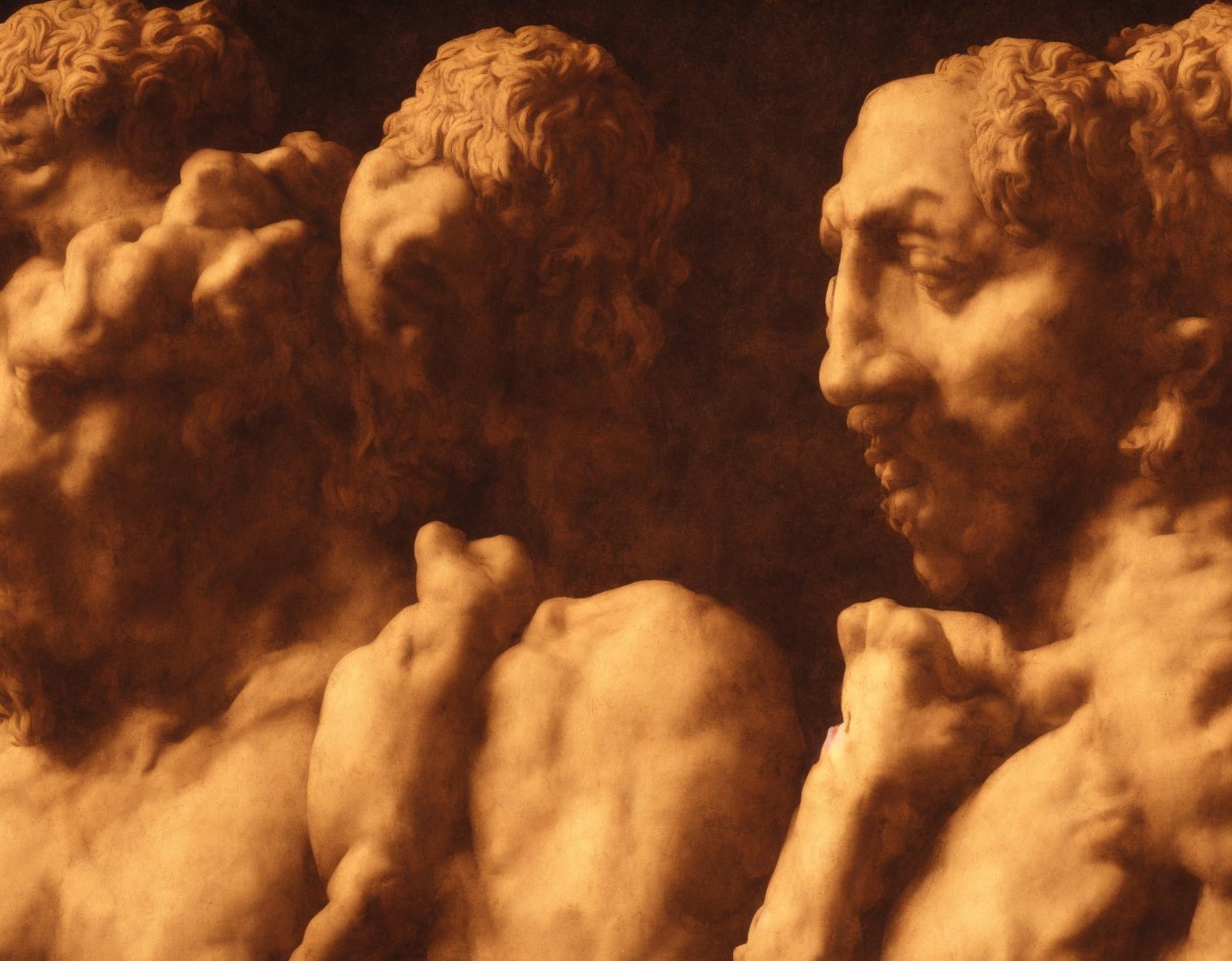
Michelangelo the Sculptor: Chiseling Divine Secrets
In the hush of a Florentine workshop, with marble dust like snowfall and the rhythm of hammer on chisel marking days and decades, Michelangelo Buonarroti began to write with stone. He is often remembered for the painted ceiling of the Sistine Chapel, but to understand the deepest currents of his genius we must follow the cold, glittering path of his sculpture. Sculpture, for Michelangelo, was not merely craft; it was a theological and philosophical excavation. He claimed, in words that flicker between confession and manifesto, that the figure was already imprisoned in the block and his duty was to free it. That image—a man wrestling the immobile weight of matter—is central to any attempt to read the forms he left behind.
This article pursues Michelangelo the sculptor as a subject of mystery and revelation. It traces his formative years in Florence and Rome, examines the physical and mental tools of his trade, and reads key works—the youthful Pietà carved for St. Peter’s Basilica and the monumental David in Florence—as inscriptions of belief, ambition, and rivalry. It also follows the darker grooves in his catalogue: the unfinished, the aborted, the pieces that seem to emerge mid-struggle from cavernous marble. These non-finito works are not failures; they are statements about process, violence, and the limits of human agency.
Across the chapters of Michelangelo’s life—his apprenticeship to Domenico Ghirlandaio, his sheltering in the Medici household, the quarrels with patrons such as Pope Julius II, and the late-career returns to idealized forms—sculpture remained his north star. He quarried Carrara marble, rode mules into quarries, negotiated the burden of commissions and the hunger for creative autonomy. Each statue, each fragment, is a palimpsest of choices: which vein of marble to trust, how far to coax a torso out of stone, when to allow a limb to remain entombed. For the modern observer, there is a lure in imagining the moment a figure overcomes the stone’s resistance and steps into light.
Did you know? Michelangelo entered the workshop of Domenico Ghirlandaio at age 13 in 1488, but left soon after to study classical sculptures in the Medici gardens.
This account privileges verifiable facts—dates of commissions, documented biographical episodes, contemporary accounts—while embracing the tantalizing uncertainties that surround interpretation: what Michelangelo intended when he left a figure half-finished, or why he would sign the Pietà in a moment of anger. The tone aims for narrative mystery: we approach the marble as detectives of form, looking for fingerprints left by a man whose voice is heard through chisels and contrapposto. Let us begin in the place where he first learned to see the human body as a block of possibility: Michelangelo’s beginnings in a Florence that was both cradle and crucible.
Early life and training
Michelangelo Buonarroti was born on March 6, 1475, in the small Tuscan village of Caprese, then part of the territory controlled by Florence. His family belonged to the lower nobility, and after his father’s return to Florence the young Michelangelo was raised in the city that served as the heart of Renaissance innovation. Florence in the late fifteenth century was a place of intense artistic ferment and ferocious political rivalry—the republic of city-states, guilds, and patrons. Against this backdrop, the boy who would become Michelangelo found himself torn between a formal education in letters and a seductive pull toward visual making.
At age thirteen Michelangelo was enrolled as an apprentice to Domenico Ghirlandaio, one of Florence’s leading fresco painters. This apprenticeship, begun in 1488, lasted only a year in the painter’s shop before he moved to the Medici gardens to study in the household of Lorenzo de’ Medici. The Medici were not merely patrons but cultivators of talent: within their complex of scholars, poets, and artists, Michelangelo absorbed classical learning, humanist philosophy, and direct access to antiquities. It was in the Medici gardens that he encountered Hellenistic and Roman sculptures, fragments that would influence his lifelong preoccupation with the classical ideal of the human body as a repository of expressive possibility.
Did you know? Michelangelo insisted on selecting his own Carrara marble blocks and personally inspected them, believing a single flawed vein could ruin the entire sculpture.
His exposure to both painting and sculpture in these formative years shaped the syncretic approach that marked his mature work. While Ghirlandaio taught him the mechanics of workshop labor—tools, apprenticeships, schedules—the Medici nurtured a deeper intellectual and aesthetic sensibility. He studied anatomy, sometimes clandestinely exhuming corpses to understand musculature, though accounts of such dissections are mixed between fact and later legend; nonetheless, Michelangelo’s intimate knowledge of the body is evident in the tautness of his forms, the way muscle and tendon appear to contract beneath skin (or stone), suggesting not only observation but an empathy for the living organism.
The young sculptor’s preference for marble was established in these early years. Florence’s sculptural tradition—Donatello, Ghiberti, and others—was a constant presence, yet Michelangelo sought a different relationship with material. He traveled with merchants to inspect Carrara marble quarries; contracts and letters testify that he cared intensely about the quality of the stone he selected. The importance of material cannot be overstated: a flawed block could determine an entire project’s fate. These early dealings with patrons, quarry owners, and fellow artists taught Michelangelo the art of negotiation and survival. He learned to translate the language of marble into forms that would address both the human body and the spiritual longings of his era.
By the time Michelangelo left the Medici circle for Rome in 1496, following the political upheavals that toppled the Medici from power, his workshop skills, anatomical knowledge, and classical training had been fused into a unique temperament. He carried with him the confidence of a craftsman and the ambition of an artist who believed that every block of marble held a destiny. This conviction—half theological, half aesthetic—would guide his dealings with patrons and his own conscience in the decades to come.
Did you know? Michelangelo carved the Pietà in Rome between 1498 and 1499 and later, upset by false claims of authorship, signed it across the Virgin’s sash.

The sculptor's technique and materials
Michelangelo’s technique is a nexus where observation, intuition, and brute force intersect. His primary material was Carrara marble, a crystalline white stone quarried in the Apuan Alps that Renaissance sculptors prized for its translucence and fine grain. Michelangelo was obsessive about the source of his marble; archival records show him inspecting blocks and negotiating purchases. He preferred large, single blocks when possible because they allowed the full development of a figure without the need for joins. Transporting such monoliths required logistics, animals, and skilled laborers; the marble’s journey from Apuan crags to Florentine workshops is an episode in itself, one that set the stage for the drama of creation.
The tools of sculpture in Michelangelo’s hands were deceptively simple: various sizes of hammers, pointed punches, tooth chisels, rasps, and polishing stones. Yet technique is not only the selection of tools but the choreography of marks. Michelangelo started with broad blows to rough out mass, then refined planes and planes again until the anatomy sang with life. He used drilling techniques to undercut deep folds or to create shadowed recesses—an approach that lent his figures dramatic chiaroscuro even in three-dimensional form. His finishing was meticulous; some surfaces, like faces and hands, were polished to a smooth sheen, while other parts retained tool marks, a deliberate decision to guide the viewer’s focus.
Anatomical mastery underpinned Michelangelo’s approach. Whether gleaned from observation, dissection, or the study of classical statuary, his handling of muscle and skeletal structure gave bodies a lived plausibility. But his sculptures often go beyond mere anatomical correctness into idealization—elongated torsos, exaggerated tension, and contrapposto postures that dramatize motion and emotion. Such formal choices were not arbitrary; they served expressive ends, communicating inner life through external strain. The David’s coiled readiness or the Pietà’s tender immersion are not naturalistic snapshots but crafted narratives of inner states.
Did you know? The Tomb of Julius II commission, begun in 1505, underwent decades of revision; the final, reduced program left only a fraction of Michelangelo’s original plan.
Michelangelo’s idea of sculpting was akin to revealing a figure already within the stone. This philosophy influenced his working method: he avoided excessive preliminary maquettes for certain commissions, preferring direct carving from the block. Yet for larger projects or architectural elements he did produce detailed models. The use of clay or wax models could help communicate intentions to patrons, but Michelangelo’s most intimate relationship was with the block itself. This insistence on direct contact sometimes produced quarrels: patrons expected predictability, but the unpredictable nature of carving made every block a gamble.
One of the more dramatic aspects of Michelangelo’s practice was his tolerance for non-finito—the deliberate leaving of works unfinished. Emerging from both necessity and choice, non-finito produces a haunting effect: figures that seem to struggle out of their matrix, half-formed arms or torsos embedded in raw stone. Such endings ask the viewer to imagine the act of liberation as part of the work’s meaning. The residue of tool marks and the contrast between polished and rough surfaces are not imperfections but intentional rhetorical devices.

Pietà and David: youth, fame, and rivalry
Michelangelo’s early masterpieces crystallized his reputation almost overnight. The Pietà, carved for St. Peter’s Basilica and completed around 1499 when Michelangelo was in his early twenties, astonished Roman patrons by its technical finesse and emotional depth. The sculpture depicts the Virgin Mary holding the dead Christ in her lap, a traditional subject reinterpreted with quiet dignity and anatomical confidence. The young artist’s treatment of folds, the serene visage of Mary, and the harmony of proportions made the Pietà an object of wonder and debate—the more so because Michelangelo was so young when he produced it.
Did you know? Michelangelo’s non-finito pieces, like the Slaves, were sometimes left uncompleted due to interrupted commissions, but they became celebrated for their expressive openness.
At the time, the work’s finish and compositional control suggested the mastery of a far older artist. The smooth surfaces, the delicate transitions between flesh and drapery, and the elegant pyramid of forms read like an argument for timelessness rather than youthful bravado. However, the Pietà is not a sentimental piece; its serenity is charged, the grief contained within composure, the christological theology implicit in the youthful body of Christ—depicted as both vulnerable and idealized.
One famous anecdote underscores the tensions that shaped Michelangelo’s early Rome career. Angry at rumors that a colleague had claimed authorship, Michelangelo signed his name across the sash of Mary—the only work he is known to have signed. The act of signing was an emphatic assertion of authorship and a rebuke to the competitive environment of Roman workshops and patrons. It also attests to the problematic status of artists at the time: revered and yet vulnerable to theft of credit.
Back in Florence, David became the emblem of civic pride. Carved from a single immense block of marble that had been quarried and then neglected by others, Michelangelo took up the challenge in 1501 and completed the statue in 1504. The decision to place David in the public square, outside the Palazzo della Signoria, turned the biblical hero into a symbol of republican Florence’s defiance against larger powers. Michelangelo’s David is not the triumphant victor but a tense, watchful figure at the moment before conflict; his brow furrows, his sling is wound, and his entire musculature prepares for exertion. The psychological tension is monumental, conveying a city’s readiness to confront tyranny.
Did you know? Michelangelo often conflated civic and sacred symbolism—David was both a biblical hero and a symbol of Florence’s republican resilience.
These two sculptures—Pietà and David—bookend the formative phase of Michelangelo’s public career and reveal complementary dimensions of his practice. One is intimate and theological, the other civic and monumental; yet both are unified by an interest in how the human body can articulate moral and metaphysical states. They also made Michelangelo famous across Italy and beyond, setting the stage for later commissions that would test both his technical limits and his tolerance for political compromise.

Tomb of Julius II and the struggle of monumental commissions
The story of Michelangelo’s commission for the tomb of Pope Julius II is one of the most revealing episodes of his career, exposing the tensions between artistic ambition and institutional reality. The original commission, contracted around 1505, envisioned an enormous freestanding tomb populated by dozens of figures and occupying a chapel-sized niche. Michelangelo threw himself into the project with zeal, producing designs, models, and sculptures such as the seated Moses—one of his most arresting figures. Moses’s beard, his forceful turn, and the propulsive energy captured in the carved drapery convey a prophet in motion, incandescent with authority.
Yet the tomb’s realization was mired in shifting papal priorities, financial constraints, and political distractions. Pope Julius II was a warrior pope, more interested at times in military campaigns and architectural grandiosity elsewhere—such as plans for a new St. Peter’s—than in completing a personal tomb. Contracts were renegotiated, reduced, and revised over decades. Michelangelo, who had wanted a monumental triumph in marble, found himself repeatedly delayed and frustrated. The tomb’s ultimate incarnation in San Pietro in Vincoli, significantly diminished from the original plan, includes the Moses and several other figures but lacks the colossal network of narrative statuary first imagined.
Did you know? After a 1972 attack that severely damaged the Pietà, restorers spent years carefully reconstructing the sculpture’s original surfaces.
This protracted imbroglio left an imprint on Michelangelo’s sensibility toward monumental projects. He learned how institutional inertia could smash ideal designs into practicality; he also learned tactical patience. The experience reshaped his relationship with Rome’s clerical patrons: he became more wary, more controlling of his means and less trusting of long-term promises. Yet even in a scaled-down tomb, the potency of Michelangelo’s sculptures remained, as seen in Moses’s living energy and an ability to convey narrative through a single, sculpted presence.
The ordeal of the Julius tomb also produced a scattering of fragments and unfinished elements: statues carved in various workshops, contractual disputes, and pieces left to languish. These disjointed outcomes are instructive for historians: they show how artistic programs could be compromised by politics, and how the artist’s ego and religious conviction could be both fuel and casualty in such battles. Michelangelo’s letters from the period read like a ledger of disappointments and stubborn hopes—a ledger punctuated by bursts of genius when, despite everything, a figure emerged that announced his mastery.

Non-finito and the poetry of unfinished stone
One of the enduring fascinations with Michelangelo lies in his non-finito pieces—the figures that appear frozen mid-emergence from raw blocks. These works, whether deliberate or born of circumstance, became central to readings of his later career. Unfinished sculptures such as the series of Slaves (or Prigioni) for the Julius tomb, or the so-called Awakening Slave and Atlas Slave now in the Galleria dell’Accademia and other collections, present an aesthetic of becoming. Limbs half-sculpted, faces partially resolved, forms trapped in matrix: they invite the viewer to witness the act of release, to imagine the chisel’s next strike.
Did you know? Michelangelo remained active almost until his death in 1564, leaving sketches and unfinished works that scholars still study today.
Non-finito can be read on multiple levels. Formally, it emphasizes the contrast between polished and rough surfaces, generating a dynamic tension that focuses attention on certain features—the face, a shoulder, a hand—while leaving the rest to the imagination. Psychological readings see non-finito as metaphor: human beings are always incomplete, lives perpetually works in progress. For Michelangelo, whose own spiritual life was complex and often ascetic, these unfinished figures might suggest humility before divine perfection, or a statement about the limits of human mastery over matter.
Practically speaking, non-finito was sometimes a result of interrupted commissions, lack of funds, or the artist’s shifting priorities. Yet even when circumstance contributed, Michelangelo could exploit the unfinishedness as a rhetorical strategy. In his later years, with his hand sometimes failing and commissions multiplied, the partiality of some works took on philosophical weight: they are testimonies to process, to mortality, to the brittle relation between human intention and material reality.
Collectors and later generations often sought to ‘complete’ Michelangelo’s works—through restorations or by interpreting them as failures—but art history’s modern appreciation of non-finito has inverted such judgments. Rather than blemishes, these pieces are now central to understanding a sculptor who viewed making as a form of excavation; they are poetic insistences that creation is also entrapment, and liberation is never absolute. The unfinished block becomes a kind of mirror: the viewer projects meaning into the void, becoming complicit in the act of revelation.

Symbolism, meaning, and the human body
To read Michelangelo’s sculptures is to read a theology of the body. He inherited classical models that celebrated proportion and heroic nudity, yet he infused these ideals with Christian anxieties and existential dynamism. His figures are often muscular and strained, their bodies not merely beautiful but charged with narrative potential: a twisted torso can become a meditation on suffering; a clenched fist can be a sermon on will. The human form becomes a signifier, an analog for spiritual states and civic identities.
Symbolism in Michelangelo’s work operates on several registers. Biblical narratives—the Pietà, the Last Judgment in painted form, the various tomb figures—contain obvious theological meanings. But other, subtler signifiers permeate: the David’s watchfulness as republican vigilance; the prophets for the Julius II tomb as embodiments of papal authority; the slaves as personifications of human struggle. Even details like the placement of limbs or the rendering of marble drapery convey relationships between objects, viewers, and spaces. Michelangelo’s drapery, carved with incisive folds, often functions like a visual prosody: it measures emotional cadence and frames the human presence.
Patronage shaped, but did not fully determine, meaning. Commissions came with iconographic prescriptions—saints to be depicted, scriptural passages to accompany figures—but Michelangelo often reworked these parameters to assert his vision. This tension—between patron’s wishes and artistic autonomy—makes the sculptures fraught with layered meanings, sometimes public and political, sometimes private and ambiguous. In that sense, his work refuses a single interpretative key; instead, it offers a stratified surface that rewards close looking.
Michelangelo’s late style, increasingly abstracted and sometimes contorted, raises questions about aging artistry and spiritual reflection. As he grew older, his figures seem to pull inward and compress; forms become more schematic yet no less potent. He returned again and again to body-as-archive: every scar, every tendon a record of experience. In this way, his sculptures function as biographies written in stone: each mark is a sentence, each unfinished arm a withheld confession.
Legacy and influence
Michelangelo’s legacy is not a single stylistic school but a gravitational field that reshaped Renaissance and post-Renaissance imagination. His insistence on the expressive potential of the human body influenced generations: from Mannerists who embraced elongated forms and heightened tension, to Baroque sculptors who amplified drama and movement. Artists such as Bernini owe an indirect debt to Michelangelo’s sculptural inventiveness, even as they diverged in temperament and effect. Bernini’s dynamic baroque theatricality is different in color and intent but shares a lineage in the idea of sculpture as action.
Beyond technical influence, Michelangelo’s career altered the social standing of artists. He was both artisan and intellectual, a figure who negotiated contracts with popes and princes and penned sonnets and letters. His assertive signature on the Pietà and his sometimes acrimonious negotiations signal an artist increasingly conscious of authorship and legacy. The ideal of the solitary genius—an artist whose inner creativity overrides workshop conventions—was in part popularized through readings of his life.
Institutionally, his works became touchstones for nations and cities. Florence’s David has been reproduced, copied, debated, and politicized across centuries. The Pietà in St. Peter’s has been conserved, rehabilitated, and, after a violent 1972 attack in which the statue was damaged, painstakingly restored—an episode that itself became part of the sculpture’s modern history. Museums, academies, and collectors have preserved Michelangelo’s unfinished works as documents of artistic process rather than damages to be corrected.
Contemporary scholarship continues to mine his letters, contracts, and sonnets for insight into the artist’s psyche. New technologies—3D scanning, residue analysis, and archival digitization—allow closer examinations of tool marks and workshop practices. Yet even as methods evolve, the essential enigma remains: Michelangelo’s capacity to make stone speak continues to confound simple explanation. He staged bodies as theatrical and theological agents, and in doing so he left a legacy that resists closure.
Michelangelo the sculptor stands at a crossroad of craft, theology, and self-fashioning. From the adolescent apprentice in Ghirlandaio’s shop to the quarrelsome titan bargaining with popes, his life is a narrative of relentless insistence: that stone contains spirit, that form can enclose and release meaning, and that the body is the most eloquent scripture. His masterpieces—Pietà, David, Moses—function as nodes in a vast conversation about power, piety, and the possibilities of human representation. The unfinished works, far from being second-rate fragments, are poetic interventions into the nature of creation itself, asking us to watch the work of making.
To approach Michelangelo’s sculptures is to become implicated in an act of witness. Each surface invites scrutiny: the tool marks that record a hand’s impatience, the polished cheek that captures a late afternoon’s light, the vein in a Carrara block that threatened to split an entire project. These matter-of-fact details are the scaffolding for deeper mysteries—about artistic intention, the politics of patronage, and the fragile boundary between idea and matter. Michelangelo’s legacy endures precisely because his works continue to demand interpretation; they are stones that still speak.
How we verify this article
By the History Unlocked editorial team
This text is built on historical facts stored in our database and drafted with AI assistance. No signed human review is recorded for this article. Report any inaccuracy: we correct it and update the modified date.
Updated on
AI-assisted drafting.
Read our editorial standardsEnjoyed this? Discover more articles in the category Art & Symbolism