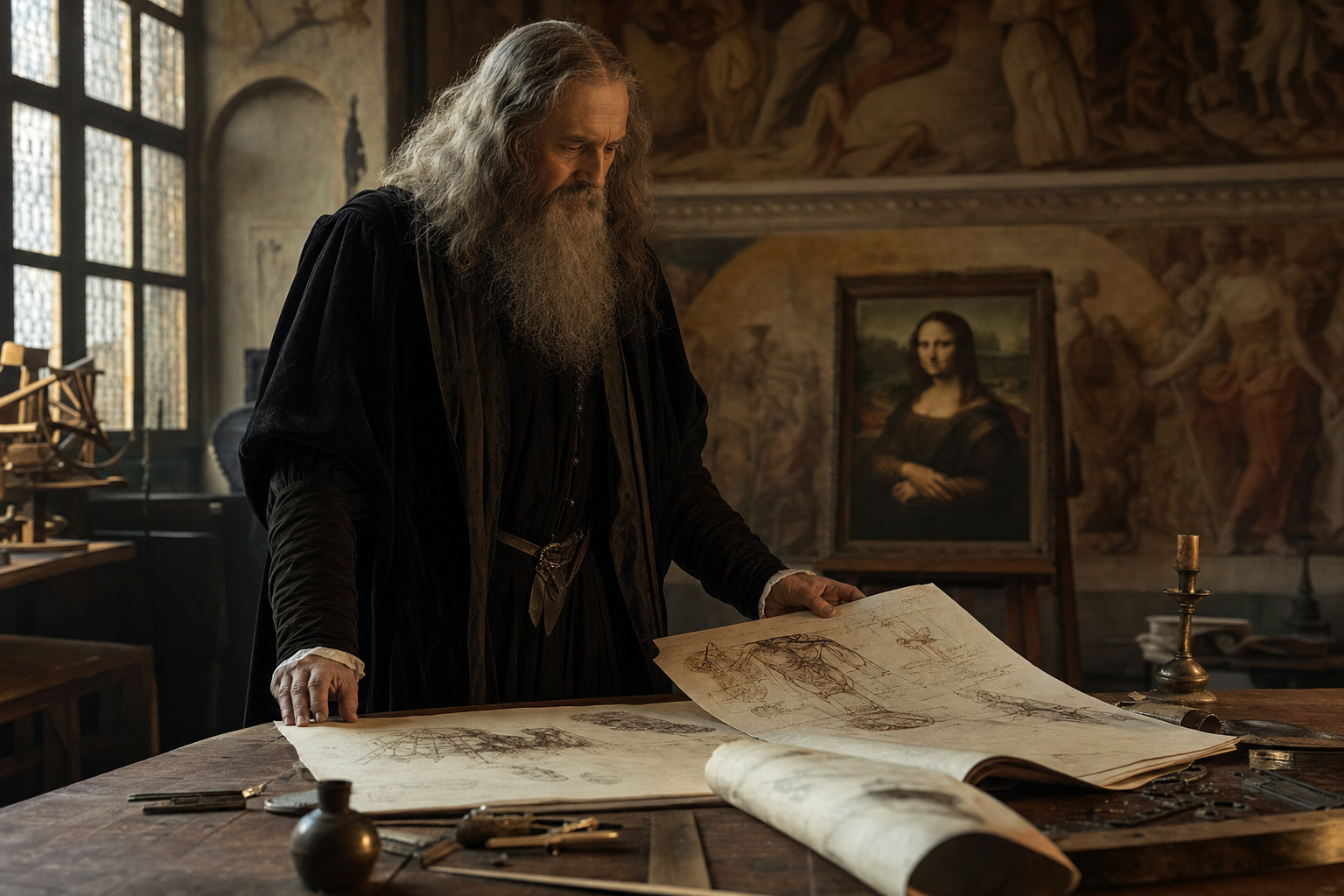
Leonardo's Code: Deciphering Art, Science and Hidden Signs
Leonardo da Vinci is one of history's most magnetic figures: a polymath who moved effortlessly between anatomy tables, workshop easels, courtly ambitions, and the lonely pages of private notebooks. His name alone summons images of the Mona Lisa's ambiguous smile, the vanished brilliance of The Last Supper, and the densely annotated pages of codices filled with mirrored script and detailed drawings. Yet as fascination has grown into obsession over five centuries, a persistent narrative has emerged — that Leonardo embedded deliberate, encoded messages in his art, a private language accessible to those who know how to read it. This narrative is seductive because it promises a key to unlock a heroic mind that seems otherwise inscrutable.
The reality is more nuanced. Leonardo did indeed write in mirror script, kept voluminous notebooks, and sometimes used playful or layered symbolism in his compositions. He also lived in an era where allegory and cryptic geometry were common modes of expression among thinkers and patrons. Many of the more sensational claims — hidden chasms of conspiracy, secret societies betrayed by brushstrokes, or deliberately planted modern puzzles — are the inventions of subsequent centuries, amplified by popular culture. Yet there is a tangible, evidence-based story that can be told: of a man who fused observation, experiment, and artistic invention in ways that occasionally produced images with ambiguous boundaries between scientific study and aesthetic design.
This article takes a long, patient look at the evidence. We will trace Leonardo's life and career, examine the notebooks where his most private thinking is recorded, analyze key paintings that have drawn the most speculation, and separate demonstrable technique from later mythmaking. Along the way we will explore the visual languages Leonardo used — anatomical precision that borders on the uncanny, experiments in optics and perspective, and a compositional logic that favors subtlety over proclamation. Ultimately, to understand whether Leonardo encoded messages intentionally requires recognizing the line between the artist's documented methods and the appetites of later interpreters. We will walk that line carefully, privileging primary sources, conservation science, and respected scholarship while acknowledging how mystery itself has become part of Leonardo's legacy.
Did you know? Leonardo was born on 15 April 1452 in the hamlet of Vinci, near Florence, and he died in Amboise, France on 2 May 1519.
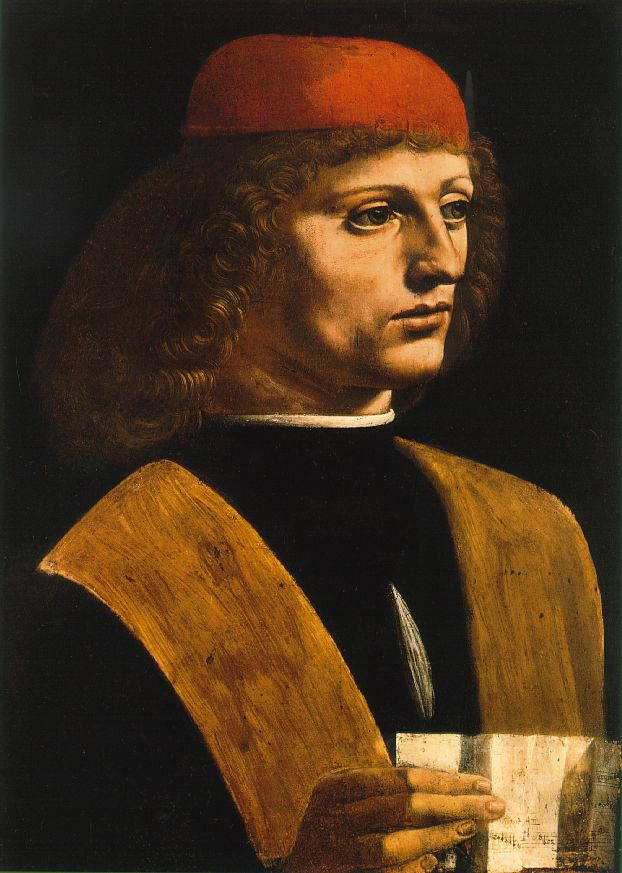
The Man from Vinci: Life, Patrons and the Workshop
Leonardo's biography is a mixture of precise dates and long stretches of creative ambiguity. Born in 1452 as an illegitimate son of Ser Piero da Vinci and Caterina, he was apprenticed in his adolescence to the Florentine workshop of Andrea del Verrocchio around 1466. Verrocchio's workshop was a thriving hub where painting, sculpture, and technical skills were taught; it provided the young Leonardo with a rigorous grounding in draftsmanship and material practice. By his twenties Leonardo was recognized as an independent master, with commissions in Florence that built his reputation for an extraordinary fidelity to natural form and a restless experimentation with technique.
In 1482 Leonardo traveled to Milan and entered the service of Ludovico Sforza, the 'Il Moro', where his work broadened into engineering, courtly design, and large-scale projects. The Milanese period (roughly 1482–1499) produced some of his most famous work: The Last Supper (Santa Maria delle Grazie) and numerous studies that combined art and mechanical thought. In court he was not only a painter but a military engineer, architect, and stage designer — roles that demanded both secrecy and ingenuity. After the fall of Ludovico in 1499, Leonardo returned to Florence intermittently and later moved between courts and patrons, including Cesare Borgia (for whom he surveyed fortifications) and eventually King Francis I of France, who invited him to the Loire and offered him the Clos Lucé residence in 1516.
Leonardo’s workshops were distinctive because his studio practice mixed students and collaborators with technical experimentation. He taught drawing and technique but also kept close, private notebooks where he recorded observations, experiments, and speculations. Unlike many workshop masters who delegated execution to pupils, Leonardo retained a high level of personal involvement in the conception and execution of his major paintings, often working asynchronously and revising compositions until material conditions (or patrons' impatience) intervened. His notebooks were not published in his lifetime and circulated only after his death; their private nature explains why later readers have sometimes treated them as secret codes rather than working journals.
Did you know? Leonardo entered the service of Ludovico Sforza in Milan in 1482 and produced The Last Supper between 1495 and 1498 at Santa Maria delle Grazie.
The demands of patrons also shaped how information was controlled. Courtly commissions could require discretion — designs for fortifications, ephemeral machinery for pageantry, and engineering proposals sometimes had military or proprietary value. In this context, Leonardo's mercurial secrecy and penchant for layered notes make sense: he was a professional negotiating complex social and political networks, not merely an artist hiding occult truths. The combination of genuine technical secrecy, private notebooks, and later myth-making created fertile ground for the stories that would follow centuries later.
Notebooks, Mirror Writing and the Language of Secrets
Leonardo's notebooks are central to any discussion of a 'code.' They include the Codex Atlanticus (a vast collection of drawings and notes), the Codex Leicester (a series of scientific observations later owned by Bill Gates), and many other smaller codices that survive in scattered collections. The notebooks cover an extraordinary range of topics — anatomy, hydraulics, flight, botany, geometry, optics, and theatrical design — and are written in Leonardo's characteristic Italian with annotations often executed in mirror script, i.e., leftward script that reads normally if reflected in a mirror.
Several explanations exist for the mirror writing. The simplest and historically plausible theory is practical: Leonardo was left-handed, and writing from right to left would have prevented smudging the ink as he drew or wrote across pages. Mirror writing may also have been a way to make notes less immediately legible to casual readers, a modest degree of privacy in an era when notebooks were not yet public property. However, there is no clear evidence that Leonardo used mirror script as a cipher to hide major secrets. Most of the content of his notebooks is straightforward observational prose and diagrams — intricate, elliptical at times, but not encrypted in any systematic cryptographic sense.
Did you know? The Codex Leicester, focused on water and geology, was bought by Bill Gates in 1994 for roughly $30.8 million and later digitized and exhibited.
The Codex Leicester, for example, is a sequence of studies mostly concerned with hydrodynamics and fossils, written in Leonardo's compact hand. It passed through various collectors before being purchased by Bill Gates in 1994 for approximately $30.8 million; Gates subsequently loaned facsimiles for public display. The Codex Atlanticus, meanwhile, contains tens of thousands of drawings and texts that illustrate Leonardo's workshop mind: experiments with perspective, technical schematics, and studies in anatomy that informed his paintings. These pages are a record of inquiry, often fragmented, that reveal a thinking style that oscillated between careful measurement and playful speculation.
Scholars such as Martin Kemp have emphasized that Leonardo's notebooks are not secret manuals but working documents where thought is in the process of becoming knowledge. The 'coded' quality is therefore often a function of their fragmentary presentation — marginal notes, interrupted sentences, and quick sketches — rather than a deliberate attempt to bury meaning. Still, their intimacy and complexity inspire readers to see patterns, and where patterns are present they are usually methodological: observational protocols, repeated geometric constructions, or repeated motifs tied to studies in anatomy or optics.

The Art of Concealment: Technique, Geometry and Symbolism
Leonardo's painting techniques contributed to the perception that his works hide deeper layers. His development and mastery of sfumato — a delicate modulation of tone where edges dissolve into atmosphere — allowed him to make transitions that the eye reads as realistic yet ethereal. Sfumato, combined with his command of chiaroscuro, created figures that emerge from darkness with ambiguous boundaries. This aesthetic ambiguity invites prolonged scrutiny and, for some viewers, the belief that forms may conceal other forms or messages.
Did you know? Leonardo's sfumato technique, particularly visible in the Mona Lisa, produces soft transitions that blur outlines and create lifelike depth without sharp demarcation.
Geometry and proportion also play roles. Leonardo drew on a long tradition of Renaissance interest in mathematics and human proportion, reflected in works such as his studies for the Vitruvian Man, which examines ideal human proportions based on the earlier Roman architect Vitruvius. He explored how geometry could structure a composition and used perspective to direct the viewer's eye. Such deliberate structuring lends itself to symbolic interpretation: a central vanishing point, a triangular composition, or the numerology of figures can all be read as meaningful. But careful art historical analysis shows many such features are conventional to Renaissance composition rather than encoded messages unique to Leonardo.
Take The Last Supper: Leonardo arranged the apostles in groups, used gestures and glances to create dramatic narrative, and placed Christ at the center with the vanishing point aligned behind his head. Some modern commentators have claimed the arrangement encodes secret doctrines or alternate lineages; however, much of the alleged symbolism collapses under direct historical scrutiny. Contemporary sources, the commission context, and Leonardo's known interests strongly suggest the drama was narrative and theological rather than a ciphered manifesto. Nonetheless, the painting's physical fragility — the result of Leonardo's experimental technique on the refectory wall — and the layers of restoration over centuries have made it particularly susceptible to pareidolia (the tendency to perceive patterns where none exist).
A cautious approach recognizes two intertwined truths: Leonardo used techniques that produce ambiguity, and human psychology is inclined to find meaning within ambiguity. Where he does embed symbolism, it is often consistent with Renaissance allegory and classical references — for instance, botanical details that may carry emblematic associations or gestures aligned with theological themes. But extraordinary claims about fully hidden, deliberately encoded messages require extraordinary evidence beyond compositional or accidental resemblances.
Did you know? The Priory of Sion documents that feature Leonardo are now recognized as 20th-century forgeries created by Pierre Plantard and collaborators.

Hidden Codes or Modern Myths? From Hoaxes to Dan Brown
The notion that Leonardo hid monumental secrets in his art achieved widespread popularity in the late 20th and early 21st centuries, culminating in Dan Brown's 2003 novel The Da Vinci Code. Brown's bestseller fused real historical details — Leonardo's notebooks, the existence of the Priory of Sion myth, and the theft of the Mona Lisa — with fictional conspiracies about bloodlines and religious suppression. The novel, while fiction, fed the public imagination and encouraged many amateur sleuths to re-examine Leonardo's works for hidden messages.
The Priory of Sion itself is a modern forgery. Pierre Plantard and collaborators manufactured documents in the mid-20th century claiming an ancient secret society with claims linking to Merovingian lineage; these documents were later exposed as fabrications. Yet because Leonardo appears in some of these falsified genealogies, modern mythmakers could anchor grand claims in a chain of apparently historical details. The result has been a popular culture in which verified facts — such as Leonardo's mirror writing or his connections to certain patrons — are blended with invented narratives.
Scholarly responses have been robust. Art historians and conservation scientists have repeatedly shown how many supposed ‘codes’ are misreadings of compositional inevitabilities, restoration artifacts, or the human tendency to see faces and symbols in visual noise. Scientific imaging — X-ray, infrared reflectography, pigment analysis — has been used to reveal underdrawings and changes, often demonstrating that what looked like intentional concealment was rather part of the artist's normal process of revision and refinement.
Did you know? Leonardo's anatomical drawings include detailed studies of the heart, lungs, and fetal development, and reflect dissections he performed in Milan and Florence.
At the same time, the cultural hunger for mysteries owes something to genuine features of Leonardo's practice: his notebooks do contain tantalizing fragments, his life intersected with powerful patrons and political intrigues, and his art invites prolonged, exploratory viewing. These ingredients, mixed with modern storytelling impulses, have turned reasonable curiosity into elaborate conspiracy. An evidence-based reading requires disentangling the seductive narrative from demonstrable provenance, technical analysis, and contextual scholarship.
Scientific Inquiry and Visual Riddles: Anatomy, Optics, and Machines
Leonardo's researches were multidisciplinary and empirical, which often gave his drawings an appearance of coded complexity. His anatomical studies — produced from dissections undertaken in hospitals and mortuaries — are notable for precise observational detail and careful labeling. Leonardo's anatomical folios include muscles, tendons, fetal development, and mechanical analogies between biological structures and machines. Some pages present dissections with cross-sections and mechanical diagrams that resemble engineering schematics; readers unversed in anatomy might interpret these as cryptic symbols rather than lucid studies.
His investigations into optics and perspective are similarly methodical. Leonardo studied how light reflects, refracts, and produces shading; his notes examine the physiology of the eye and the physics of vision. These studies directly informed his painting practice: the modulation of tone in sfumato arises from an empirical understanding of how surfaces appear under varied illumination. Where viewers perceive 'hidden' faces or secondary images in paintings, it is often because Leonardo was deliberately experimenting with visual perception — producing images that engage the observer in a dynamic act of seeing.
Did you know? The Mona Lisa was stolen from the Louvre in 1911 by Vincenzo Peruggia and recovered in 1913, a crime that drastically increased the painting's global fame.
Leonardo's notebooks also record numerous mechanical designs — flying machines, hydraulic pumps, war engines — that were rarely constructed but were practical in conception. The diagrams for such devices often employ exploded views and cross-sectional renderings familiar to modern engineers. To a casual observer, such schematics might seem symbolic or allegorical, but they are technical proposals expressed in drawing.
This interdisciplinary style is essential to understanding the 'code' question: Leonardo was translating observations across domains, so forms in a painting might simultaneously correspond to anatomical knowledge, geometric construction, or mechanical insight. That multiplicity can be read as hidden meaning only if one ignores the working habits and experimental ethos that generated these cross-domain correspondences.

Case Studies: Re-examining the Mona Lisa and The Last Supper
Two paintings stand at the center of 'Leonardo code' claims: the Mona Lisa and The Last Supper. Each has a complex material history that complicates simplistic interpretations. The Mona Lisa, begun in Florence around 1503-1506 and perhaps worked on intermittently until Leonardo's death, is famous for its enigmatic smile, intimate scale, and extraordinary surface condition — the result of layers of delicate glazes and painstaking sfumato. The painting's provenance includes royal ownership and, most dramatically, its 1911 theft by Vincenzo Peruggia, who held it in Italy for two years before it was recovered in 1913. The theft amplified the painting's celebrity and fed speculation.
Did you know? Leonardo's notebooks were preserved and dispersed by his pupil Francesco Melzi, who inherited many of the master's papers after Leonardo's death; this dispersed transmission shaped how the material was later collected and interpreted.
Technical study of the Mona Lisa — including infrared reflectography and pigment analysis — reveals pentimenti (changes to the composition), underdrawing, and the layers that produce its soft modeling. Researchers have suggested that some illusions within the face and hands are the result of Leonardo's understanding of retinal persistence and the way small, subtle contrasts produce perceived motion or expression changes as the viewer shifts position. Claims that the painting encodes secret messages in facial features or landscape elements are rarely supported by primary documents or conservation data. Instead, the painting exemplifies Leonardo's interest in how subtle shifts in tone and proportion generate psychological complexity.
The Last Supper, painted as a mural in the refectory of Santa Maria delle Grazie, faces additional complications. Leonardo painted on dry plaster using experimental oils and tempera techniques rather than true fresco, a choice that allowed greater detail but made the work vulnerable. It began deteriorating within decades, was subjected to repaintings and restorations, and endured structural damage over centuries. Many 'hidden forms' reported by viewers are artifacts of deterioration, overpainting, or earlier restoration work. Infrared and X-ray studies have revealed underdrawings and compositional adjustments, but they have not substantiated claims of elaborate encoded messages.
Both paintings demonstrate how material history, technique, and public fascination combine to produce a sense of mystery. Proper historical method relies on documentary evidence, conservation science, and an understanding of Renaissance conventions. Where visual anomalies exist, they often have material rather than conspiratorial explanations.
Conclusion: Reading Leonardo Between Evidence and Enchantment
Leonardo da Vinci's life and work invite both rigorous scholarship and imaginative curiosity. He was a man of disciplined observation, prolific note-taking, and restless invention; his art and notebooks reflect a thinker who constantly translated between visual observation, mechanical reasoning, and poetic image-making. The myth of a hidden 'Leonardo code' is attractive because it promises a single, sensational key to a complex mind. But the historical record supports a different, richer claim: that Leonardo encoded the world itself into his pages and canvases — the textures of flesh, the dynamics of water, the geometry of vision — not a secret manifesto.
Understanding Leonardo requires attending to the evidence: dates, commissions, archival records, the physical materials of paintings, and the notebooks themselves. It also requires acknowledging how later cultural forces — romanticism, nationalist myth-making, sensational fiction — have reshaped public perception. Conservation science, archival research, and careful art historical contextualization have repeatedly clarified many of the most persistent mysteries, showing that material processes, artistic revision, and subsequent restoration often account for seemingly enigmatic features.
At the same time, the allure of mystery plays a legitimate role in how we engage with art. Leonardo's works are designed to resist a single glance; they reward repeated viewing and speculative thought. The fascination with codes is thus as much about the pleasures of interpretation as about any factual claim. A balanced approach embraces both elements: the disciplined use of evidence and the allowance for wonder. If we can read Leonardo's drawings and paintings as layered records of observation — technical diagrams, compositional experiments, and aesthetic expressions — we find a living, empirical intelligence rather than a cryptic cipher.
For historians, conservators, and curious readers alike, the invitation is to look closely and skeptically, to value the notebooks as working documents, and to appreciate the techniques that made Leonardo a lasting mystery. The 'code' that matters is not a secret message waiting to be decoded, but an invitation to inhabit the processes by which Leonardo sought knowledge — an enduring model of curiosity, craft, and a mind forever attentive to the riddles of the visible world.


How we verify this article
By the History Unlocked editorial team
This text is built on historical facts stored in our database and drafted with AI assistance. No signed human review is recorded for this article. Report any inaccuracy: we correct it and update the modified date.
Updated on
AI-assisted drafting.
Read our editorial standardsEnjoyed this? Discover more articles in the category Art & Symbolism