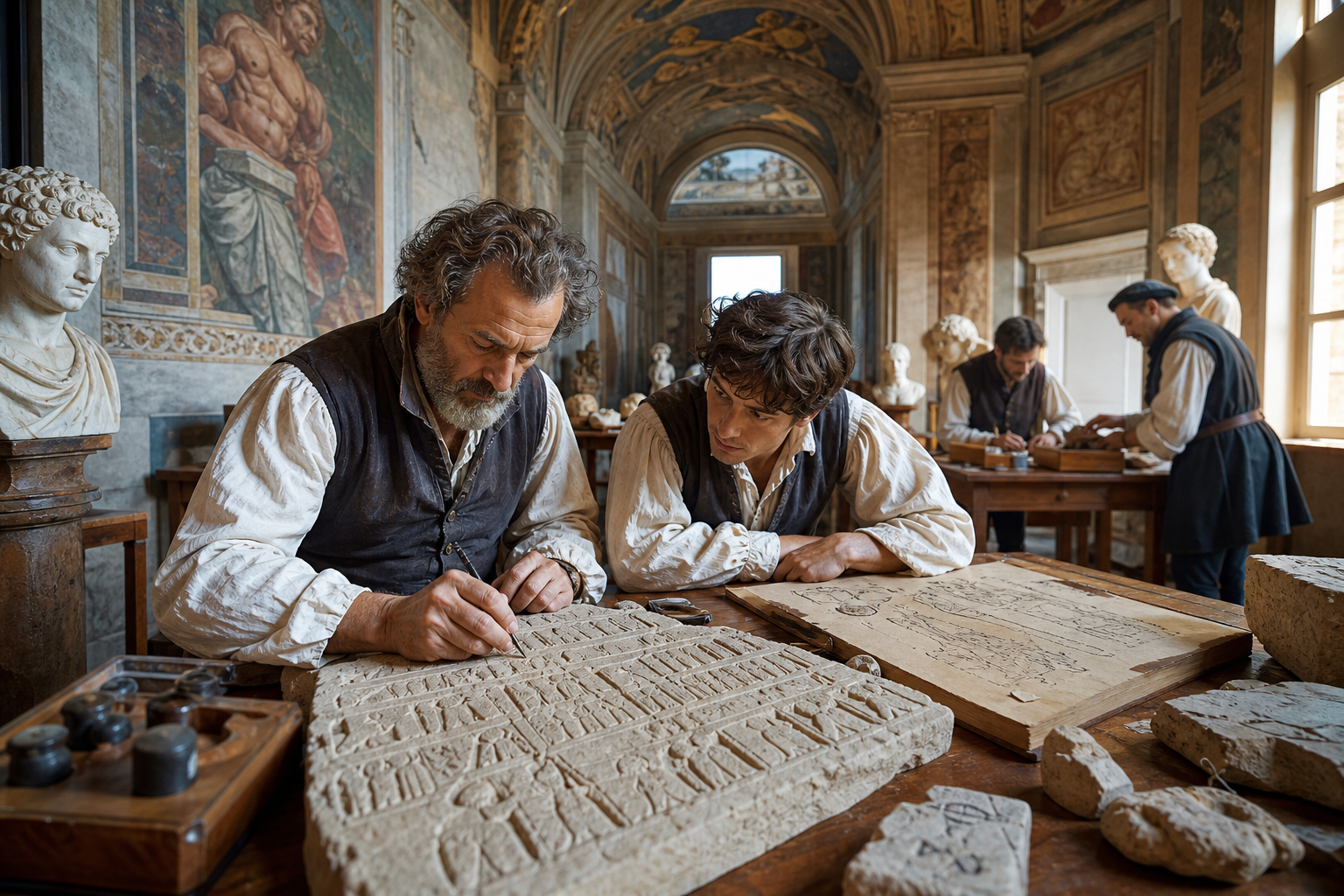
Deciphering the Silent Script: The Mystery of Egyptian Hieroglyphs
From the first chiseled images on limestone to the delicate strokes on papyrus, Egyptian hieroglyphs have long been a bridge between the living and the dead, the political and the sacred, the visible and the unsaid. For millennia, these pictures and signs spoke a language without vowels, a consonantal mosaic that wrapped gods and kings in a narrative both public and personal. The story of hieroglyphs is not merely a technical history of a script; it is a drama of secrecy and revelation, of deliberate obscurity and eventual unmasking. Ancient Egyptian scribes—guardian artisans trained in tightly controlled schools—wove their worldviews into stone, wood, and ink, inscribing what they believed would outlast life and time.
To the modern observer, hieroglyphs convey an aura of mystery: animals and humans frozen mid-gesture, sun-discs and ankhs that shimmer with symbolic weight. Yet behind that visual poetry lies a rigorous system of language and grammar, one that evolved across three millennia and adapted to changing political regimes and cultural currents. The hieroglyphic tradition begins in the shadows of prehistory and comes into clearer view as Egypt centralized under powerful dynasties; it transforms through cursive forms for everyday administration and, finally, retreats as new languages and scripts supplant it. Its rediscovery in the late 18th and early 19th centuries—an intellectual thriller culminating in archaeology-discoveries-the-rosetta-stone-secret-code" title="The Rosetta Stone: The Secret of the Code that Unlocked Ancient Egypt" class="text-primary underline decoration-primary/40 underline-offset-4 hover:decoration-primary">Jean-François Champollion’s epiphany—tore the veil from a civilization’s voice and opened an entire literate archive to modern historians.
This introduction will serve as a doorway. Below, we will follow the traces of hieroglyphic writing from its earliest archaeological appearance through its structural complexities, its applications in religion and governance, its evolution into hieratic and demotic scripts, and the dramatic modern unraveling of its code. Expect close readings of monumental texts—the Pyramid Texts of the Old Kingdom, the funerary Book of the Dead, and the official Ptolemaic decrees—while paying attention to the quiet work of scribes who preserved administrative records and personal letters. This narrative keeps a mystery-driven tone while insisting on verifiable facts: dates rooted in archaeological layers, names of scholars who contributed to decipherment, and the known timeline of the script’s decline. It aims to give you the sensation of handling a reed pen, feeling the papyrus fibers, and, ultimately, listening to voices that spoke across three thousand years.
Did you know? The Pyramid Texts in the tomb of Pharaoh Unas (c. 24th century BCE) are among the oldest extensive hieroglyphic inscriptions, preserving spells aimed at protecting the king in the afterlife.
Origins and Early Development
The origins of Egyptian hieroglyphs are anchored in the late Predynastic (Naqada) periods, where proto-hieroglyphic signs began to appear on pottery, labels, and early palettes. These incipient marks—sometimes simple pictographs and sometimes complex signs—gradually became systematized as Egypt moved toward political unification near 3100 BCE. The earliest securely datable hieroglyphic inscriptions appear in the Early Dynastic period and Old Kingdom. Chief among the early monumental attestations are the royal serekh inscriptions and the ceremonial labels associated with rulers who consolidated territory along the Nile. The evolution of pictorial signs into a full writing system was neither instantaneous nor uniform; it developed as administrative needs, religious expression, and monumental propaganda demanded more precise communication.
The Old Kingdom (c. 2686–2181 BCE) produced landmark textual corpora with considerable religious depth. The Pyramid Texts, inscribed on the walls and sarcophagi of royal burial chambers from the 5th and 6th Dynasties, present some of the earliest extensive sequences of hieroglyphic writing. These texts are among the first to demonstrate how writing could encapsulate ritualized language, cosmology, and a structured set of spells intended to secure a king’s afterlife. Later, during the Middle Kingdom (c. 2055–1650 BCE), the Coffin Texts reworked and democratized many of these funerary utterances, extending them beyond the pharaoh to the broader elite. This period shows not only the continuity of religious content but also the increasing role of writing in private and provincial contexts.
Early corpus material is also invaluable for tracing the development of specific sign forms. Many hieroglyphs show continuity across millennia while others morph to meet stylistic or functional needs. Inscriptions carved on hard stone are durable and often formal; contrast them with ostraca and papyri, where brush and ink allowed rapid cursive variations. Importantly, the specialization of scribal schools during the Old and Middle Kingdoms professionalized literacy. Scribes were trained in distinct repertoires of signs, and their role linked administration to ideology: naming, recording tribute, and inscribing royal achievements were as much acts of governance as they were records.
Did you know? Gardiner's sign list, a modern categorization used in Egyptology, groups hieroglyphs into 26 categories and lists roughly 700 common signs used for academic study and transliteration.
Archaeological context also helps date the appearance and consolidation of hieroglyphic signs. Pottery labels from Abydos and tomb labels from Umm el-Qaab include incised signs that reflect early attempts at representing speech. The presence of logosyllabic and phonetic elements in these early artifacts indicates that by the Early Dynastic period the script had begun the complex interplay between sign types that would characterize the mature system. All this ties hieroglyphs to the political and religious centralization processes happening in Egypt: writing became a tool for legitimizing power, managing resources, and enshrining theological assertions that sustained a pharaonic state.

Beyond monuments and elite tombs, seals and small labels indicate that hieroglyphic elements circulated in everyday administrative contexts. These artifacts reveal a complex relationship between picture and sound that scribes exploited: some signs operated as pictorial ideograms, some as phonetic symbols, and others as markers that clarified meaning but were not pronounced. Over time, this duality allowed hieroglyphs to record not only names and titles but whole narratives, legal decrees, and ritual instructions—a development that would be crucial for later decipherment because it preserved patterns and repeated formulae.
The System: Signs, Grammar, and Reading
Egyptian hieroglyphs embody a sophisticated script system combining logographic, phonetic, and determinative elements. Understanding hieroglyphic writing requires grasping several principal categories: phonograms (signs that denote sounds), ideograms or logograms (signs that represent whole words), and determinatives (signs that clarify meaning and are not pronounced). Phonograms can be uniliteral (single-consonant signs), biliteral (two-consonant signs), or triliteral (three-consonant signs). A relatively small set of uniliteral consonantal signs constitutes the backbone of the phonetic component; these signs are often compared to an alphabet, though the Egyptian script functions differently because vowels are usually absent from the written record.
Did you know? The Rosetta Stone's three scripts—hieroglyphic, demotic, and Greek—were intended for different audiences: priests, local administrators, and the Hellenistic ruling class respectively.
Reading direction in hieroglyphs is a visually governed choice: the orientation of human and animal figures faces the beginning of the line. Thus, inscriptions can be read left-to-right or right-to-left, and in some monumental compositions they are arranged vertically. This flexibility is not arbitrary but stylistic—statuary facings, symmetry, and the physical layout of the monument often determined orientation. Another hallmark is honorific transposition: when a god or king’s name appears in a phrase, the signs representing that name are sometimes written earlier (or given visual prominence) in the inscription even if they are spoken later. This practice emphasized reverence and had implications for the syntactic order of particular formulae.
Determinatives play a unique role—these non-phonetic signs anchor meaning. For instance, a determinative of a seated god clarifies a divine name; a determinative representing a rolled reed or a man undertaking a particular activity narrows down semantic range, resolving potential ambiguity. Consider the word for “house” (pr): the house hieroglyph can function as the logogram for the word and as a phonetic complement in other contexts. Such flexibility often puzzled early decipherers, who first mistook many signs as purely pictorial rather than encoding sound.
Grammatical features of Egyptian reflected in hieroglyphs include a verb-subject-object tendency in certain constructions and a complex system of suffix pronouns, nominal endings, and a bipartite verb system distinguishing stative and dynamic forms. The language recorded by hieroglyphs evolved: Old Egyptian used in the Old Kingdom differs in morphology and lexicon from Middle and Late Egyptian. Importantly, Middle Egyptian (c. 2000–1350 BCE) became a classical written standard—like Latin in medieval Europe—and was studied and copied for centuries even after it ceased to be the vernacular. Knowledge of these diachronic layers was essential to modern scholars as they mapped phonetic values and syntactic patterns across texts.
Did you know? Coptic scripts include letters borrowed from demotic signs to represent Egyptian sounds not covered by Greek characters, preserving phonetic clues for older stages of Egyptian.
Phonetic complements are another mechanism: when a word is written with a biliteral or triliteral sign, scribes often added uniliteral signs to reinforce pronunciation. These spelling conventions left traces that helped Champollion and his contemporaries deduce consistent correspondences. Furthermore, the regular presence of formulaic phrases—royal titulary, offerings lists, and ritual recitations—created repetitions that could be used like hooks: once one element in a string is recognized, the others can be inferred by context.

This tripartite nature—graphic, phonetic, and determinative—meant that Egyptian scribes operated with a high degree of economy and redundancy. For religious and monumental inscriptions, redundancy served aesthetics and sanctity; for administrative texts, cursive variants and shortcuts prioritized legibility and speed. These internal consistencies ultimately allowed the pattern-seeking intellect of the 19th century to reconstruct phonetic values and to map hieroglyphs onto the later vocalic record preserved in Coptic.
Uses and Mediums: Where Hieroglyphs Appeared
Hieroglyphs were never merely an abstract code; they were part of lived spaces and lived beliefs. Monumental architecture—temples, pylons, obelisks, and tombs—provided the most visible canvases. In temples, hieroglyphic inscriptions served liturgical and commemorative purposes: hymns to gods, ritual instructions, lists of offerings, and royal cartouches proclaiming pharaonic achievements. Tombs used hieroglyphs to script the deceased’s journey into the afterlife, with spells, offering formulas, and biographical inscriptions ensuring immortality in the Egyptian cosmological imagination.
Did you know? Jean-François Champollion announced his decipherment of Egyptian hieroglyphs in 1822, establishing phonetic values through comparison with Coptic and the Rosetta Stone’s Greek text.
The funerary repertoire evolved over time. The early Pyramid Texts confined much of this sacred language to kings; later the Coffin Texts allowed a wider circle of the elite to benefit from funerary spells. By the New Kingdom (c. 1550–1070 BCE), the Book of the Dead—more a collection of spells and vignettes than a single canonical book—became widely copied on papyrus for individualized burials. These manuscripts combine hieroglyphic, hieratic, and sometimes demotic notations and are rich sources for understanding theological nuance and the interplay between image and text.
Daily and administrative life used hieratic script—an abbreviated, cursive derivative of hieroglyphs that was faster to write with reed pens on papyrus, ostraca (potsherds), and leather. Legal documents, tax registers, and letters were the currency of hieratic literacy. Examples include the accounts from the temple archives at Karnak, which record offerings and personnel, and the extensive correspondence preserved from the 18th Dynasty. These documents reveal the bureaucratic sophistication of ancient Egypt and the pivotal role of scribes in maintaining the state.
Demotic later took over many of the civil administrative functions and emerged as a distinct script in the first millennium BCE. It became particularly important during the Late Period and Ptolemaic eras when it served as a vernacular script on contracts, petitions, and private letters. The Rosetta Stone itself exemplifies this layered use: its decree is inscribed in three scripts—hieroglyphic (for priests), demotic (for native bureaucrats), and Greek (for the Hellenistic administration)—a stratification that ultimately allowed cross-linguistic comparison.
Did you know? The last known hieroglyphic inscriptions date from around 394 CE, carved at the Temple of Philae, marking the end of a writing tradition stretching over three millennia.
Beyond the written word, hieroglyphs functioned as potent visual signs within art. They integrated with iconography, enhancing the viewer’s understanding of a scene in ways that modern linguistic categories struggle to capture. For instance, a depiction of a king smiting an enemy accompanied by hieroglyphs describing the act merges pictorial narrative and linguistic assertion into a single political statement. The interplay gave hieroglyphs a performative power: they did not just record events; they made ideological claims about the world and the divine order.

Architectural placement also mattered. Inscribing the walls of temple sanctuaries or pylons ensured permanence; papyri and ostraca, conversely, were ephemeral. The choice of medium reflected purpose: to be seen forever by gods and future generations, or to be used and then discarded in the course of daily affairs. This dual economy of permanence and transience shaped which texts survived and which were lost, thereby influencing modern reconstruction of the corpus.
The Script Evolves: Hieratic, Demotic, and Coptic
As Egyptian civilization matured, writing changed forms to suit new needs. Hieratic developed as a cursive shorthand from the practice of writing hieroglyphs quickly on papyrus and other portable materials. Its origins may be traced as early as the First Dynasty, but it became firmly established for administrative, literary, and religious manuscripts by the Old and Middle Kingdoms. Scribes trained in the hieratic hand could write more rapidly than they could carve, and so papyri containing mathematical problems, medical treatises, and literary compositions proliferated. The Edwin Smith Papyrus and Ebers Papyrus—medical texts from the New Kingdom—exemplify the use of hieratic in technical literature.
Did you know? Gardiner's classification and 19th-century epigraphic methods remain essential tools in modern Egyptology, enabling consistent transcription and comparison across thousands of texts.
Demotic emerged later and is often associated with the 7th century BCE, becoming prominent during the Late Period and flourishing under the Ptolemies. It represented a further streamlining, optimized for commerce, contracts, and daily correspondence. The demotic script covers an impressive range of genres: legal formulae, business records, magical texts, and literary compositions. Its name—demotic, from the Greek demotikos, meaning "popular"—reflects its widespread use among the non-priestly population and the Hellenistic-era administrators.
Coptic, the stage of the Egyptian language written in a script based on the Greek alphabet with additional demotic signs for Egyptian sounds, represents the final major evolutionary step. Emerging in the early centuries of the Common Era, Coptic preserves vowel information and thus is indispensable for modern attempts to approximate the phonology of ancient Egyptian. As Christianity spread through Egypt, Coptic became the principal written language for Egyptian Christians and thus the vehicle for religious texts and translations. Although it eventually supplanted hieroglyphic and demotic literacies, Coptic preserves morphological and lexical features that allow linguists to read older stages of Egyptian with greater confidence.
This chain—hieroglyphic to hieratic to demotic to Coptic—illustrates both continuity and transformation. Each script adapted elements from its predecessor: hieratic retained the visual syntax of hieroglyphs while abbreviating forms; demotic further abstracted lines into swift strokes; Coptic imported an entirely different alphabet yet kept Egyptian grammatical structure. Studying these transitions provides a diachronic ladder that scholars climbed in the 19th century when reconstructing the sounds that underlay hieroglyphic signs.
The coexistence of these scripts in the Late Period and Ptolemaic Egypt meant many texts are multilingual mosaics. Scribes were often bilingual or trilingual, switching between demotic for a legal document and Greek for Hellenistic correspondence. The Rosetta Stone’s tripartite inscription is a canonical example of how authorities used different scripts to address different social strata. For modern scholars, the interplay among the scripts provides critical cross-references: where hieroglyphs remain obscure, demotic or Coptic parallels sometimes reveal meanings and pronunciations.
The Rosetta Stone and Decipherment Mystery
The discovery of the Rosetta Stone in 1799 on Napoleon’s Egyptian campaign launched a scientific race that reads like a detective novel. Unearthed by French soldiers near the town of Rashid (Rosetta) in the Nile Delta, the granodiorite slab contains a decree issued in 196 BCE under Ptolemy V. Crucially, its text appears in three scripts: hieroglyphic, demotic, and Greek. The presence of Greek, a language accessible to European scholars, offered the comparative anchor necessary for decipherment. Still, the route from inscription to pronunciation and meaning was neither straightforward nor immediate.
Early attempts at decipherment included those by Athanasius Kircher in the 17th century, who produced imaginative but inaccurate readings, and by later philologists who made incremental progress. In the early 19th century, the English polymath Thomas Young identified phonetic values for several hieroglyphs in the cartouches containing Ptolemaic names. He also made significant observations about the demotic script. However, the decisive breakthrough came from Jean-François Champollion, who combined Young’s findings with a deeper knowledge of Coptic. Champollion recognized that hieroglyphs were not purely ideographic but contained a substantial phonetic component: some signs represented sounds while others functioned as logograms or determinatives.
Champollion’s 1822 Lettre à M. Dacier laid out the principle that unlocked the script: a systematic correlation between hieroglyphic signs and their phonetic values, firmly grounded in Coptic vocabulary for later Egyptian phonology. He demonstrated how proper names—especially foreign names written phonetically in hieroglyphs—could act as keys. For example, the cartouche for Ptolemy included phonetic spellings corresponding to Greek letters. By extrapolating those phonetic values across the corpus, Champollion reconstructed a large number of signs and established a methodological foundation for subsequent Egyptology.
Beyond the intellectual drama, there were political and institutional consequences. The Rosetta Stone itself became a diplomatic touchstone: after the capitulation of the French in Egypt, the artifact came into British possession under the terms of the 1801 Treaty of Alexandria and was transported to the British Museum in 1802, where it remains on public display. The stone’s public exhibition helped popularize Egyptology and fueled European fascination with ancient Egypt throughout the 19th century.
Champollion’s work did not instantaneously translate every inscription; it opened a methodology that allowed subsequent scholars to refine phonetic values, grammatical rules, and sign catalogues. Later contributions by scholars like Karl Richard Lepsius, Sir Alan Gardiner, and others developed rigorous sign lists and grammatical frameworks that standardized transliteration and interpretation. Gardiner’s sign list, in particular, remains a foundational reference in modern Egyptology, helping scholars to categorize and reference signs efficiently.
The decipherment had a stylistic and cultural ripple: deciphering hieroglyphs transformed how Europeans perceived ancient Egypt—not as an inscrutable, pictorial curiosity but as a literate civilization with complex administrative, religious, and literary traditions. The ability to read inscriptions revealed pharaonic self-representation, laws, and everyday concerns with a clarity unattainable in earlier centuries.
Legacy and Rediscovery in Modern Times
The aftermath of decipherment reshaped the intellectual landscape. Egyptology emerged as an academic discipline in the 19th century, with museums, universities, and archaeological expeditions committed to excavating and cataloguing inscriptions and artifacts. Excavations at sites like Thebes, Giza, Abydos, and Saqqara unearthed tombs and temples whose inscriptions now form the backbone of Egyptological study. The recovered texts—ranging from monumental inscriptions to personal letters—allow historians to reconstruct political events, religious beliefs, and social practices with detail and nuance.
The 20th and 21st centuries brought new technologies and interpretive frameworks. Photography, for example, allowed epigraphers to capture inscriptions in detail; rubbings and squeezes recorded reliefs for study outside Egypt. More recently, multispectral imaging and digital epigraphy have recovered faded ink on papyri and ostraca, revealing texts invisible to the naked eye. These techniques continue to refine readings, correct earlier errors, and sometimes reveal entirely new texts that change scholarly understandings. Digital corpora and searchable databases have democratized access to inscriptions, enabling a global community of scholars to collaborate and critique interpretations.
Beyond academia, hieroglyphs have saturated popular imagination and visual culture. From 19th-century Egyptomania and the use of Egyptian motifs in architecture and decorative arts to modern cinematic and literary portrayals, hieroglyphs act as evocative symbols of antiquity and mystery. The discovery of Tutankhamun’s intact tomb in 1922 by Howard Carter and the fame of the young pharaoh’s golden mask rekindled public interest and underscored how material culture and writing combine to capture imaginations worldwide.
Modern debates also engage with heritage, repatriation, and the ethical management of artifacts housed in foreign museums. The Rosetta Stone’s presence in the British Museum is part of broader discussions about colonial-era acquisitions and the rightful custodianship of cultural heritage. At the same time, Egyptian institutions and international partners collaborate on conservation and site management to protect inscriptions from environmental damage and human threats.

Contemporary scholarship continues to refine our understanding of hieroglyphs as more texts come to light and as interpretive paradigms shift. Recent work emphasizes the social practices of writing: who wrote, where they trained, and how literacy functioned as a tool of power and identity. At the same time, philological advances refine readings of ritual texts and administrative documents, offering ever-more-subtle portraits of ancient Egyptian thought and organization. The dialogue between the ancient signs and modern readers remains dynamic: each new discovery is a fresh clue in an ongoing narrative that binds us to the Nile’s long human history.
Conclusion: Listening to an Ancient Voice
If one stands before a temple wall carved with hieroglyphs, time collapses: the chisel marks made by artisans thousands of years ago still catch the sun, and the script’s forms radiate a carefully ordered cosmos. Reading hieroglyphs is partly an intellectual endeavor—deciphering patterns, sounds, and grammar—and partly an imaginative act, reconstructing worlds where kings negotiated with gods and scribes mediated between cosmic imperatives and daily administration. The trajectory of hieroglyphic writing—from early pictographs to a full-fledged script, from its transformation into cursive forms, to its final flicker in late antique Egypt—maps a civilization’s capacity to make the invisible authoritative.
The mystery that once shrouded hieroglyphs has not entirely vanished; modern scholarship peels away layers while new questions always appear. Some signs remain ambiguous, and nuances of ancient pronunciation are mediated by Coptic reconstructions and linguistic inference. Yet the great arc of revelation—from the stone discovered by chance in a Nile delta town to the learned rooms of 19th-century Paris where letters and proofs were feverishly exchanged—demonstrates how human curiosity can resurrect entrenched silence.
Today, hieroglyphs continue to speak: to scholars working in dusty archives, to conservators under the blazing Egyptian sun, and to museumgoers tracing the sinuous lines that once recorded a civilization’s prayers, laws, and love for order. To decode them is to listen across millennia to a voice at once administrative, devotional, and deeply human. The script’s endurance—materialized in stone and papyrus—invites us to keep reading, comparing, and imagining, ever aware that each new fragment might change the story we tell about ancient Egypt’s long and luminous past.
How we verify this article
By the History Unlocked editorial team
This text is built on historical facts stored in our database and drafted with AI assistance. No signed human review is recorded for this article. Report any inaccuracy: we correct it and update the modified date.
Updated on
AI-assisted drafting.
Read our editorial standardsEnjoyed this? Discover more articles in the category Art & Symbolism