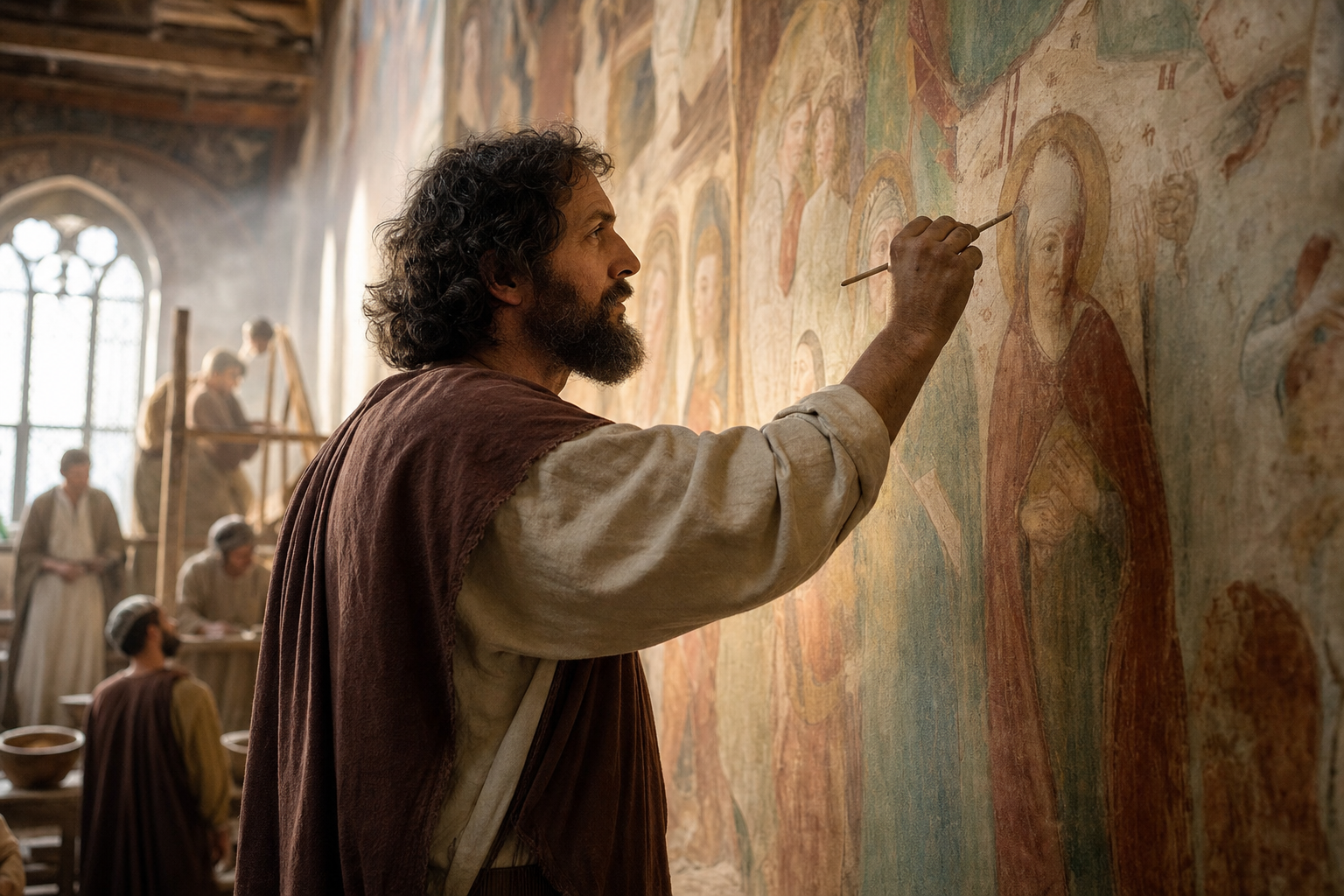
Giotto and the Painting Revolution: The Birth of Renaissance Art
In the annals of art history, few figures stand as tall or cast as long a shadow as Giotto di Bondone. Emerging from the twilight of the Middle Ages, an era dominated by the rigid, symbolic aesthetic of Byzantine art, Giotto ignited a revolution that would forever alter the course of Western painting. Before him, art served primarily as a didactic tool, an expression of spiritual truths rendered in flat, two-dimensional forms that transcended earthly realities. Figures floated against golden backgrounds, devoid of weight or human emotion, their gestures stylized and their expressions serene, almost ethereal. Giotto, however, dared to look at the world with fresh eyes, to see humanity not as an abstract concept but as a tangible reality, imbued with flesh, blood, and a full spectrum of emotions. He brought the sacred down to earth, imbuing his madonnas and saints with a startling humanity, their faces etched with joy, sorrow, and contemplation. This was not merely a stylistic shift; it was a profound reorientation of artistic purpose, a bold declaration that art could reflect the temporal world with all its complexities and beauty, without diminishing its spiritual resonance. His innovations in perspective, chiaroscuro, and the depiction of emotional depth laid the foundational stones upon which the entire edifice of the Italian Renaissance would later be built. To understand Giotto is to understand the very birth of modern Western art, a seismic shift that continues to resonate through centuries of artistic endeavor, challenging artists to look beyond convention and discover new ways of seeing and representing the world.
From Byzantine Flatness to Revolutionary Naturalism
The artistic landscape of Europe prior to Giotto was largely defined by the Byzantine tradition, a powerful and enduring aesthetic inherited from the Eastern Roman Empire. Characterized by its adherence to strict iconography, stylized forms, and a pronounced flatness, Byzantine art emphasized spiritual transcendence over earthly verisimilitude. Figures, often elongated and ethereal, populated golden, undifferentiated backgrounds, their gazes direct and unwavering, as if peering into an otherworldly realm. The intent was not to replicate the visual world but to symbolize divine truths, creating an art that was abstract, hieratic, and deeply reverent. While possessing a profound beauty and spiritual intensity, this style offered limited scope for individual expression or the exploration of human emotion and physical reality. Giotto, born around 1267 in Vicchio, near Florence, grew up in this artistic milieu, yet his genius would lead him to break free from its rigid constraints. The precise details of his early training remain shrouded in some mystery, but legend suggests he was discovered by the renowned painter Cimabue, who recognized the young shepherd boy’s remarkable talent for drawing. Whether fact or charming fable, the story underscores Giotto’s innate capacity for observation and his inherent departure from established norms. He sought to imbue his figures with weight, volume, and a sense of three-dimensionality, using subtle gradations of light and shadow—a technique known as chiaroscuro—to model their forms and anchor them firmly in space. No longer did saints float weightlessly; they stood on solid ground, their drapery falling in convincing folds that revealed the underlying anatomy. This revolutionary approach brought an unprecedented sense of realism to religious narrative, transforming the static, symbolic tableau into a dynamic, emotionally resonant scene. His figures conversed, grieved, and expressed joy with a naturalness previously unseen, drawing the viewer into the narrative with an immediacy that was both unprecedented and deeply moving. This transition from the flat, symbolic world of Byzantine art to an art rooted in observation and human experience marks one of the most significant revolutions in Western painting, a paradigm shift that Giotto spearheaded with unparalleled vision and skill, laying the essential groundwork for the artistic innovations that would follow.
The Scrovegni Chapel: Giotto's Masterpiece
Among Giotto's extensive oeuvre, no single work encapsulates his revolutionary vision and artistic genius more profoundly than the frescoes adorning the Scrovegni Chapel in Padua, completed around 1305. Commissioned by Enrico Scrovegni, a wealthy banker, as a private chapel intended to atone for his father's usury – a practice condemned by the Church – the chapel is a veritable visual Bible, narrating the lives of Joachim and Anne, the life of the Virgin Mary, the life of Christ, and culminating in the Last Judgment. What makes the Scrovegni Chapel so groundbreaking is not just the sheer scale of the undertaking, but the consistency and daring of Giotto's artistic program. Within this relatively small space, Giotto achieves a sense of monumental grandeur and narrative intimacy that was astonishing for its time. He meticulously divides the walls into horizontal registers, each panel depicting a specific scene with unparalleled clarity and emotional depth. The blue vault of heaven, dotted with golden stars, unifies the entire composition, creating an illusion of open sky above the earthly narratives. Giotto's figures here are not idealized, abstract types; they are tangible, relatable individuals, each endowed with a distinct personality and emotional resonance. The famous Lamentation over the Dead Christ, for instance, is a tour de force of human suffering and empathy. The crumpled figures, the anguish on Mary's face, the sorrow of the disciples, and the heart-wrenching gestures of the angels above, all contribute to an overwhelming sense of shared grief. The careful arrangement of figures, the dramatic use of gesture and facial expression, and the subtle yet powerful indication of a three-dimensional space through foreshortening and architectural elements, all serve to draw the viewer into the sacred narrative with unprecedented emotional intensity. Unlike the flattened, symbolic compositions of his predecessors, Giotto's scenes unfold in believable, if still idealized, environments. His use of a deep, rich palette, moving away from the more vibrant, jewel-toned hues of Byzantine art, also contributes to the gravity and naturalism of the scenes. The Scrovegni Chapel stands as a singular testament to Giotto’s revolutionary ability to bridge the spiritual and the earthly, making divine stories powerfully human and profoundly moving. Its influence was immediate and far-reaching, setting a new benchmark for narrative painting and inspiring generations of artists who would follow in his footsteps, solidifying its place as one of the most important monuments in Western art history.
Did you know? It is said that Giotto once painted a fly on a painting by his master Cimabue so realistically that Cimabue tried to swat it away.

Mastering Perspective and Emotional Depth
One of Giotto's most profound and enduring contributions to the history of art was his innovative approach to perspective and the depiction of emotional depth. Prior to his work, the illusion of three-dimensional space within a two-dimensional painting was largely absent in Western art. Byzantine artists, as discussed, prioritized symbolic representation over spatial accuracy, resulting in flat, hierarchical compositions. Giotto, however, sought to create a believable, illusionistic space in which his figures could exist and interact. While he did not invent linear perspective in its fully developed form – that development would come later with artists like Brunelleschi and Masaccio in the early Renaissance – he made significant strides towards it. Giotto experimented with intuitive perspective, arranging architectural elements and figures in a way that suggested depth and recession. He manipulated scale, placing figures further away smaller than those in the foreground, and used overlapping forms to create a sense of foreground, middle ground, and background. Although not always geometrically precise, his efforts significantly advanced the representation of spatial depth, moving away from the stacked, symbolic spaces of earlier art towards a more coherent and unified pictorial environment. This innovation dramatically enhanced the storytelling power of his frescoes, allowing viewers to feel as if they were peering into a real, three-dimensional scene rather than merely observing a flat surface. Beyond spatial innovation, Giotto was a master of conveying human emotion. His figures are not impassive or generalized; their faces are often portraits of intense feeling. He understood the nuances of human expression, depicting grief, joy, anger, contemplation, and resignation with astonishing accuracy. In the Kiss of Judas in the Scrovegni Chapel, for example, the intense confrontation between Christ and Judas is heightened by their penetrating gazes, their faces almost touching, surrounded by the chaotic swirl of soldiers and disciples. This psychodrama is rendered with an emotional intensity that had no precedent. Giotto used subtle shifts in body language, gesture, and facial expression to communicate complex inner states, inviting the viewer to empathize with the characters and become emotionally invested in the narrative. This profound psychological insight, combined with his burgeoning understanding of spatial illusion, allowed Giotto to render grand narratives with an unprecedented level of human truth, effectively making sacred stories feel intimately relatable. His ability to fuse spatial innovation with emotional depth would become a hallmark of Renaissance art, a legacy that can be traced directly back to his pioneering efforts to bring humanity and realism to the canvas.
Giotto's Workshop and Legacy
Giotto’s revolutionary approach to painting did not operate in a vacuum. Like many prominent artists of his time, he maintained a highly active and influential workshop, a bustling hub where apprentices and assistants learned his techniques, prepared pigments, and contributed to the execution of his extensive commissions. The workshop system was crucial for disseminating artistic innovations, and Giotto's certainly played a pivotal role in spreading his new naturalistic style throughout Italy. Apprentices would meticulously copy the master’s drawings, learn his methods for constructing compositions, and assist in applying frescoes, internalizing his revolutionary concepts of space, form, and emotion. This pedagogical approach ensured that Giotto's artistic language, with its emphasis on volume, naturalism, and dramatic narrative, would endure and evolve beyond his lifetime. The sheer demand for his work, from papal commissions in Rome to grand projects in Florence, Padua, and Assisi, meant that he required a skilled team to execute his vision. While attributing specific hands within extensive fresco cycles can be challenging, the overall consistency and quality across projects underscore the effectiveness of his workshop in maintaining a distinctive
How we verify this article
By the History Unlocked editorial team
This text is built on historical facts stored in our database and drafted with AI assistance. No signed human review is recorded for this article. Report any inaccuracy: we correct it and update the modified date.
Updated on
AI-assisted drafting.
Read our editorial standardsEnjoyed this? Discover more articles in the category Art & Symbolism