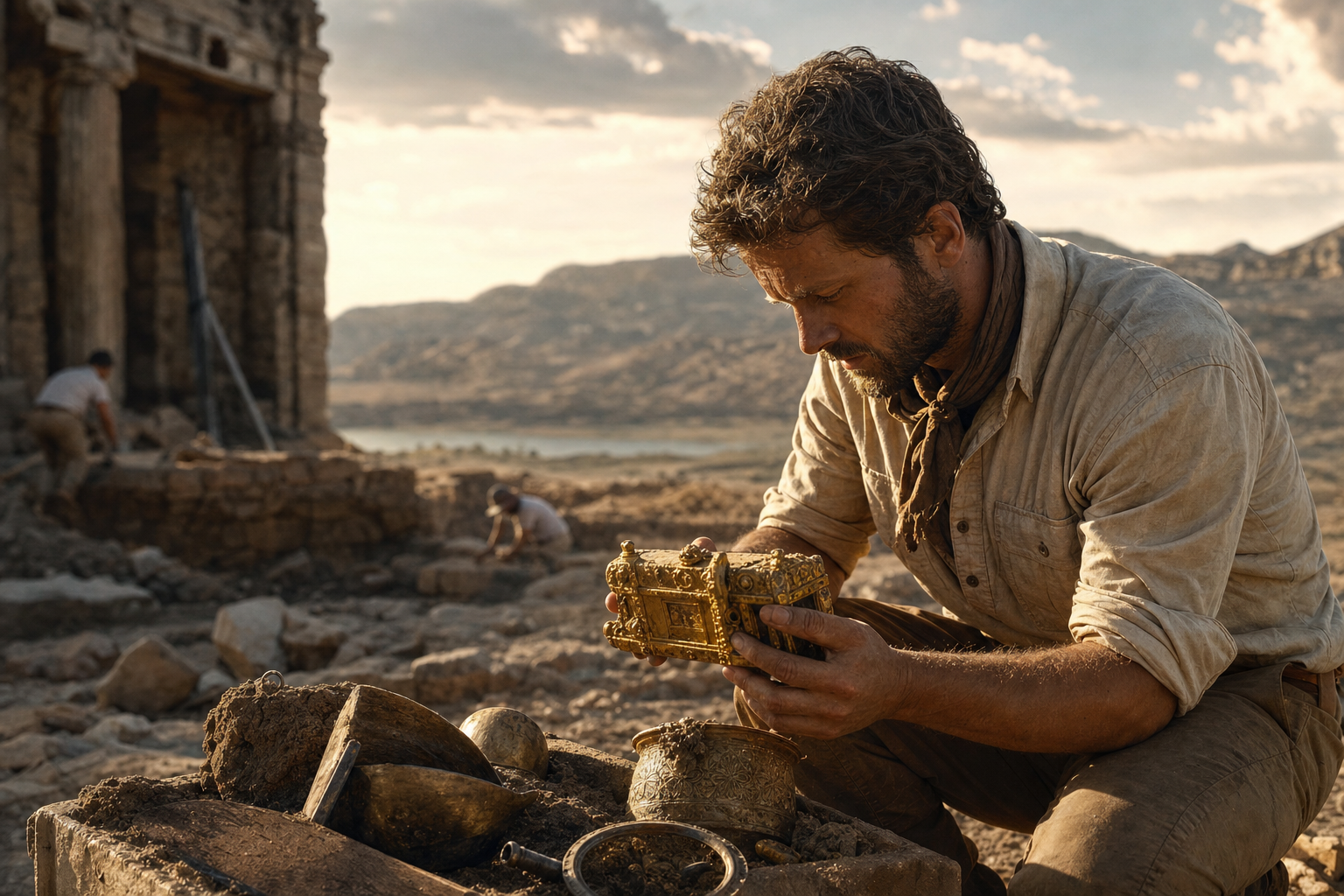
King Solomon's Mines: Myth, Archaeology, and the Search for Ancient Riches
The legend of King Solomon's mines has lodged itself in the popular imagination for more than a century, a glittering confluence of biblical text, Victorian adventure fiction, colonial ambition, and modern archaeological inquiry. From the brief, evocative mentions in the Hebrew Bible of a monarch whose wealth was measured in tons of gold to the dashing fictional expeditions of 19th-century novelists, the idea of secret mines that supplied Solomon's splendor has been retold, reimagined, and repurposed across cultures and eras. Yet the boundary between myth and material evidence is porous: archaeologists and historians have unearthed real mining landscapes, metallurgical installations, and trade networks that explain how ancient polities acquired the metals necessary for palaces, temples, and decoration. Understanding King Solomon's mines therefore requires walking a narrow path between textual exegesis, literary history, and hard geological and archaeological fact.
In this long-form study I aim to trace that path. I begin with the earliest textual traces: the biblical references to Solomon's gold, to the elusive land of Ophir, and to the maritime ventures that returned with cargoes of exotic timber and precious metals. Then I follow how those sparse verses were transmuted, in the Victorian imagination, into a full-blown adventure archetype by writers such as H. Rider Haggard. From there I shift to the archaeological record: the copper-smelting fields of Timna in southern Israel, the vast mined landscapes of Faynan and Khirbat en-Nahas in modern Jordan, and the metalworking remains that speak to long-distance trade. I examine the competing theories for Ophir’s location (East Africa, southern Arabia, the Indian Ocean rim), the role of Phoenician and Egyptian trade in moving bullion across the ancient world, and the colonial-era appropriation of the Solomon motif in Africa, notably in interpretations of Great Zimbabwe.
Throughout, I emphasize verifiable findings. Dates for Solomon's conventional reign are given by historians as c. 970–931 BCE, and archaeological chronologies for copper and gold exploitation are derived from radiocarbon and typological analysis. Where evidence is lacking or disputed—such as a direct archaeological link between a specific mine and the historical Solomon—I make those gaps explicit. The goal is not to demolish the romance but to situate it: to reveal how myth and material culture inform one another, why certain sites became labelled 'Solomonic' in the past, and what modern science can, and cannot, tell us about the sources of ancient wealth. By the end of this article readers will have a clear sense of which parts of the story rest on solid ground and which remain the stuff of legend.
Did you know? The Bible records Solomon's annual gold intake as 666 talents (1 Kings 10:14), a number that later generations found symbolically evocative for reasons that have nothing to do with ancient metallurgy.
The Biblical Roots: Solomon, Ophir, and the Language of Wealth
The earliest and most influential source for the image of Solomon's wealth is the Hebrew Bible. The books of 1 Kings and 2 Chronicles—composed and compiled over centuries but preserving traditions that many scholars situate in or about the tenth century BCE—offer the most concrete allusions. Several short but striking passages describe Solomon's acquisition of vast quantities of gold and exotic goods. 1 Kings 10:14 famously lists Solomon's annual gold intake as 666 talents; Genesis-era units make exact conversion difficult, but the image is unmistakable: a king whose coffers overflowed with bullion. Other passages speak of a fleet of ships (often associated with Ezion-Geber on the Red Sea) that voyaged to distant lands and returned with gold, almug wood (often translated as 'algum' or sandalwood), and precious stones (1 Kings 10:11–22).
The name Ophir appears repeatedly as the source of Solomon's gold. Ophir's precise location, however, is not identified in the biblical texts themselves; rather, it is placed within the narrative world of Near Eastern trade and seafaring. Ancient scribes and later interpreters offered competing guesses: Ophir has been associated with locations as diverse as the Red Sea coast of Arabia, the southern Arabian region of Dhofar (modern Oman), coastal East Africa (including sites along Tanzania and Mozambique), and even the Malabar coast of south-west India. Each identification relies on strands of evidence: ancient toponyms, classical and medieval geographical texts, and archaeologists' readings of trade networks.
Importantly, the biblical references do not explicitly claim that Solomon personally owned or operated underground gold mines of the kind imagined in later fiction. The model the Bible presents is complex: gold might arrive as tribute, as trade goods from long-distance commerce, and as part of tributary arrangements with neighboring kingdoms. The texts also reflect the reality of elite consumption in the ancient Near East, where rulers obtained luxury materials by sponsoring long-distance expeditions or by controlling local production and trade infrastructure.
Did you know? H. Rider Haggard wrote King Solomon's Mines after time spent in South Africa; the real discovery of the Witwatersrand gold reef in 1886 fed contemporary fantasies of subterranean treasure.
When historians date Solomon to c. 970–931 BCE they are using chronologies derived from biblical synchronisms and external anchors, such as Egyptian and Near Eastern king lists. While there is ongoing debate about the scale of Solomon's polity and economic reach, the tenth century BCE remains the conventional temporal frame for evaluating claims about his reign. Archaeological evidence for urbanization and monumental building in sites traditionally linked to united Israel—such as Khirbet Qeiyafa and Megiddo—has both reinforced and complicated historians' pictures of the 10th century. None of these finds, however, constitute a smoking gun that ties a particular mine or deposit directly to a named monarch from the biblical record.
H. Rider Haggard and the Victorian Alchemy of Adventure
The leap from biblical allusion to cinematic subterranean treasure was made not by archaeologists but by fiction. In 1885 H. Rider Haggard published King Solomon's Mines, a novel that reshaped the legend for a global reading public. Haggard's tale draws on the conventions of imperial exploration, the contemporary news of African mineral wealth, and the appetite of Victorian readers for exotic, quasi-anthropological thrills. The novel presents a lost inland kingdom, guarded riches, and the interplay of European explorers with African polities, thereby giving shape to a visual and narrative template that would recur in literature, film, and popular discourse.
Haggard himself was influenced by the age of exploration and by earlier travel narratives; the discovery of the Witwatersrand goldfields in South Africa (late 19th century) and the ongoing penetrations of interior Africa by European explorers fed the public imagination. Haggard's narrative is not archaeology, yet it has been enormously consequential: the phrase 'Solomon's Mines' became shorthand for any exotic, colonially imagined source of great wealth, fueling amateur prospectors and professional colonial administrators alike. The novel also reflected and reinforced prevailing racial and imperial attitudes; its depictions of African polities were selective and shaped by Haggard's Victorian worldview.
Did you know? At Timna, the sandstone pillars popularly called 'Solomon's Pillars' are a natural feature; the archaeological record there shows strong traces of Egyptian-style material culture in some layers.
The impact of Haggard's fiction extended into the field of exploration. Treasure-hungry prospectors and archaeologists of the colonial period sometimes described their searches in terms that echoed Haggard's tropes, even when the physical evidence did not. Expeditions that sought the 'real' Solomon's Mines often conflated biblical and classical geography with local oral traditions, misread natural formations, and projected European categories onto landscapes with different histories. Yet the novel also inspired a productive curiosity: in the decades that followed its publication, scholarly and popular interest in ancient trade routes, South Arabian inscriptions, and African monumental ruins intensified.
Haggard's work also brought the idea of 'lost' or hidden knowledge in the context of empire. The titular mines resemble many other literary motifs where ancient civilizations possess concentrated wealth now buried by time. In this sense, Haggard's novel functions as both entertainment and a cultural lens through which imperial Europe viewed foreign economic potential. Artifacts and architectural forms that archaeologists would later date precisely and analyze scientifically were, in Haggard's fiction, tokens of moral and narrative mystery. The public's appetite for rediscovery encouraged museums, collectors, and colonial administrations to fund expeditions, mapping projects, and antiquarian studies—all activities that eventually yielded the raw data of modern archaeology.

Timna and Khirbat en-Nahas: Copper Landscapes and 'Solomonic' Labels
If the idea of Solomon's gold is hugely attractive, the most tangible archaeological landscapes often associated with the broader Solomonic corpus are copper production sites. Two locations figure prominently in scholarly and popular discussions: the Timna Valley in the southern Negev (modern Israel) and Khirbat en-Nahas and the broader Faynan region of southern Jordan. Excavations at both places have revealed extensive evidence of ancient mining and metallurgical activity. The temptation to label these remains as 'Solomonic' emerged in the 19th and early 20th centuries and persisted in popular literature and early archaeological writing, but modern research has nuanced or rejected a direct, exclusive attribution to Solomon.
Did you know? The port of Sofala in Mozambique was famous in medieval times for supplying gold to the Indian Ocean trade; while often invoked in discussions of long-distance gold trade, it reflects a later phase than the biblical narrative.
Timna has been subjected to sustained archaeological investigation since the mid-20th century, notably by Beno Rothenberg beginning in the late 1950s and continuing through the 1960s and 1970s. Rothenberg's work identified large-scale copper-smelting furnaces, slag heaps, and associated mining features. He and others originally dated intensive activity at Timna to the Late Bronze Age and Iron Age periods; specific phases have been tied to the 13th–10th centuries BCE, although more refined stratigraphic and radiocarbon work has shown multiple periods of exploitation, including earlier and later episodes. The iconic sandstone formations known as 'Solomon's Pillars' in Timna contributed to the site's popular branding as Solomonic, but archaeological layers and material culture often point to Egyptian presence and influence, especially in the Late Bronze Age contexts when Egypt had broader control or influence over the southern Levant.
Khirbat en-Nahas, by contrast, lies within the Faynan region of southern Jordan and has been central to discussions about regional metallurgy in the Iron Age. Recent excavations and surveys—led by international teams including Thomas E. Levy and others—have produced evidence for extensive smelting installations, large slag heaps, and evidence of organized production that could support state-level demands for metal. Radiocarbon dates and stratigraphic analysis suggest major activity in the 11th–9th centuries BCE, a period that overlaps with the conventional chronological frame for the early Israelite kingdoms and neighboring polities such as Edom. Some scholars have argued that the scale of metallurgy at Faynan indicates centralized control, possibly by emerging states in the region. Others emphasize the multi-ethnic and multi-political character of the production landscape; the label 'Edomite' or 'Israelite' applied to such sites must be used cautiously.
Crucially, the presence of large-scale copper production in the southern Levant and Transjordan does not confirm the existence of Solomon's legendary treasure chambers. What it does confirm is that the ancient Near East possessed the technological capacity to extract and smelt non-ferrous metals and that these industries operated in complex political economies. The attribution of such sites to 'Solomon' comes from a mixture of early archaeological enthusiasm, local toponymy, and the appeal of biblical narratives to explorers and colonial officials. Modern archaeology, with better dating techniques and more careful cultural analysis, tends to treat these sites as evidence of regional metal economies rather than proof of a single monarch's monopoly over mineral wealth.
Did you know? Gertrude Caton-Thompson's 1931 excavation report on Great Zimbabwe convincingly demonstrated the indigenous African origins of the site, challenging widespread claims that it was built by outsiders like Phoenicians or followers of Solomon.
Ophir, Sheba, and the Maritime Networks of the Ancient World
The figure of Ophir in the Hebrew Bible has driven much speculative geography. Because the biblical text emphasises seafaring and exotic goods—gold, almug wood, precious stones—many investigators have inferred that Ophir lay on or near maritime trade routes. The multiplicity of proposed locations reflects the broad reach of Late Bronze and Iron Age trade networks and the fragmentary nature of the evidence.
One of the oldest proposals places Ophir in southern Arabia, a region traditionally associated with the kingdom of Saba (Sheba). Sabaean inscriptions and South Arabian architecture attest to a wealthy, maritime-oriented polity that controlled incense routes and engaged in trade across the Red Sea and Indian Ocean. The port of Sumhuram (Khor Rori) in modern Oman, and sites in the Dhofar region, have been suggested as potential nodes in a network that could have supplied precious goods to the Near East. Archaeological and epigraphic evidence from South Arabia corroborates the existence of an active long-distance commerce in the first millennium BCE, but linking any specific South Arabian site directly to Ophir remains speculative.
Another set of proposals locates Ophir in East Africa. Classical authors, and later medieval geographers, sometimes associated the African coast—especially areas corresponding to modern Somalia, Kenya, Tanzania, and Mozambique—with rich sources of ivory and gold. The port of Sofala (in modern Mozambique) became renowned in the medieval period for its gold trade into the Indian Ocean complex, and some historians have argued that the East African gold trade has deeper roots extending into the first millennium BCE. Archaeological finds on the Swahili coast show Indian Ocean trade connections in later periods, but establishing direct links to the tenth century BCE and to the Ophir of the Bible is difficult.
Did you know? Lead isotope analysis has been used to match copper and bronze artifacts to specific ore fields, providing powerful evidence for ancient trade patterns—but gold provenance remains more challenging due to its geochemical behavior.
A third hypothesis places Ophir on the Malabar Coast of India, where classical references to 'gold' and 'precious woods' could match imported goods. Indian Ocean trade between South Asia and the Middle East is well documented in the first millennium BCE and later; maritime technology and seasonal monsoon navigation made such long voyages possible. Yet, as with other identifications, the evidence tying a specific Indian port to Ophir is circumstantial rather than definitive.
In short, Ophir may be less a single, geographically fixed site than a shorthand for a constellation of trade partners and exchange networks. The biblical description highlights the movement of goods across oceans and seas, a reality that archaeologists and historians now recognize as a defining feature of the ancient world. Understanding Ophir therefore requires comparative study of South Arabian epigraphy, East African coastal archaeology, and Indian Ocean trade dynamics.
Colonial Mythmaking and Great Zimbabwe: When Archaeology Met Empire
During the late 19th and early 20th centuries European colonial administrators and antiquarians were eager to map local ruins onto familiar classical and biblical narratives. Nowhere was this more pronounced than in southern Africa, where the impressive stone enclosures of Great Zimbabwe, discovered by Europeans in the 19th century, were variously attributed to Phoenicians, Arabs, or even to King Solomon himself. These attributions reflected a colonial reluctance to accept that indigenous African societies could have produced large, complex stone constructions and vibrant commercial networks.
Did you know? Modern underwater archaeology and surveys of Red Sea ports continue to expand our knowledge of ancient maritime networks that could have supplied exotic goods to the Levant in the first millennium BCE.
The work of archaeologists such as Gertrude Caton-Thompson in the 1920s and 1930s was crucial in overturning these myths. Caton-Thompson's excavations and analyses demonstrated that Great Zimbabwe—now dated primarily to the 11th–15th centuries CE—was an indigenous Shona-built complex with deep historical roots in southern Africa. Her work, published in 1931, provided stratigraphic and material evidence that undermined claims of Phoenician or Solomonic origins. Modern archaeological and ethnohistorical work has reinforced this conclusion: Great Zimbabwe was part of a broader southern African political economy exploiting gold fields in regions of modern Zimbabwe and Mozambique, but it belonged to African trajectories of state formation and trade, not to mythical Near Eastern interventions.
Colonial narratives that linked Great Zimbabwe to 'Solomon's Mines' were not harmless misreadings; they facilitated interpretations of African pasts in which European and Asian influences were privileged over indigenous agency. These narratives also fed popular imaginations and prospectors who continued to search for literal Solomonic treasure in southern Africa. It is important to emphasize that Great Zimbabwe and the later Kingdom of Mutapa were indeed connected to regional gold production and long-distance exchange, especially in the Indian Ocean world of the second millennium CE. But their histories are distinct in time and context from the biblical tenth century BCE associated with Solomon.
The deconstruction of Solomonic attributions in Africa exemplifies how archaeology can disentangle myth from material fact. It also demonstrates the political stakes of archaeological interpretation: who gets credit for monumental achievements, and how are ancient peoples and states represented in histories shaped by colonial power? The legacy of the Solomon myth in Africa thus provides sobering lessons about the intersection of romance, imperial ambition, and scientific inquiry.

Modern Scientific Methods: Tracing Metals and Reconstructing Trade
In the last half-century archaeological science has given scholars new tools to investigate ancient metallurgy and long-distance exchange—tools that allow nuance where older narratives offered only grand claims. Radiocarbon dating, archaeometallurgical analysis, and isotopic sourcing techniques have all contributed to a more detailed understanding of where metals originated and how they were moved, recycled, and consumed.
Archaeometallurgy involves the study of furnaces, slag, crucibles, and metallurgical debris to reconstruct production techniques. Analysis of slag chemistry can reveal the temperatures achieved in furnaces and the efficiency of smelting techniques. Radiocarbon dating of associated charcoal and organic remains provides absolute chronological anchors for production episodes. In regions such as Timna and Faynan, these approaches have refined occupational chronologies and identified multiple phases of production, sometimes separated by centuries.
Isotopic analysis—particularly lead isotope analysis—has been pivotal in sourcing non-ferrous metals. Lead isotopes vary with geological deposits and can sometimes link a finished metal object or metal sample to a particular ore field. Such methods have been successfully applied to match copper objects to Cypriot, Anatolian, or Iberian ore sources in various contexts. Gold presents different challenges: its geochemical signatures are more difficult to use for provenance work because gold often occurs with trace elements that may not be diagnostic over long distances. However, studies combining trace element analysis, lead isotopes (when gold contains trace lead), and archaeological context can narrow possibilities.
Beyond geochemical techniques, palaeoenvironmental and botanical studies inform our understanding of the logistical dimensions of metal production. Charcoal species analysis reveals what types of wood were used as fuel, offering clues about deforestation, trade in fuelwood, and the transport costs associated with metallurgical industries. Spatial analyses—using GIS and landscape archaeology—help reconstruct ancient routes between mines, smelting sites, and consumption centers.
These scientific methods have not produced a definitive map of 'Solomon's Mines', but they have yielded a richly textured picture of an interconnected ancient world. Metals and luxury goods moved across vast distances through complex chains of production, exchange, and consumption. Some of the raw materials in King Solomon's realm may have been locally produced (for copper, for example), while gold and exotic timbers probably came via maritime networks that included South Arabia, East Africa, and even South Asia.
Conclusion: The Enduring Appeal and the Real Work of Discovery
Why does the idea of King Solomon's mines persist? At one level the answer is simple: gold and mystery are perennial attractions. At another level, the legend endures because it sits at the intersection of narrative needs and historical possibility. The biblical texts contain tantalizing hints about wealth and long-distance exchange; Victorian fiction dramatized those hints into adventure; colonialism and early archaeology variously amplified or distorted them. Modern archaeological science has been busy dismantling simplistic equations between mythic kings and imagined treasure troves, but it has also shown how real landscapes of mining and trade supported ancient polities.
The most responsible historical reading is a layered one. The biblical Solomon likely presided over polities that engaged in tribute and long-distance commerce; archaeological sites in the southern Levant and Transjordan demonstrate that copper production and metalworking were significant economic activities. The label 'Solomon's mines', however, functions better as a cultural metaphor than as a specific archaeological descriptor. Sites such as Timna and Khirbat en-Nahas tell us about technologies, economies, and political organizations in the first millennium BCE; they do not deliver a single narrative about one legendary king's hoard.
Future work will continue to refine chronologies, trace networks with better geochemical tools, and recover the human stories embedded in slag heaps and harbor deposits. New fieldwork in the Arabian Peninsula, advances in underwater archaeology along Red Sea and Indian Ocean coasts, and improved isotopic techniques for precious metals will make the picture yet more complex and fascinating. Most importantly, contemporary approaches stress local agency and a respect for indigenous histories rather than telescoping all evidence into foreign legends.
In the end, King Solomon's mines remain a powerful lens through which to explore ancient globalization, the production and consumption of luxury, and the modern politics of interpretation. The legend may not yield a single subterranean vault stuffed with bullion for some intrepid adventurer to plunder. But the archaeological record gives us something truer and more interesting: a map of human ingenuity, trade connections, and the ways in which wealth was produced and displayed across a wide and interconnected ancient world.
How we verify this article
By the History Unlocked editorial team
This text is built on historical facts stored in our database and drafted with AI assistance. No signed human review is recorded for this article. Report any inaccuracy: we correct it and update the modified date.
Updated on
AI-assisted drafting.
Read our editorial standardsEnjoyed this? Discover more articles in the category Archaeology & Discoveries