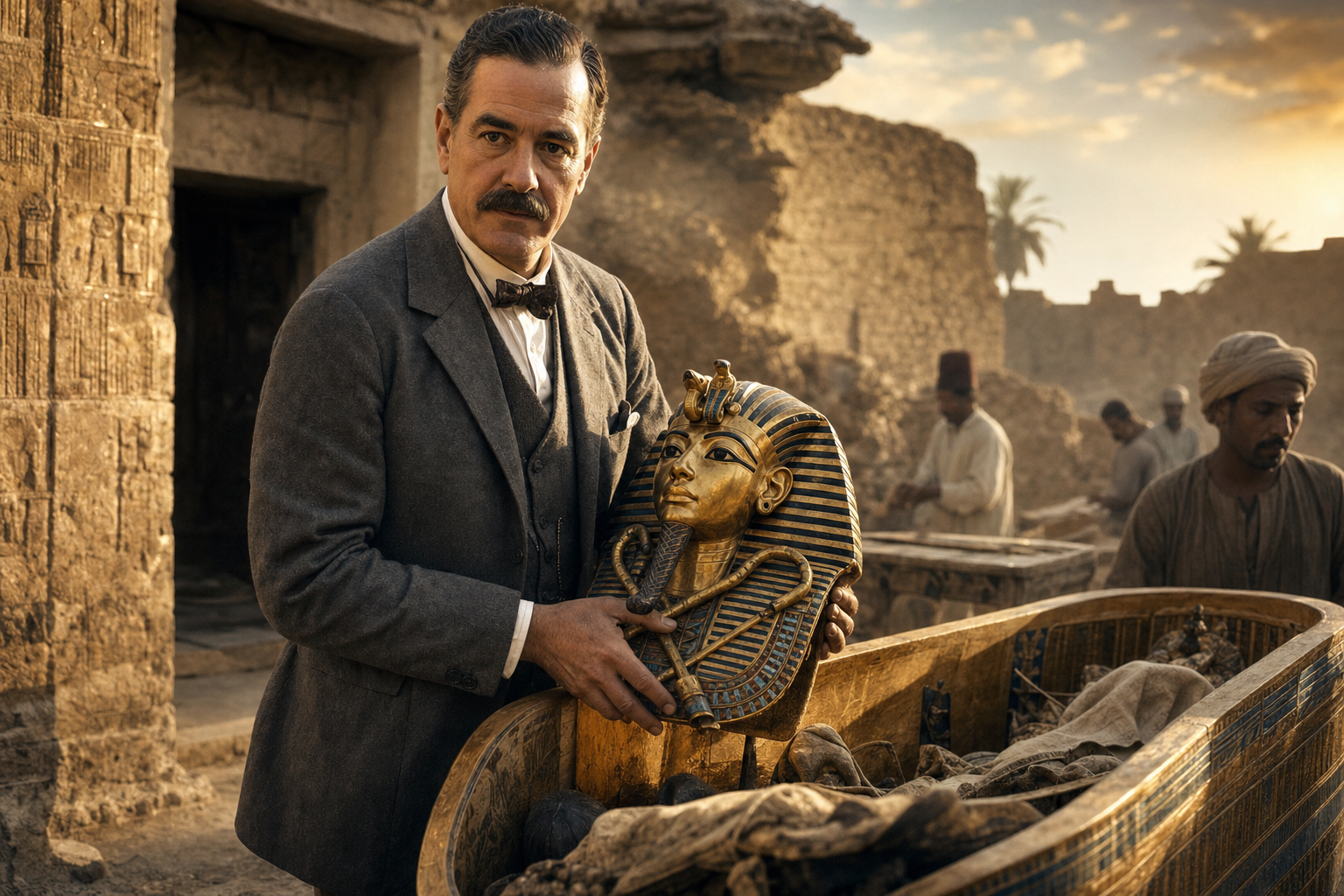
The Discovery of Tutankhamun: Howard Carter's Golden Find
The story of Tutankhamun’s discovery reads like an archaeological thriller: a decade-long search in Egypt’s Valley of the Kings, the dogged patience of a British archaeologist, the funding of an aristocratic sponsor, and finally the moment when a sealed doorway yielded a chamber that had not been looted in millennia. That moment—when Howard Carter peered through a breach and is said to have replied “Yes, wonderful things” after Lord Carnarvon asked if he could see anything—would launch an era of global fascination with ancient Egypt and the boy pharaoh whose modest tomb contained treasures unimaginably rich in craftsmanship and meaning.
The discovery did not come from a single lucky sweep of the trowel. It came from methodical excavation, an intimate knowledge of the landscape, and a persistence that survived years of hot sun, bureaucratic friction, and the shifting politics of early 20th-century Egypt. KV62, the official designation given by the Theban Mapping Project, was small by royal standards yet astonishing in content. For Egyptologists and the general public alike, the tomb’s discovery reopened questions about burial practices, succession crises in the Eighteenth Dynasty, and how a nearly intact tomb could have survived the tomb robbers who had ransacked so many others.
The find has been celebrated, debated, and mythologized. Newspapers around the world amplified every twist: the glittering image of a golden mask, the tragic early death of Lord Carnarvon months after the tomb’s opening, and a long-running saga of conservation challenges as conservators struggled to preserve delicate wood, textiles, and gold. At its heart, however, the discovery remains a moment when the past was revived in three dimensions—when objects that had been silent for more than 3,000 years suddenly articulated the daily life, beliefs, and artistry of the New Kingdom. As modern science—X-rays, CT scans, DNA analysis—has layered new evidence over Carter’s meticulous notes and photographs, the enigma of Tutankhamun has gained new nuance rather than being resolved. Tutankhamun’s tomb is not only an archaeological miracle but a mirror reflecting how archaeology, politics, and popular culture collide.
Did you know? The first interaction at the breached doorway—Carter’s reply “wonderful things”—became one of archaeology’s most quoted moments, though some scholars debate the exact phrasing recorded in contemporary accounts.
The Archaeological Prelude in the Valley of the Kings
For decades before 1922 the Valley of the Kings had been the crucible of Egyptological ambition. Since the late 18th century, European explorers and early archaeologists had sifted through tombs, often with a mix of curiosity and commercial interest. By the late 19th and early 20th centuries, systematic methods had started to replace treasure hunting, and the Egyptian Antiquities Service sought to regulate excavations and protect heritage. The Valley itself, a wadi on the west bank of the Nile opposite Luxor, contained hundreds of known tombs and many more suspected hollows where pharaohs of the New Kingdom—principally the 18th, 19th, and 20th Dynasties—were laid to rest. However, the landscape was deceptive: tombs ranged from monumental rock-cut complexes to modest, cramped chambers hastily adapted for emergency burials.
Howard Carter’s own career had prepared him for the task. Born in 1874, Carter had worked in Egypt for decades as a tracer, artist, and excavator, gaining an intimate familiarity with tomb architecture, funerary furniture, and the stratigraphy of the necropolis. His approach blended careful recording with an almost artisanal eye for detail. He had cultivated relationships within the Egyptian Antiquities Service and among the patronage networks that raised funds for fieldwork. The man who would discover KV62 arrived at the Valley already aware that the easiest theory—only large, elaborately marked tombs belonged to kings—did not always hold. Some royal burials were intentionally obscure, disguised, or squeezed into available spaces during times of political upheaval.
The early 20th century saw an intensification of field activity. European institutions and private patrons financed work that combined archaeological interest and the prestige of owning a share of finds through various legal arrangements such as partage, the division of artifacts between excavator and host country. It was in this climate that a British aristocrat, George Herbert, 5th Earl of Carnarvon, financed continued exploration in the Valley. Carnarvon’s patronage was typical of the period: private funds enabled sustained campaigns but also introduced tensions over access, publicity, and the distribution of finds. The operating balance—between scientific method, photographic documentation, and the demands of patrons and public curiosity—would become central to the discovery narrative.
Did you know? The famous funerary mask of Tutankhamun weighs about 10 kilograms and is made primarily of gold, with inlays of glass and semi-precious stones forming the eyes and eyebrows.
Across the Valley, many tombs had long been known to local villagers and had been robbed in antiquity. Yet some niches, behind collapsed rock or beneath desert sands, had remained sealed or were overlooked. Carter’s method was to follow patterns, both of architecture and of human behavior. He studied the positions of nearby tombs, the alignment of shafts, and even traces of debris that might indicate a hidden entrance. He and his team moved deliberately, keeping meticulous records even as the possibility of spectacular finds loomed. This methodical groundwork would prove decisive: when the team finally uncovered a set of steps in late 1922, the significance would be recognized immediately by a keen practitioner who understood the valley’s grammar as well as its map.

The Discovery: November 1922 and the Opening of KV62
The precise sequence of events in November 1922 is so often recounted that its rhythms have become almost ceremonial in Egyptological lore. After seasons of work with intermittent success, Howard Carter’s excavation crew removed debris and cleared an area near the foot of the Valley. On the morning of November 4, 1922, Carter’s workmen uncovered a series of steps cut into the bedrock. The steps led to a sealed doorway bearing the impressions of ancient seals—a sign that a burial chamber might lie beyond. Carter immediately recognized the potential importance and halted further work until his sponsor, Lord Carnarvon, could arrive. Carnarvon traveled from England to Egypt, creating the charged theatrical moment between patron and archaeologist that would be replayed across newspapers worldwide.
The official breach of the tomb occurred on November 26, 1922. Carter made a small breach in the top left-hand corner of the doorway and inserted a candle to peer into the dim interior. When Lord Carnarvon asked if he could see anything, Carter famously answered that he could see ‘‘wonderful things’’. That short exchange—perhaps more legend than verbatim quotation—captures the mixture of reverence and astonishment that meets anyone who first beholds ancient Egyptian burial goods. The tomb, later catalogued as KV62, proved to contain an antechamber, a burial chamber, and several smaller annexes, all densely packed with funerary furniture, chests, thrones, and ritual objects arranged as if for an eternal domesticity.
Did you know? Tutankhamun changed his name from Tutankhaten to Tutankhamun to signal the restoration of worship of Amun after the Amarna period.
Carter’s team began the long process of cataloguing, photographing, and conserving items. This painstaking work required not only archaeological expertise but careful diplomacy with Egyptian authorities. The division of finds—according to the laws and customs of the time—was negotiated, though in practice the majority of artifacts remained in Egypt. Newspapers, however, ran with the visually irresistible images of gold and votive statuary, and public appetite grew for tales of curses, mummified pharaohs, and lost civilizations. Carter maintained exhaustive notes and hundreds of photographs; his documentation remains one of the great legacies of the excavation. The excavation also opened questions: why was a pharaoh buried in a comparatively small tomb? Was Tutankhamun’s burial hurried because of political instability or an unexpected death? The architecture suggested haste, but the quality of the goods and their rich symbolism confirmed royal status.

Inside the Tomb: Layout, Artifacts, and Their Meanings
KV62’s interior furnishes one of the most complete case studies of New Kingdom funerary equipment. The tomb’s antechamber and burial chamber were a riot of material culture: chests stacked with linens, boxes containing ceremonial garlands, gilded furniture, and ritual objects including canopic equipment, shabti figurines, and models of daily life meant to animate the afterlife. Perhaps most iconic among these objects is the pharaoh’s funerary mask—crafted of gold, inlaid with semiprecious stones—whose visage has become the visual shorthand for ancient Egypt in the global imagination.
The tomb contained nested coffins: a human-shaped outer coffin and two inner coffins, the innermost made of solid gold and inlaid with glass and colored stone. These were housed within a large quartzite sarcophagus set inside a shrine. Surrounding the sarcophagus were objects meant to accompany the king: ritual furniture, weapons, canopic chests that once contained viscera (though the canopic jars themselves had been disturbed), and thousands of small items whose presence signaled both wealth and the symbolic needs of the afterlife. Carter’s cataloging recorded thousands of items—more than many other royal tombs combined. The sheer range of objects, from mundane household implements to objects of lavish workmanship, illustrated the Egyptian belief in an afterlife that required the king to be provisioned as if for a continued existence.
Did you know? Lord Carnarvon died in April 1923 in Cairo of blood poisoning; media speculation about a “curse” quickly followed, though modern scholars dismiss supernatural explanations.
Material evidence in KV62 invites both art historical and anthropological readings. Inlaid relief, inscriptions, and objects bearing the golden falcon and cartouche of Tutankhamun convey both personal royal identity and broader cosmological themes: rebirth, protection, and the pharaoh’s role in maintaining cosmic order. Other finds—like miniature boats—play into funerary concepts of the journey through the underworld, while everyday items hint at the continuity between daily life and the rituals that sustained kingship. Scholars also drew attention to the hasty repairs and repurposing visible in some items, such as altered inscriptions or reused furniture, suggesting that the burial may have occurred under time pressure, perhaps after Tutankhamun’s unexpected death.
One intriguing element was the mix of ceremonial regalia and items that reflect the everyday: a chariot, fine jewelry, faience vessels, and boxes filled with perfumes and oils. The combination indicated not only the pharaoh’s regal trappings but also personal tastes and the practical necessities believed to be required in the afterlife. Conservation teams faced enormous challenges: organic materials like wood and textiles had been sealed for millennia and began to deteriorate rapidly once exposed to the dry modern air and light. Carter’s careful photography and immediate conservation efforts preserved much, but the removal of objects and subsequent handling introduced long-term preservation dilemmas that would influence museum practice for decades.

The Boy King: Tutankhamun’s Life, Lineage, and Historical Context
Tutankhamun ascended the throne as a child of roughly eight or nine years old and reigned during a turbulent epoch of the Eighteenth Dynasty. His reign, conventionally dated around 1332–1323 BCE, followed the controversial religious revolution of Akhenaten, who promoted the worship of the sun-disk Aten and shifted royal iconography and religious centers. Tutankhamun—originally named Tutankhaten—restored traditional religious practices, changed his name to reflect devotion to Amun, and returned the royal court to Thebes. These acts indicate a political program of restoration that sought to reestablish traditional institutions undermined during Akhenaten’s reign.
Did you know? Modern CT scans have identified a fracture in Tutankhamun’s leg and traces of malaria in his remains, suggesting a combination of trauma and disease may have contributed to his death.
The king’s youthful age is central to understanding both his biography and the archaeological record. A boy king could not have enacted reforms or led campaigns alone; governing would have depended heavily on powerful officials and advisers, some of whom left their own physical traces in the period’s historical record. Among these figures was Ay, who succeeded Tutankhamun as pharaoh, and the influential general Horemheb, whose later reign would seek to erase traces of the Amarna interlude. The abbreviated reign and youthful death left Tutankhamun with little time to commission an enormous, elaborately planned tomb; some Egyptologists therefore interpret KV62’s modest dimensions and hurried elements as the consequence of an unexpected death and a burial arranged quickly and perhaps in a tomb originally intended for another member of the royal household.
Modern biological and textual research adds complexity to Tutankhamun’s biography. Radiological examinations performed in the mid-20th century and later CT imaging and DNA analyses in the early 21st century have yielded evidence about his health and familial relationships. Studies published in 2010 and subsequent analysis suggested that Tutankhamun suffered from several congenital conditions, possibly exacerbated by inbreeding within the royal line, and that he may have been afflicted with malaria at or near the time of his death. Other interpretations emphasize trauma—a broken leg or compound fracture that might have become infected—and the absence of a single definitive cause emphasizes the uncertainties that persist. Still, biological data has helped reconstruct the royal family’s genetic networks and underscored how the boy king’s life was shaped by broader dynastic patterns.
Tutankhamun’s allure also stems from the poignancy of youth and the human scale of his belongings. Unlike the huge monuments commissioned by long-lived pharaohs, KV62’s artifacts convey the tastes and needs of a young monarch. Jewelry, games, and cosmetic items appear alongside symbols of kingship, producing a portrait that is both intimate and royal. His posthumous fame, then, is not merely the product of wealth but also the narrative cadence of a brief life that reached us through an almost intact material record.
Did you know? Carter’s meticulous photographic record included hundreds of images that remain vital to modern conservation, allowing restorers to understand conditions at the moment of discovery.

The Curse, Public Frenzy, and the Global Impact of the Find
No discovery of the 20th century so quickly generated myth and spectacle as did KV62. Newspapers fed sensationalist stories, and the public devoured images of gold masks, jewelry, and gilded thrones. The so-called "curse of the pharaohs" entered popular discourse after the death of Lord Carnarvon in April 1923—some months after the tomb’s opening—when reports suggested that his death from an infected mosquito bite was somehow linked to the tomb. The British press and later Hollywood amplified these accounts into a cultural mythology that persists in novels, films, and documentaries. In reality, most members of Carter’s team lived to old age, and statistical analyses of supposed curse victims show no unusual mortality pattern. Yet the trope of a supernatural retribution proved irresistible, providing a tantalizing narrative that complemented the visual drama.
Beyond myth, the discovery had profound cultural and political consequences. Egypt’s government, increasingly responsive to nationalist sentiment and skepticism about foreign excavators, saw Carter’s find through the lens of cultural patrimony. The exhibition of artifacts, initially in Cairo and then internationally through curated tours decades later, became both a diplomatic instrument and a source of revenue through tourism. Tutankhamun’s artifacts toured the world in the 20th century—most famously in the 1970s exhibition that played to packed museums across the United States and beyond—bringing millions of visitors and revitalizing global interest in ancient Egypt. These touring exhibitions also ignited debates about ownership, conservation practice, and the ethics of moving fragile objects across continents.
The discovery also rewired popular imagination and academic interest. Schools, museums, and popular culture reframed ancient Egyptian history around the imagery associated with Tutankhamun. More academically, the find provoked renewed fieldwork, improved conservation techniques, and debates on the best ways to present ancient objects to modern publics. The tomb’s artifacts became emblematic of heritage management challenges: balancing public access, scholarly research, and the imperative to preserve objects that begin to degrade once removed from their sealed environments.
Did you know? More than 5,000 artifacts were recorded from KV62, making it one of the richest single tomb assemblages discovered in the Valley of the Kings.
Scientific Study, Conservation, and Changing Interpretations
From Carter’s day of meticulous photography to the high-resolution imaging of the 21st century, the study of Tutankhamun’s tomb has been a story of evolving methods. Early conservation confronted immediate threats: organic materials like wood and linen began to deteriorate when exposed to light, air, and modern humidity regimes. Carter and his team initiated packing and careful storage, but conservation science as a disciplined field was still developing. Over subsequent decades, museums and conservation labs refined chemical stabilizers, environmental control systems, and display techniques designed to mitigate damage while allowing public viewing.
Radiology and molecular biology have layered new evidence onto Carter’s records. The mid-20th-century X-rays offered early glimpses of Tutankhamun’s skeletal remains. Later, in 2005–2010, CT scans and DNA analysis—led in part by teams associated with Egyptian authorities—provided more detailed assessments: evidence of a fractured femur; indications of a clubfoot or other skeletal anomalies; traces of malaria parasites detected in the genetic material. Such findings suggested that Tutankhamun’s vulnerability to disease and trauma might have contributed to his early death, but the debate remains open because preservation and contamination issues complicate molecular studies.
Technological advances also informed non-invasive study of objects. Imaging techniques like X-radiography, neutron imaging, and advanced microscopy have revealed construction techniques, tool marks, and earlier repairs. For example, analysis of the famed mask and nested coffins has helped conservators understand ancient metalworking technologies and the risks associated with electrochemical corrosion when gold and other metals are displayed together. Conservationists have also re-evaluated how best to house such artifacts; national museums in Cairo and the newer Grand Egyptian Museum have invested in climate-controlled galleries and storage that seek to balance visibility with preservation.
Did you know? The discovery of Tutankhamun spurred a major international exhibition in the 1970s—the Treasures of Tutankhamun—that drew record crowds and revitalized global interest in Egyptology.
Ethically, the discovery prompted reflections on archaeological stewardship and the rights of source nations. The early-20th-century system of partage—through which finds were divided—has given way to modern legal frameworks that emphasize national ownership and collaboration. Egypt’s policies have evolved to ensure artifacts remain within the country and to promote research led by Egyptian institutions. The long arc from Carter’s notebooks to contemporary multi-disciplinary studies illustrates how archaeological interpretation is never fixed: new methods can challenge older assumptions and add complexity to simple narratives about royal lives and deaths.

Conclusion: Why Tutankhamun Still Matters
A century after Carter’s candle illuminated KV62, the discovery of Tutankhamun remains both a landmark of archaeological method and a cultural touchstone. It was not just the riches that captured the public imagination but the intimacy of the find: a child king’s jewelry, games, and cosmetics lying among the regalia of pharaonic power. KV62 bridged epochs: it is at once an archaeological site, a primary source for historians of the New Kingdom, and a mirror for modern concerns about heritage, science, and spectacle.
The tomb’s survival and subsequent study teach multiple lessons. First, meticulous fieldwork and documentation are indispensable; Carter’s photographs and notes continue to guide present-day researchers. Second, the intersection of science and humanities yields richer narratives: radiology, genetics, and materials science complement textual and art historical reading. Third, the politics of archaeology—patronage, national ownership, and the demands of global tourism—shape how artifacts are understood and displayed. Finally, the emotional resonance of Tutankhamun’s material world reminds us that archaeology is not merely about objects but about human lives: individuals who lived, ruled, and died within complex societies.
Did you know? The name KV62 designates the tomb in the Valley of the Kings; “KV” stands for “King’s Valley,” and the numerical system is a modern cataloguing tool used by archaeologists and mapmakers.
Today, as museums refine conservation strategies and Egyptian institutions steward these treasures, Tutankhamun’s legacy endures. New technologies may yet resolve lingering questions about his health, lineage, and death, but the discovery’s most enduring power is narrative. KV62 returns us to the past with the immediacy of object biography: each gilded piece, each inlaid stone, each carved emblem speaks to a worldview in which kingship was cosmic and death was only another stage of life. The excitement once sparked by Carter’s candle continues to glow in museum galleries, lecture halls, and in the imaginations of millions who, even now, approach ancient Egypt with a sense of wonder.
How we verify this article
By the History Unlocked editorial team
This text is built on historical facts stored in our database and drafted with AI assistance. No signed human review is recorded for this article. Report any inaccuracy: we correct it and update the modified date.
Updated on
AI-assisted drafting.
Read our editorial standardsEnjoyed this? Discover more articles in the category Archaeology & Discoveries