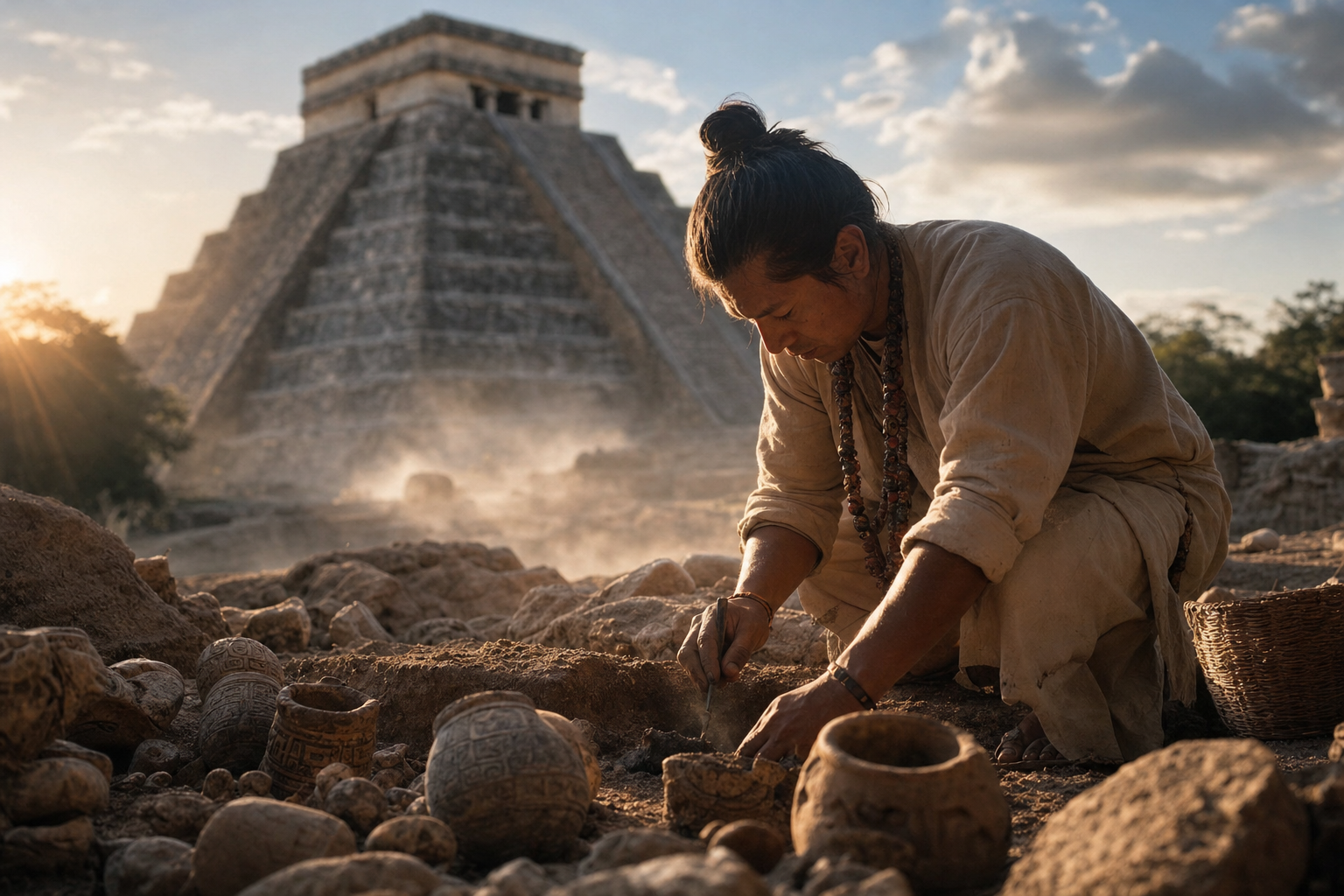
Chichén Itzá: Secrets of the Maya's Sacred City
Intro
The limestone plain of northern Yucatán is an expanse where shadows and stone converse with the sky. There, rising above a landscape of scrub and cenotes, stands Chichén Itzá — a city that once pulsed with the rituals, politics, and astronomical genius of the Maya. To walk through Chichén Itzá is to move through a layered narrative: a story of conquest and cosmology, of artisanship and engineering, of calendars carved in stone and performers who enacted the cycles of the heavens. This introduction invites the reader into both the visible and the hidden: the architectural masterpieces that still command the horizon, the archaeological debates that shape scholarly understanding, and the quieter mysteries that refuse absolute explanation.
Chichén Itzá flourished between the Late Classic and Terminal Classic periods (roughly AD 600–900) and continued to exert influence into the Postclassic period. It attracted inhabitants and elites from across Mesoamerica and absorbed stylistic elements from distant regions. The site is marked by a hybrid of Maya traditions and central Mexican influences, which gives it an unusual architectural and cultural complexion. Standing at the center is the pyramid known popularly as El Castillo, or the Kukulkan Pyramid — a monument that encodes astronomical knowledge, calendar systems, and ritual symbolism into its very walls.
Did you know? The city's name means "at the mouth of the well of the Itzá," pointing to the central importance of cenotes for water and ritual.
Yet Chichén Itzá is not merely a monument to knowledge; it is also a theater of power. Its plazas held great gatherings, its ballcourts echoed with the thud of ritual games, and its temples were settings for rites that bound communities to the cycles of maize, rain, and celestial bodies. Archaeology has peeled back layers of occupation, offerings, and later modifications, but plenty remains opaque. Who exactly controlled the city at its zenith? How did different cultural influences arrive and cohere? What aspects of daily life remain hidden under the stones or lost to the cenotes?
The narrative that follows balances careful scholarship with a sense of wonder. It blends archaeological evidence — ceramics, radiocarbon dates, iconographic analysis — with accounts of European contact and modern conservation. The city is approached both as a locus of empirical inquiry and as a palimpsest of human meaning. The goal is not to assert final answers but to frame Chichén Itzá as an active puzzle: one that rewards measured interpretation and invites continued exploration. For travelers, scholars, and the curious alike, Chichén Itzá remains a place where past and present converse in enigmatic and revealing ways.
Foundations and Early Development: Human Settlement and Political Growth
Chichén Itzá's origins are rooted in the complex social and environmental dynamics of the northern Yucatán Peninsula. The site's name in Yucatec Maya, roughly translated as "at the mouth of the well of the Itzá," locates the city around natural cenotes that provided freshwater in a seasonally dry landscape. The Great Cenote and the Sacred Cenote were not just water sources; they were cosmological spaces integral to the city's ritual life. Early settlements at the site date back to the Preclassic period, but Chichén Itzá's most intense phase of construction and political significance emerges in the Late Classic to Early Postclassic periods (circa AD 600–1200), when it became an important regional center.
Did you know? El Castillo's four stairways plus summit temple total 365 steps, reflecting the solar year and Maya calendrical knowledge.
The city's growth was tied to trade networks that extended across Mesoamerica. Obsidian, pottery styles, shell, and other luxury goods flowed through the site, signaling Chichén Itzá's integration into broader exchange systems. Contact with central Mexican cultures is visible in certain architectural forms and iconographies — for example, the presence of the feathered-serpent imagery and the chacmool figures that resemble sculptural types found at sites like Tula. The degree and nature of that interaction remain debated: whether it was the result of migration, military conquest, elite emulation, or a mixture of factors.
Archaeologists piece together Chichén Itzá's political history by analyzing ceramics, settlement patterns, and monumental construction phases. These data suggest a shifting political landscape where power was consolidated and redistributed across generations of rulers and elite factions. The presence of high-status residential compounds, elaborate burials, and monumental public architecture indicate a hierarchy of political and religious leadership. Yet even as elites directed large-scale construction projects, the city's public spaces—plazas, ballcourts, and stairways—served collective purposes: ceremonies, markets, and civic events shaped communal identity.
The cenotes played a dual role. While they provided water essential for survival, they also served as repositories for offerings—precious objects, human remains, and organic materials cast into the water as part of propitiatory ceremonies. The Sacred Cenote excavations in the early 20th century revealed a trove of artifacts including gold, jade, carved wooden objects, and skeletal remains that speak to a long tradition of ritual deposition. These finds have informed understandings of elite ritual practices and the cosmological significance of water in Maya belief systems.
Did you know? Offerings found in the Sacred Cenote include gold, jade, and human remains, evidencing ritual deposits to request rain.
Scholars often stress that Chichén Itzá was not a monolithic polity. Its growth involved alliances, incorporations, and internal competition. The city acted as a nexus where local Maya traditions met incoming influences, producing an urban landscape of hybrid forms. It was this dynamic interaction of local and external elements that shaped Chichén Itzá's distinctive identity, setting the stage for the grand architecture and ritual spectacles that would later capture the imagination of the world.

Architectural Masterpieces: El Castillo, the Temple of the Warriors, and the Great Ballcourt
The monumental architecture of Chichén Itzá forms an urban vocabulary meant to be read by its inhabitants and visitors. Each structure is a narrative device, encoding cosmology, politics, and social order. At the heart of that vocabulary is El Castillo, the Kukulkan Pyramid. Rising nearly 24 meters above its platform (about 30 meters including the temple at the summit), El Castillo is a step pyramid with nine terraces and a stairway on each side. Scholars have long noted its calendrical architecture: each of the four stairways has 91 steps that, together with the temple platform, total 365 — a symbolic representation of the solar year. Twice a year, during the equinoxes, the interplay of sunlight and shadow along the northwest balustrade creates the illusion of a descending serpent, an architectural enactment of Kukulkan's descent.
Beyond El Castillo lies the Temple of the Warriors, a complex of columns and reliefs that speak to both ceremonial power and martial iconography. The temple is surrounded by a portal of columns that once supported a colonnaded hall, and within its relief panels are depictions of warriors and captives. The presence of chacmools — reclining figures holding bowls or plates — in the temple complex suggests offerings and sacrificial rituals. These sculptures, combined with the martial imagery, point to Chichén Itzá's role as a place where ritualized violence and political authority intertwined.
Did you know? LiDAR surveys have revealed previously unknown structures and causeways around Chichén Itzá, expanding estimates of the city's extent.
The Great Ballcourt is the largest known in Mesoamerica, stretching 168 meters in length and lined with stone rings and carved panels that depict scenes of ritual decapitation and mythic narratives. The ballgame here was not mere sport but a cosmological drama, re-enacting themes of fertility, death, and the cycles of the sun. The acoustics of the ballcourt are also remarkable: a whisper at one end can carry to the other, a design that may have amplified ritual speech or announcements during the game. The carved panels along the sides depict the stakes of the game and the fates of participants, embedding political and eschatological meaning into the spectacle.
Stone carvings and sculptural programs at Chichén Itzá reveal a vivid visual language. Serpents, jaguars, and feathered deities populate facades. The Tzompantli motif — representations of skull racks — and reliefs of bound captives give evidence of ritualized conflict. Meanwhile, columns, vaulting techniques, and masonry practices showcase sophisticated engineering: corbel arches, finely cut blocks, and stucco finishes created imposing facades that simultaneously resisted erosion and embodied symbolic resonance.
The built environment also orchestrated movement. Processional routes, terraces, and sightlines tied the city's monuments into an integrated civic-religious landscape. Approaches to El Castillo, for example, were calibrated so that the pyramid’s axis aligned with specific astronomical events. The placement of plazas and ballcourts near residences and markets indicates a multifunctional use of space, where civic, ritual, and economic activities overlapped.
Did you know? Visitors are no longer allowed to climb El Castillo; the restriction was implemented to protect the pyramid's fragile surfaces and reduce erosion.

Ritual Life, Cosmology, and Astronomical Knowledge
Ritual practice at Chichén Itzá was inseparable from cosmology. The Maya patterned social life around celestial cycles, seasons, and agricultural imperatives. The architecture encoded this worldview: pyramids linked earth and sky, cenotes mediated between the living and water deities, and ballgames enacted mythic confrontations. The presence of astronomical phenomena in the architecture — such as the equinox serpent — demonstrates a sophisticated empirical observation of solar motion and a cultural system that translated those observations into ritual form.
Astronomical alignments at Chichén Itzá are numerous and deliberate. El Castillo's orientation aligns with solar events that allowed the play of light and shadow to form serpentine images on its balustrades. Other buildings, such as certain temple doorways and platforms, are oriented to mark important solar risings or settings, or to align with the horizon points of Venus — a planet of great ceremonial importance in Mesoamerican cosmologies. Maya priests and astronomers used observational techniques and recorded cycles in codices and on stelae; while some written records were destroyed in the colonial era, the built record at Chichén Itzá preserves a memorial of those practices.
The ritual use of cenotes reveals another facet of cosmology: water as a portal to the underworld. Offerings recovered from the Sacred Cenote include jewelry, metalwork, carved bone, and human remains, cohering into a picture of propitiatory sacrifices intended to secure rain and agricultural fertility. Such practices speak to the existential dependency of the city on seasonal rains and to the symbolic potency of cenotes as places where the human and the divine exchanged goods and blood.
Did you know? Early explorers like Stephens and Catherwood brought Chichén Itzá to global attention with vivid drawings that influenced archaeological interest.
The ballgame itself is imbued with layered meanings. Scenes carved on the panels flanking the Great Ballcourt suggest that the game reenacted mythic battles between celestial forces. Decapitation scenes are often interpreted symbolically: the game's outcome might be framed as a renewal imperative, a mythic substitution where sacrifice ensured the continuation of cosmic order. The identities of the participants — whether they were elite warriors, ritual specialists, or captives — remain a matter of debate and may have varied over time and context.
Religious specialists occupied the liminal space between empirical knowledge and ritual power. They were custodians of calendars, masters of timing, and interpreters of omens. Their authority came from an ability to read the sky and to translate astronomical cycles into ceremonial calendars that synchronized planting, sacrifice, and political events. These priestly functions were essential to social stability, enabling coordinated agricultural activity and reinforcing elite claims to cosmic sanction.

Archaeological Investigations: Early Explorations to Modern Science
Chichén Itzá's modern history of investigation begins in the 19th century when explorers, antiquarians, and early archaeologists brought the site to broader attention. John Lloyd Stephens and Frederick Catherwood's 1840s accounts combined evocative narrative with accurate drawings that revealed Chichén Itzá's monuments to a global audience. Their work inspired subsequent expeditions and the more systematic archaeological projects of the late 19th and early 20th centuries, including those by Edward Thompson, who controversially dredged the Sacred Cenote, and later by Sylvanus Morley and other Carnegie Institution scholars.
Did you know? Scholars still debate whether the winged serpent imagery arrived via trade, migration, or local adoption of central Mexican motifs.
Early investigations often prioritized spectacular finds—jewelry, sculpture, and dramatic human remains—while sometimes overlooking stratigraphic context and careful preservation. Thompson's work at the Sacred Cenote, for instance, recovered vast quantities of artifacts but also raised ethical and methodological questions that shaped later archaeological practice. As the discipline matured, archaeological methods became more rigorous: stratigraphic excavation, radiocarbon dating, ceramic seriation, and interdisciplinary analyses (paleoethnobotany, bioarchaeology, and geophysical surveying) provided a more nuanced and evidence-based narrative of Chichén Itzá's development.
Recent decades have seen the application of remote sensing and scientific techniques that transform understanding of the site. LiDAR (Light Detection and Ranging) surveys reveal how extensive the city's built environment and landscape manipulations actually were, including features hidden beneath vegetation or altered by centuries of agricultural use. Geochemical analysis of offerings, isotopic studies of human remains, and microbotanical analysis of residue and soil samples help reconstruct diets, migrations, and ceremonial practices. Conservation science also emerged as a central concern: preserving stucco facades, stabilizing masonry, and protecting cenotes from contamination require advanced materials science and careful site management.
Museums and local communities now play a greater role in shaping archaeological interpretation. Collaborative projects with Maya descendants and Mexican institutions aim to prioritize local perspectives, ethical stewardship, and public education. This shift has sparked debates about repatriation, the display of human remains, and how best to balance tourism with preservation. International conventions and UNESCO's involvement (Chichén Itzá was inscribed as a World Heritage Site in 1988) have brought resources and attention, but also the ongoing challenge of managing increasing visitor numbers while protecting fragile monuments.
Scientific methods continually refine chronologies and challenge earlier assumptions. Radiocarbon dates constrain building phases; pottery typologies help identify trade connections; and high-resolution mapping reconstructs the city's urban footprint. These tools do not erase mystery, but they do reposition hypotheses: scenes once read as evidence of a single conquest may instead reflect multiple episodes of contact, migration, and cultural synthesis. Modern archaeology at Chichén Itzá is thus a dialogue between technology, fieldwork, and community engagement, seeking to tell a more ethically responsible and empirically grounded story.
Conservation, Tourism, and Cultural Heritage in the Present Day
Chichén Itzá's global fame brings both blessings and burdens. As one of Mexico's most visited archaeological sites, it generates tourism revenue that supports local economies and funds conservation initiatives. However, the sheer volume of visitors poses wear-and-tear challenges to ancient stone surfaces, stucco remains, and fragile ceremonial spaces. Managing these pressures requires a careful balance between access and protection, involving heritage managers, local communities, national authorities, and international bodies.
Conservation programs at Chichén Itzá have focused on stabilizing architecture, restoring degraded facades, and implementing measures to control erosion and biological growth on stone surfaces. Techniques range from traditional masonry repairs to modern treatments that reduce salt crystallization and biological colonization. The site's inclusion on the UNESCO World Heritage list has helped secure funding and technical expertise, but conservation also demands local knowledge and monitoring. Collaborative projects with Maya artisans help recover traditional practices for lime plaster and other materials, fostering community participation and cultural continuity.
Tourism management strategies have evolved. In the past, visitors could climb many structures, including El Castillo, but strict restrictions now limit physical interaction with vulnerable monuments. Interpretative programs, guided tours, and visitor centers aim to provide historical context while shaping respectful behavior. Nevertheless, tourism brings commercialization pressures: souvenir markets, infrastructure development, and the need for parking and visitor amenities all alter the landscape around the site. Sustainable tourism planning seeks to minimize negative impacts while maximizing economic benefits for nearby communities.
Cultural heritage discussions also engage living Maya communities. For many Maya people, Chichén Itzá remains a site of spiritual resonance and ancestral connection. Contemporary ceremonies and pilgrimages still occur, especially at solstices and equinoxes, when participants gather to acknowledge the continued cosmological rhythms encoded at the site. Government policies and heritage managers must negotiate access that respects religious expression while ensuring conservation. Issues of representation are crucial: how the narrative of Chichén Itzá is presented in museums, signage, and tours affects public understanding and local pride.
Environmental challenges compound conservation issues. Climate change, with shifting precipitation patterns and greater storm intensity, affects the preservation of exposed stonework and the hydrology of cenotes. Water management, both historical and contemporary, remains a pressing concern. Protecting cenotes from contamination and calibrating visitor access to sensitive areas are part of broader environmental stewardship strategies.
Cultural Legacy, Interpretation, and Continued Mysteries
Chichén Itzá occupies a unique place in both academic study and popular imagination. Its imagery—feathered serpents, chacmools, and towering pyramids—has become shorthand for Maya civilization in the global mind. Yet the site's cultural legacy is more complex than any singular image; it includes living traditions, contested histories, and ongoing scholarly debates. Interpretation of Chichén Itzá speaks to broader questions of how civilizations interact, adapt, and express power through built environments.
Debates about Chichén Itzá's political history continue. Was the city dominated by a single dynasty, or did it function as a coalition of competing lineages and external actors? The presence of non-local styles and artifacts suggests that Chichén Itzá was a cosmopolitan center where different groups negotiated identity and authority. Some scholars argue for episodes of militarism and foreign dominance; others emphasize cultural exchange and elite patronage as engines of stylistic change. The truth likely weaves together multiple threads: migration, military encounters, diplomatic marriages, and the emulation of prestigious forms.
Chichén Itzá also forces a reconsideration of collapse narratives. Whereas earlier models of Maya decline posited abrupt collapses, contemporary research favors complexity: political fragmentation, environmental stressors, and shifting trade networks all contributed to transformations. Chichén Itzá demonstrates resilience and adaptation as well as vulnerability; its monuments attest to both remarkable civic organization and the contingencies that recalibrated power among regional centers.
Finally, the site provokes existential reflections about the relationship between humans and the environment, between ritualized violence and social cohesion, between knowledge and spectacle. The Maya who built and used Chichén Itzá engaged in practices that balanced empirical observation — of stars and seasons — with symbolic enactment. Their capacity to translate cosmological order into stone yields lessons about long-term thinking and the ways societies inscribe meaning into landscapes.
The mystery of Chichén Itzá is persistent because the evidence is both abundant and partial. Stones can be read, but they do not tell everything. Human remains provide biological data but cannot fully convey the intangible meanings ascribed by those who lived and believed there. Archaeological interpretation remains an act of piecing together voices from fragments — a careful, sometimes speculative, but always disciplined dialogue.
Chichén Itzá stands as a complex dialogue between past ingenuity and present interpretation. Its pyramids, temples, and ballcourts are not merely relics; they are narratives hewn in stone that continue to provoke questions about cosmology, power, and human creativity. Archaeology has illuminated many facets of the city's life — its trade, ritual practices, and architectural sophistication — yet every answer opens new questions about migration, identity, and the precise meanings of carved symbols. The city's survival into the modern era owes much to the work of generations of researchers, local custodians, and the communities that maintain cultural ties to the site.
Visiting Chichén Itzá is to enter a space where sky, stone, and water intersect. It is a place that rewards patient observation: the slow tracing of light across a stairway at equinox, the discovery of an abandoned relief in a quiet courtyard, the sensation of standing where cenote water once linked the living world to the underworld. For archaeologists, it is a field of ongoing inquiry where new technologies like LiDAR and isotope analysis extend the scale and resolution of research. For communities and visitors, it remains a cultural touchstone that fosters identity and wonder.
The story of Chichén Itzá is not finished. Each season of study, each conservation intervention, and each respectful pilgrimage adds another layer to its history. As we interpret the carved narratives and sift the offerings from cenotes, we must remember that Chichén Itzá was made by people who sought to understand their place in a cosmos of recurring cycles. The city's stones speak across centuries, inviting us to read, to question, and to listen.
How we verify this article
By the History Unlocked editorial team
This text is built on historical facts stored in our database and drafted with AI assistance. No signed human review is recorded for this article. Report any inaccuracy: we correct it and update the modified date.
Updated on
AI-assisted drafting.
Read our editorial standardsEnjoyed this? Discover more articles in the category Archaeology & Discoveries