Colossus of Rhodes: The Bronze Giant and Its Secrets
The morning the sun first gilded the bronze of Rhodes' greatest ambition, citizens and sailors paused as if the world had shifted. For a generation the island’s gift to the sun god Helios had been only a rumor and a dream: an audacious attempt to give shape to divine favor and mortal pride in the wake of survival. The Colossus of Rhodes, erected in the late 4th to early 3rd century BCE, was not merely a colossal image; it was a statement of identity for a people who had resisted siege and refused subjugation. In this introduction I invite you to step into the harbor dust of ancient Rhodes, to feel the bronze's heat and the creak of scaffolding, and to track how an engineering marvel became a legend clothed in fragmentary evidence, conflicting testimonies, and centuries of speculation.
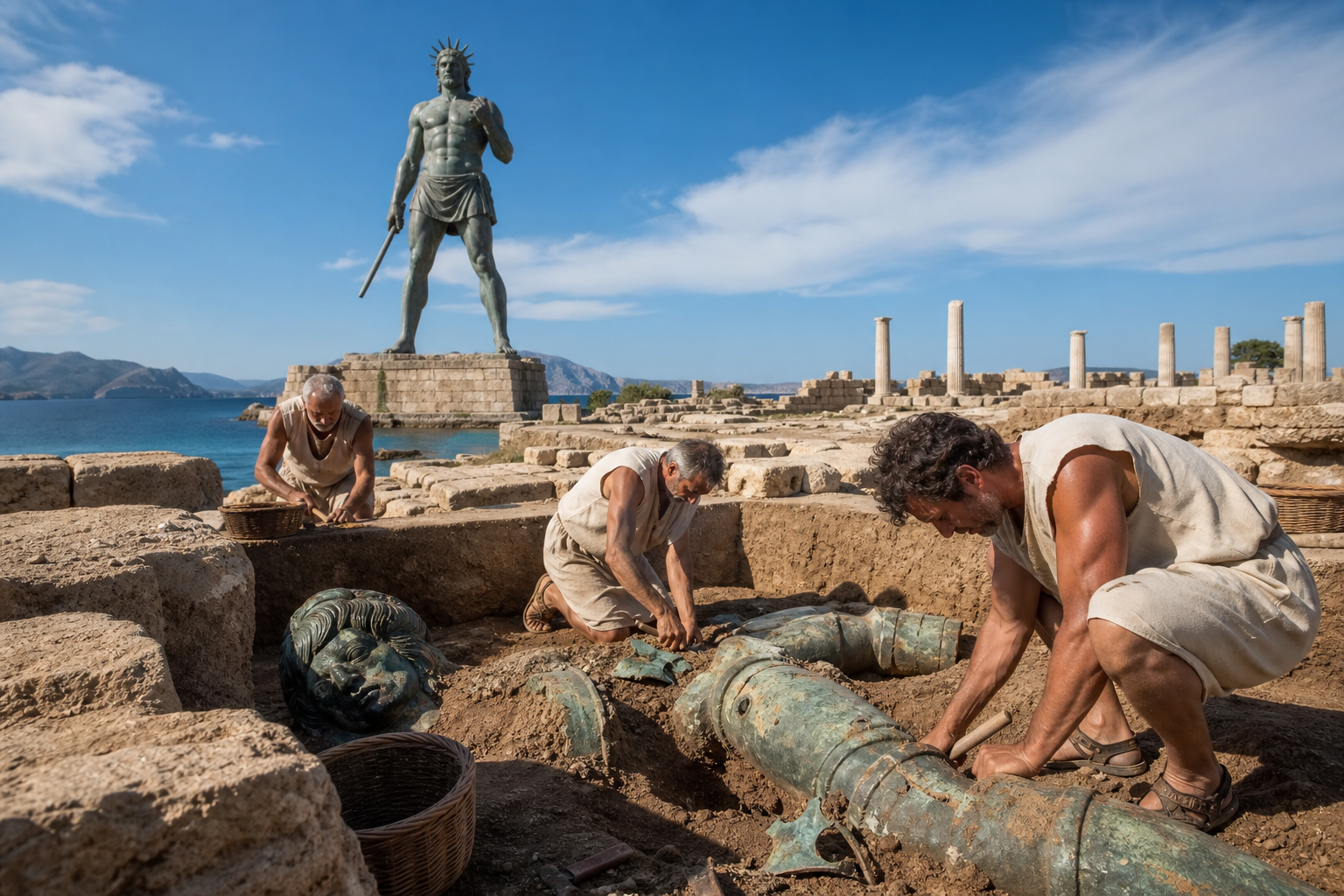
Our knowledge of the Colossus is stitched together from ancient historians, numismatic and literary echoes, and modern archaeological reasoning. No excavated limb, no buried base has yet been uncovered to offer the definitive blueprint. Instead we rely on careful texts — Pliny the Elder, Strabo, and later Byzantine and Arab chroniclers — plus surviving coins and reliefs that suggest how the statue might have looked. Yet each source has a bias, an agenda, or a gap: Pliny wrote centuries later and sometimes repeated hearsay; Strabo offered his own geographic skepticism; medieval imaginations produced images that would endure in Europe long after the statue had fallen. This blend of genuine testimony and layered legend is what gives the Colossus its mystery-driven allure.
As archaeologists and historians have examined the available evidence over the last two centuries, new questions multiply. Was the Colossus 70 cubits high as one ancient text claims — a scale that would place it near 33 meters? Did it truly straddle the harbor, legs apart like a gateway, an image now entrenched in popular imagination? Or did it stand on a dedicated stone podium near the Mandraki harbor’s entrance? How was so much bronze cast and assembled in a Hellenistic island workshop? Why do accounts of its destruction and disposal vary so widely, with stories of an earthquake collapse followed by an Arab convoy of 900 camels carting fragments away? These are not merely idle curiosities; each leads us to the technological, political, and religious world of Hellenistic Rhodes.
Did you know? The Colossus was financed in part by the sale of siege engines abandoned by Demetrius Poliorcetes after his failed siege in 304 BCE.
In the sections that follow I will guide you through the known facts—construction methods, materials, and patronage; the political context of Rhodes after the wars of the Successors; detailed readings of the textual evidence about its fall; the archaeological searches and the modern debates over its location and appearance; and, finally, the statue’s afterlife in art, memory, and proposals for resurrection. Along the way you will encounter surprising details that have slipped into myth and some persistent falsehoods scholars have had to correct, plus a string of tantalizing curiosities.
The Historical Context: Rhodes after the Wars of the Diadochi
To understand why Rhodes decided to erect a monument that would tower above contemporary sculptural practice, one must first understand the island’s precarious and ambitious position in the late 4th and early 3rd centuries BCE. Rhodes had been a thriving maritime and mercantile center during the Classical era, but the vacuum left by Alexander the Great’s death in 323 BCE and the ensuing wars of his successors (the Diadochi) transformed the Aegean’s political landscape. Rhodes, thanks to its naval resources and strategic location between the Anatolian coast and the Greek mainland, found itself negotiating autonomy and alliance in a world of shifting hegemonies.
The most immediate catalyst for the Colossus project was the siege of Rhodes (305–304 BCE) by Demetrius I Poliorcetes, son of Antigonus I Monophthalmus. Demetrius attempted to capture Rhodes to control the island's powerful fleet; yet despite demonstrating formidable siegecraft — including the famous siege tower Helepolis — his assault failed. According to ancient sources, the Rhodians refused to surrender and ultimately negotiated terms that preserved their autonomy. The failed siege left behind significant war materiel and a sense of triumphant survival. In the weeks and months after the siege, the islandors convened to decide what to do with the abandoned siege engines and spoils. The council reportedly sold these machines and used the proceeds to finance public projects.
Did you know? The construction likely used internal iron braces and an external shell of bronze plates rather than massive solid-casting, a design choice to reduce weight and material cost.
Chares of Lindos, the sculptor traditionally credited with designing and erecting the Colossus, emerged into this context as both an artisan and a civic figure tasked with translating Rhodes’ gratitude and identity into stone and metal. The decision to dedicate the statue to Helios, the sun god often identified with Rhodes' patron deity, fused religious homage with a political message: Rhodes would announce itself as a resilient maritime power whose prosperity and divine favor were now immortalized in bronze.
The timing of the statue's erection, commonly estimated around 292–280 BCE with a conventional date for its dedication around 280 BCE, situates it within the larger Hellenistic age of ambitious public monuments and dynastic propaganda. Across the eastern Mediterranean, cities were building rhetorical and material programs to project prestige: royal portraits, temples, and public works. However, few undertakings matched the audacity of the Colossus. It was not only a religious offering but an infrastructural claim — an emblem designed to be visible to allies and rivals alike as they approached Rhodes’ harbor.
Materially, Rhodes had advantages that made the project feasible. Bronze—an alloy of copper and tin—was abundant enough in the Hellenistic world that large-scale casting could be attempted, and the island’s skilled artisans were familiar with monumental sculpture. Yet the sheer scale required innovations in casting and assembly, and Chares’ team would have needed access to large quantities of alloy, heavy lifting equipment, and an organizational structure capable of coordinating labor, transport, and finishing. The political will—public consent and civic pride—supplied the rest.
Did you know? No ancient source unambiguously describes the Colossus straddling the harbor; this dramatic image is a later medieval and Renaissance invention.
Beyond the immediate civic narrative, the Colossus embodied broader Hellenistic themes: the fusion of divinity and civic identity, the display of technological mastery as a symbol of cultural superiority, and the use of monumental art to narrate a city’s past struggles and future ambitions. Rhodes’ decision to cast itself in bronze and lodge that casting on the sea’s edge was a multilingual statement read across religion, commerce, and diplomacy.

Construction and Craftsmanship: Bronze, Iron, and Hellenistic Engineering
The technical heart of the Colossus’ mystery is the question of how the ancient craftsmen converted raw metal into a standing figure of extraordinary scale. Bronze statues of monumental size were not unprecedented by the Hellenistic era, but each such undertaking required solutions to unique structural and logistical problems. The main technical choices concerned the method of casting, the structural support plan, and the finishing touches that would give the statue both durability and expressive detail.
Primary ancient sources do not provide a step-by-step blueprint; instead modern scholars infer methods by analogy with other Hellenistic projects, accounts of metalworking, and practical engineering principles. One widely accepted reconstruction posits that the statue was made from hammered bronze plates fixed over an internal iron or stone core. Large bronze statues were often constructed by creating a skeleton—an internal framework that supported the weight—and then attaching cast or sheet-bronze panels to create the outer surface. The process would have required extensive use of clamps, mortises, and possibly welding or brazing techniques to fuse sections. Iron rods and braces could have been used to tie different pieces together and anchor them to the base.
Did you know? Ancient writers report that the Colossus stood for roughly 54 years before an earthquake toppled it circa 226–224 BCE.
Lost-wax casting (cire-perdue) was a common technique for bronze statuary, but it is less likely that an entire statue of the Colossus’ size was cast in a single piece. More probable is a sectional technique: individual parts—head, arms, torso sections, legs—could have been cast separately in manageable pieces and then assembled. The seams would have been smoothed and chased, with surface details finished by hammering and engraving. Contemporary Hellenistic workshops, especially on islands like Rhodes with strong maritime traditions, had experience with large timbers and rigging, which would have supported hoisting and maneuvering heavy bronze segments.
A central question is how the statue bore its own weight. Bronze and iron are heavy materials, and the statue’s mass would have placed immense stress on its ankles and base. Archaeologists and engineers have argued for a substantial masonry pedestal, possibly against natural rock, which distributed loads more safely than a narrow plinth. Internal bracing with iron would have reduced bending stresses. Some reconstructions suggest that the statue’s posture was more conservative—standing straight with weight distributed—rather than dramatic contrapposto gestures that concentrate stress on one leg. If popular images of the Colossus splayed over the harbor mouth were true, the engineering challenges would have been far greater and arguably impossible with the technology then available.
The finishing of the bronze would also have mattered aesthetically and practically. Polished bronze gleams and develops a protective patina over time; ancient smiths knew how to produce bright, reflective surfaces. The statue would have been internally hollow in places to reduce weight and material cost while retaining structural integrity. Tools like small bronze or iron pegs might have held plates in position, and decorative elements—perhaps gilded features or inlaid eyes—would have enhanced the presence of Helios.
Did you know? Coins from Hellenistic Rhodes often depict Helios with a radiate crown, providing one of the clearest visual clues about the statue’s iconography.
Chares of Lindos, the sculptor popularly credited with overseeing the work, was likely not a lone artisan but the head of a workshop employing smiths, metalworkers, stonecutters, riggers, and laborers. Hellenistic sculpture often translated craft into civic spectacle, with the master sculptor assuming fame comparable to that of a modern architect. Ancient reports hint at Chares’ fame but also at the strain of the project; some later accounts claim he died before completion, though such details are hard to verify beyond the weight of legend.

Appearance and Position: Debunking the Harbor-Straddling Myth
One of the most enduring images of the Colossus is the dramatic one: the giant, legs apart, straddling the harbor entrance as ships passed between them. This cinematic view became popular in Renaissance and later European art and helped cement the Colossus in the imagination as an enormous gateway. But that image is likely a medieval fantasy rather than an archaeological reality. Modern scholarship has increasingly rejected the harbor-straddling idea on structural, textual, and topographical grounds.
First, consider the engineering: a statue with legs set wide enough to allow ships to pass would have required a foundation and limb strength beyond what Hellenistic technology could reliably provide. A statue of such posture would concentrate enormous torque and bending stresses at the hips and ankles, demanding an internal support system and base anchoring that are not convincingly consistent with what we know of ancient metallurgy and masonry. Most reconstructions that take structural principles seriously instead show the Colossus standing on a substantial plinth or pedestal adjacent to the harbor, where the statue’s weight could be safely distributed.
Did you know? The popular image of the Colossus straddling the harbor likely originates in medieval maps and Renaissance imagination, not ancient eyewitness accounts.
Second, the textual evidence does not give a single clear eyewitness account that decisively describes the straddling posture. The earliest detailed ancient descriptions are sparse and sometimes ambiguous. Pliny the Elder, writing in the first century CE, describes the statue and its height but not the dramatic gateway pose. Strabo, writing slightly earlier, provides geographic descriptions that many interpret as indicating the statue was by the harbor but not spanning it. Coins and inscriptions from Rhodes depict a bearded figure, often shown with radiate crown or halo—typical attributes of Helios—but these numismatic images do not show a full-figure straddle; instead they suggest a statue on a base or platform.
Topography also argues against the myth. The entrance to the Mandraki harbor is relatively narrow and was in antiquity protected by mole and breakwaters. A statue built with one leg on each side would have interfered with navigation and placed stress on the harbor infrastructure. Moreover, recent studies of the ancient shoreline and harborworks suggest that the most plausible location was a dedicated podium near the acropolis or a platform on the harbour’s edge—visible to approaching ships but not an obstruction.
The popular straddling image likely arose from medieval mapmakers and storytellers who had little concrete evidence and preferred dramatic compositions. By the time Renaissance artists and travelers recorded their visions, the Colossus had long since been reduced to rubble, and artists relied on imagination and hearsay. The nineteenth-century revival of interest in the Seven Wonders cemented these romantic images in Western art, despite the lack of archaeological corroboration.
Did you know? Several modern engineering studies confirm the logistical implausibility of a harbor-straddling pose for the Colossus given known Hellenistic materials and techniques.
Nevertheless, the magnificence of the statue is not diminished by a more conservative placement. A 30–33 meter-high bronze figure on a towering pedestal at the harbor's mouth or on a promontory would still have dominated sightlines and performed the civic ritual of greeting mariners. Its presence on a constructed plinth would have been both feasible and awe-inspiring.
The Fall: Earthquake, Aftermath, and Conflicting Accounts
If the erection of the Colossus reads like a triumphal human story, its fall is a study in how material vulnerability and political change reshape myth. Multiple ancient sources agree that an earthquake brought the Colossus down, but they differ on details about the date, the manner of collapse, the fate of the fragments, and the subsequent attitudes of the Rhodians toward rebuilding. These variations have generated centuries of scholarly debate.
The most commonly cited chronological marker places the earthquake around 226/224 BCE, depending on the source. Ancient historians report that the statue stood for approximately 54 to 56 years before being toppled. Pliny the Elder and other writers noted that after the quake the remains lay where they fell, and were widely admired for the craft even in ruin. A recurring theme in ancient testimony is that the Rhodians declined to rebuild the Colossus out of respect for the god’s will; some sources claim an oracle or divination interpreted the earthquake as a sign that Helios did not wish for his image to be raised again.
How the statue fell is another contested detail. Some accounts suggest the statue simply collapsed at the base, while others claim specific points of failure—ankles, knees, or the lower torso—gave way. The problem for historians is that the precise structural weak points are speculative without remains; the variance in accounts likely reflects the way later writers borrowed older sources and often filled gaps with assumption.
Even more provocative are tales of what happened to the remains. A famous medieval story—found in Arab and later Western sources—claims that in the 7th century CE, when Muslim forces conquered Rhodes, they discovered the fallen Colossus and transported the metal on 900 camels to Syria where it was sold. This colorful narrative may find its earliest version in Islamic geographers or later storytellers, and many historians now treat it with skepticism. From a practical standpoint, the logistical and monetary implications of such a removal are questionable: moving massive bronze fragments, some likely fused and partially intact, across long distances would have been a considerable enterprise. Additionally, the archaeological absence of moved fragments or reliable contemporary records weakens the claim.
There is also an alternative interpretation: the remains could have been left in situ and scavenged gradually over the centuries for metal, a common fate for large bronze monuments. Bronze was valuable and malleable; during times of economic strain or political change, local actors—governors, shipbuilders, or smiths—might have taken pieces for reuse. Yet the record is unclear, and the absence of systematic salvage records leaves room for speculation.
The Rhodians’ reported refusal to rebuild is an interesting cultural note. Hellenistic cities often interpreted disasters through religious frameworks; an earthquake could be construed as divine displeasure. If an oracle or civic consensus decided not to raise another image, that decision reflected a complex negotiation between piety, finances, and a changing political calculus. By the Roman era, the Colossus existed primarily in the memory of travelers and the pages of writers. Its physical vanishing only increased its mythic presence.

Archaeology, Numismatics, and Modern Reconstructions
Because no large-scale archaeological excavation has produced definitive fragments of the Colossus, researchers turn to indirect evidence: coins, reliefs, building remains around the ancient harbor, and comparisons to other Hellenistic works. Rhodes’ numismatic record is especially valuable. Coins minted in the city-state frequently depict a radiate-headed figure identified as Helios, sometimes standing, sometimes bearded—an iconographic shorthand that may reflect the statue’s image. While coins are small, stylized sources, their circulation across the Mediterranean means they contributed to a shared visual vocabulary and provide clues about how the citizens of Rhodes wanted the deity and the monument perceived.
Archaeological surveys around Mandraki harbor and the acropolis have mapped harborworks, breakwaters, and possible pedestals. Submerged structures and shifting coastlines complicate the search. Over the last century, underwater archaeology has improved, but the layers of silt, harbor modification in Roman and later periods, and modern construction make locating a monumental base challenging. Some scholars have argued for a site on the promontory of the acropolis; others favor a lower, harbor-adjacent location where the statue would be immediately visible to approaching vessels.
From a technical perspective, experimental archaeology and engineering modeling have tested how such a statue might have been built and how it might have failed. Large-scale reconstructions—digital and physical models—explore load distributions, material properties, and possible assembly strategies. These reconstructions have largely converged on the idea that a standing statue on a robust pedestal is the likeliest solution, reinforcing the critique of the harbor-straddling myth.
Modern aesthetic reconstructions—paintings, sculptures, and 3D visualizations—vary widely because they adopt different scholarly assumptions. Some emphasize a youthful, beardless Helios with radiant crown; others depict a mature bearded figure akin to later Hellenistic deity portraits. The choice reflects both the ambiguity of the sources and the era's evolving tastes in depicting divinities.
In the 20th and 21st centuries, proposals to rebuild the Colossus have recurred intermittently. These proposals ranged from the purely commemorative to ambitious engineering projects that would recreate a colossal bronze statue using modern materials and methods. While these schemes capture public imagination, they encounter practical obstacles: cost, historical authenticity debates, and concerns about the monument becoming a modern spectacle rather than an archaeological tribute. To date, none of these plans has come to fruition, though the idea continues to surface whenever Rhodes considers a high-profile cultural project.
Cultural Legacy: The Colossus in Art, Memory, and Identity
What survives of the Colossus is primarily cultural: images, stories, and the conceptual power of an ancient city daring to place itself in bronze. As one of the Seven Wonders of the Ancient World, the Colossus occupied a privileged position in classical lists of marvels compiled by Hellenistic and Roman authors, and later it was championed by Renaissance and Enlightenment writers who sought a lineage of human achievement stretching from antiquity to their own age. The statue became an emblem of technological aspiration and civic pride across centuries.
Artists and writers have repeatedly revived the Colossus to make contemporary points. For Romantic and nationalist painters in the 19th century, the Colossus symbolized the grandeur of classical civilization and its seeming fragility. For modern engineers and conceptual artists, it became a case study in the limits of material culture and the ways human-made monuments both assert and invite transience. The recurring artistic image of a straddling giant, even if historically improbable, speaks to a human hunger for spectacle: we prefer metaphors that render ideas visually immediate, even if they distort historical likelihood.
In Rhodes itself, the Colossus remains a central identity marker. The island celebrates its ancient heritage in museums, public narratives, and tourist literature. Small replicas, coins, and commemorative icons keep the memory alive. Debates about whether to reconstruct the Colossus are not only technical; they concern what it means to resurrect a symbol with layers of religious, civic, and economic meaning. Would a reconstruction honor the ancient Rhodians’ achievement, or would it become a theme-park feature divorced from context?
The Colossus’ story also encourages reflection on how cultures remember loss. The statue’s fall, its rumored dispersal, and its persistence in literary memory show that monuments are as much about narrative as about metal and stone. The way later writers embellished or misremembered specific details also tells us about changing priorities—Christian and Islamic authors, for example, reframed classical marvels to fit new cosmologies and political agendas. Each retelling added a layer to the Colossus’ afterlife.
Conclusion: The Colossus as Question and Inspiration
The Colossus of Rhodes persists at the intersection of fact and imagination. We can reconstruct parts of its story with confidence: Rhodes erected a monumental bronze statue of Helios in the late 3rd century BCE, likely dedicated around 280 BCE, led by Chares of Lindos and funded in part by the spoils of war. It stood for roughly half a century before an earthquake toppled it in the early 3rd century BCE, and thereafter its fragments were subject to both salvage and speculation. Beyond these core facts, however, the greater narrative has been elaborated, contested, and romanticized by centuries of human creativity.
For archaeologists the Colossus is a challenge: how to transform numismatic images, ancient texts, and landscape analysis into a convincing reconstruction without overreaching the evidence. For historians, it is a case study in Hellenistic identity, material culture, and the symbolic uses of art. For the public imagination, it remains the archetype of a colossal achievement whose physical remains were lost to time but whose idea endured.
The unanswered questions are part of the Colossus’ appeal. Where exactly did it stand, how precisely was it built, and what ultimately happened to its bronze—these are puzzles that reward patience, interdisciplinary research, and humility before the fragmentary past. In that sense the Colossus continues to do what Helios might command: to be seen as a bright emblem on the horizon—an invitation to come closer, to wonder, and to keep looking.
How we verify this article
By the History Unlocked editorial team
This text is built on historical facts stored in our database and drafted with AI assistance. No signed human review is recorded for this article. Report any inaccuracy: we correct it and update the modified date.
Updated on
AI-assisted drafting.
Read our editorial standardsEnjoyed this? Discover more articles in the category Archaeology & Discoveries