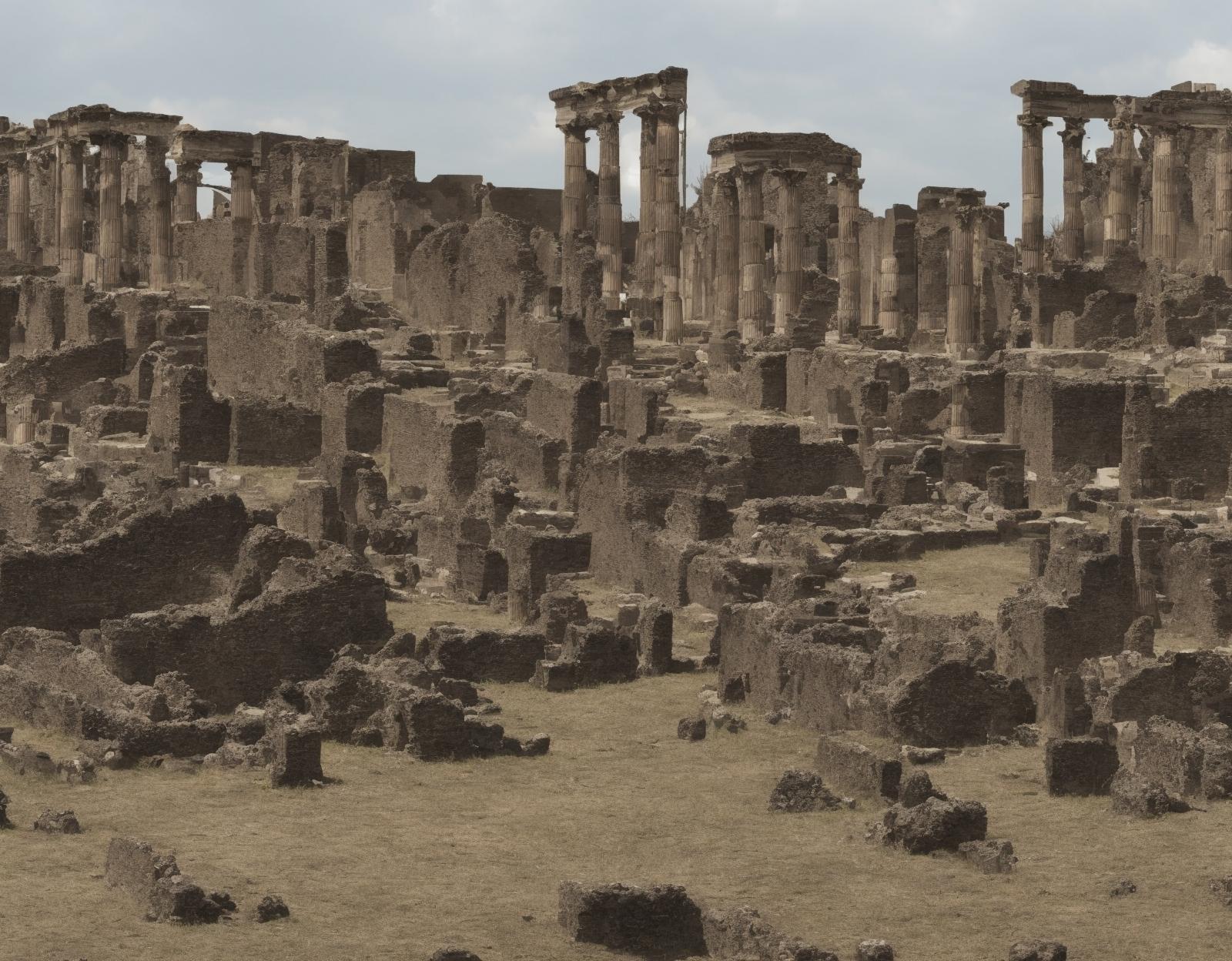
Pompeii's Lost Souls: The Eruption That Froze a Roman City in Time
In the shadow of a seemingly dormant mountain, life in the Roman city of Pompeii hummed with a familiar, vibrant rhythm. It was, by all accounts, a day like any other in the late summer of 79 AD. Merchants hawked their wares in the bustling forum, the scent of freshly baked bread wafted from bakeries, politicians campaigned for local office with graffiti scribbled on city walls, and wealthy patricians relaxed in their lavishly decorated villas. Children played in the streets, slaves toiled in kitchens and gardens, and the sounds of a living, breathing city filled the air. They were utterly oblivious to the cataclysm brewing beneath their feet. The mountain they called Vesuvius had been silent for eight hundred years, its slopes covered in lush vineyards and woods, offering no hint of the apocalyptic power it was about to unleash. Minor earth tremors had shaken the region for years, but in an area known for seismic activity, they were a nuisance, not a harbinger of doom. The people of Pompeii had no word for "volcano." To them, Vesuvius was simply a part of the landscape, a beautiful, fertile backdrop to their prosperous lives. This profound ignorance was the first act in a tragedy that would see an entire city and its population erased from the world in less than twenty-four hours, only to be rediscovered seventeen centuries later as the most astonishingly preserved time capsule of the ancient world. The story of Pompeii is not merely one of destruction, but of a life so perfectly, so tragically, frozen in time that it continues to speak to us today, revealing the most intimate secrets of the Roman Empire.
The Day the Mountain Awoke The catastrophe began not with a river of lava, as many might imagine, but with a deafening explosion that was heard for hundreds of kilometers. Around midday, the peak of Vesuvius blew apart with a force far greater than any man-made weapon. It propelled a colossal column of superheated gas, ash, and pumice stone miles into the stratosphere. The Roman author and administrator, Pliny the Younger, witnessed the event from the nearby town of Misenum and later described the cloud in a letter to the historian Tacitus. He famously compared its shape to that of an umbrella pine tree, a vast, dark trunk rising high into the sky before spreading out into great branches. For the people of Pompeii, looking up from their daily routines, it must have been a sight of terrifying, incomprehensible awe. For hours, the primary assault came from above. A thick rain of lightweight, grey pumice stones, known as lapilli, began to fall on the city. It accumulated at a rate of 15 centimeters per hour, piling up in the streets, on the rooftops, and in the courtyards. This phase presented a terrifying dilemma for the inhabitants. Some chose to flee immediately, grabbing what valuables they could and making a desperate run for the coast or a mad dash through the suffocating, debris-filled streets. Many others, however, chose to seek shelter inside their homes, believing it was a passing storm of rock they could simply wait out. It was a fatal miscalculation. As the hours wore on, the weight of the accumulating pumice became immense, causing roofs to groan and then collapse, crushing those huddled within. The air became thick with abrasive dust and sulphurous gases, making breathing difficult and stinging the eyes. The sky was plunged into a terrifying, unnatural darkness, a day turned to night, punctuated only by the flashes of lightning within the eruptive column and the constant, thundering roar of the mountain.

The Deadly Embrace: Pyroclastic Surges While the falling pumice was deadly, the most horrific phase of the eruption was yet to come. The first stage had buried the city and trapped many of its citizens; the second stage would entomb them. Sometime during the night and into the following morning, the massive eruptive column, now overloaded with dense material, lost its upward momentum and collapsed upon itself. This generated a series of pyroclastic surges—searingly hot, fast-moving avalanches of gas, ash, and rock. These were not slow-moving lava flows but turbulent, ground-hugging clouds that raced down the flanks of Vesuvius at speeds exceeding 100 kilometers per hour, engulfing everything in their path. The first surge did not reach Pompeii, but it obliterated the nearby town of Herculaneum, instantly killing its inhabitants. Subsequent surges, however, swept over the walls of Pompeii. The temperature within these clouds was extreme, estimated to be between 250-300°C (482-572°F). This intense heat was the primary agent of death for anyone still alive in the city. It was a near-instantaneous thermal shock, causing immediate death as the searing gas scorched lungs and contracted muscles. It was this second, more sinister phase that created the conditions for Pompeii’s unique preservation. The fine ash that accompanied the surges was like a hot, wet plaster. It blanketed the city and everything in it, penetrating every room, covering every body, and clinging to every surface. It followed the precise contours of the deceased in their final postures—a mother shielding her child, a man lying in a protective crouch, a dog writhing on its back. As the layers of ash and pumice cooled and hardened over the centuries into a dense rock called tuff, the soft tissues of the bodies decomposed, leaving behind a perfectly detailed cavity, an empty mold that held the exact shape and final moment of a life.
Unearthing a Lost World: The Rediscovery For over 1,500 years, Pompeii lay silent and undisturbed, buried under more than six meters of volcanic material. Its name and location were lost to memory, becoming more of a legend than a tangible place. The landscape had changed, and new towns were built on the layers of earth that concealed the old one. The first accidental rediscovery occurred as early as 1599, when the architect Domenico Fontana was overseeing the digging of an underground aqueduct to divert water from the river Sarno. His workers struck ancient walls covered in paintings and inscriptions, one of which mentioned "decurio Pompeiis," a town official of Pompeii. Incredibly, Fontana, either through lack of interest or a desire to avoid scandal due to the erotic nature of some frescoes, had the findings covered up. The true secret of what lay beneath would remain hidden for another 150 years. Proper excavations did not begin until 1748, under the patronage of the Bourbon monarchy that then ruled Naples. The initial work, however, was far from the scientific archaeology we know today. It was, in essence, a treasure hunt. The primary goal of excavators like Rocque Joaquin de Alcubierre was to recover valuable artifacts—statues, frescoes, mosaics, and precious objects—to adorn the palaces of King Charles III. Their methods were haphazard and destructive. Tunnels were dug haphazardly through buildings, frescoes were hacked from walls, and any object not deemed valuable enough was either destroyed or reburied. They were searching for art, not knowledge. Detailed records were sparse, and the context of the finds was often completely lost. This period robbed future generations of invaluable information, but it was also the period that brought the wonders of Pompeii to the attention of the world, sparking the new science of archaeology and the Neoclassical movement in art.
Fiorelli's Revolution: The Plaster Casts Archaeological methods at Pompeii changed forever with the arrival of Giuseppe Fiorelli in 1863. Appointed as the director of the excavations, Fiorelli brought a scientific and systematic approach to the site. He was not a treasure hunter; he was an archaeologist interested in reconstructing the life of the city as a whole, from its grandest villas to its most humble workshops. He introduced a system of dividing the site into "regions," "insulae" (blocks), and "domus" (doorways), a system still in use today. But his most famous and poignant innovation was a direct response to the macabre mystery of the voids in the hardened ash. Previous excavators had occasionally encountered these hollow spaces containing human bones. They had correctly inferred what they were but had no method for preserving them. Fiorelli devised a simple yet ingenious technique. When his workers discovered a cavity, they were instructed to stop digging immediately. The team would carefully clear a small opening into the void and pour in liquid plaster of Paris (gesso). The plaster would fill every nook and cranny of the cavity, perfectly capturing the space left by the decomposed body. After the plaster had set, the surrounding tuff could be carefully chipped away. The result was a stunningly detailed and deeply moving cast of the victim at the very moment of their death. This revolutionary technique yielded some of the most iconic and haunting images in all of archaeology. It gave form to the final moments of Pompeii’s citizens: the so-called "Garden of the Fugitives," where a group of thirteen individuals were caught as they tried to escape; the chained dog, contorted in its final agony; casts of embracing lovers; and a muleteer who fell beside his animal. These were no longer just skeletons or lost souls; they were people, frozen in their last breath, their humanity restored by Fiorelli’s plaster.

A City in High Definition: What Science Reveals Today Fiorelli’s work laid the foundation for over a century of continuous discovery that has transformed our understanding of the Roman world. Modern archaeology, armed with an array of scientific tools, has put Pompeii under a microscope, revealing details of daily life with astonishing clarity. Bakeries have been found with carbonized loaves of bread still sitting in their ovens, their texture and shape perfectly preserved. At the numerous thermopolia—the Roman equivalent of fast-food counters—archaeologists have analyzed the contents of terracotta jars (dolia), finding traces of pork, fish, snails, and beef, a menu for the common citizen. The walls of the city are a public diary, covered in thousands of pieces of graffiti ranging from complex political advertisements ("I ask you to elect Claudius Verus, a man worthy of the republic") to personal insults and declarations of love. The Lupanar, Pompeii’s best-preserved brothel, features explicit frescoes depicting various sexual acts, serving as both decoration and a "menu" of services. Beyond the social fabric, scientific analysis of the human remains themselves offers a direct biological window into the past. CT scans of the plaster casts allow researchers to see the skeletons within, revealing the age, sex, and potential pathologies of the victims. DNA and isotopic analysis of teeth and bones have provided insights into the Pompeian diet, which was surprisingly healthy and varied, rich in fruits, vegetables, and seafood. However, these studies also show widespread health problems, such as worn teeth from the grit in their stone-milled flour and evidence of diseases like brucellosis, likely contracted from consuming contaminated milk or cheese. Recent discoveries continue to challenge and refine the long-held narrative. For example, the discovery of a charcoal inscription dated to "the 16th day before the calends of November" strongly suggests the eruption occurred in late October, not August as has been traditionally believed, a theory supported by the presence of autumn fruits like pomegranates and the warmer clothing worn by some victims.
Echoes in the Ash Pompeii stands as a unique and somber monument, a place where life and death are captured in a single, terrible moment. The eruption of Vesuvius in 79 AD was an unparalleled tragedy, but it paradoxically created an archaeological miracle. Unlike other ancient sites, which fell into ruin over centuries, were plundered, or were rebuilt upon, Pompeii was sealed in a moment. It did not decay; it was flash-frozen, protected from the ravages of time by the very agent of its destruction. The journey from its rediscovery as a royal treasure chest to its current status as a meticulously studied archaeological park charts the evolution of our relationship with the past. Fiorelli’s casts, in particular, force us to confront the profound human reality of the disaster. They are not art; they are the silhouettes of a final agony, a chillingly intimate portrait of individuals caught in the last seconds of their existence. This raises complex ethical questions about their display, but it also provides an unparalleled connection to the ancient world, bridging the gap of two millennia with a shared sense of humanity and vulnerability. Today, Pompeii is more than a ruin; it is a living laboratory. Each new excavation, each technological advance, allows us to hear the echoes from the ash more clearly. We can map their social networks, understand their diets, diagnose their diseases, and read their private thoughts on a tavern wall. The enduring mystery of Pompeii is no longer simply about how its people died, but about the intricate, vibrant, and incredibly detailed story of how they lived. It remains a direct, unfiltered voice from the heart of the Roman Empire, a city of ghosts that, against all odds, has achieved a kind of immortality.
How we verify this article
By the History Unlocked editorial team
This text is built on historical facts stored in our database and drafted with AI assistance. No signed human review is recorded for this article. Report any inaccuracy: we correct it and update the modified date.
Updated on
AI-assisted drafting.
Read our editorial standardsEnjoyed this? Discover more articles in the category Archaeology & Discoveries