Easter Island's Moai: Secrets of the Stone Giants
The wind that sweeps across the volcanic plateau of Rapa Nui carries more than salt and sand; it carries the whisper of human hands chipping away at tuff stone, of ropes tightened around ancient bodies, of ceremonies shouted into the Pacific and of toppled faces lying like fallen sentinels across the landscape. The moai—the monumental carved figures that have become the emblem of Easter Island—are at once familiar and strangely unknowable. They occupy a curious place in the imagination: icons photographed for postcards, subjects of daring transport experiments, and the centerpieces of a profound debate about human ingenuity, environmental change, and cultural fate.
This article invites the reader into a long, layered story. It is a story of voyages across the vast Pacific, of a people who carved their ancestors into stone, and of the ways in which later contact and calamity altered their world. It is also a story of modern archaeologists and local Rapa Nui researchers who have gradually peeled back centuries of assumptions to reveal a far more complex past than the simplistic rise-and-fall narrative popularized through mid-20th-century accounts. Throughout, the moai remain a focal point: evidence of craftsmanship, of social organization, and of ritual life.
Here we will examine the earliest settlement of the island and the arrival of the first carvers; the quarry at Rano Raraku where hundreds of figures were begun and sometimes abandoned; the ingenious and contested ideas about how massive statues were moved from quarry to ahu; the heated debates over deforestation, population change, and ecological collapse; the later religious transformations that saw the Birdman cult replace certain ancestor rituals; and the modern era of excavation, restoration, and cultural revival. Woven into the narrative are the small, arresting curiosities that humanize the archaeological record: the coral eyes once set into hollowed sockets, the red pukao hats quarried from different rock, and the enigmatic smiles worn by so many weathered faces.
Did you know? Katherine Routledge led a major archaeological and ethnographic expedition to Rapa Nui in 1914–1915, producing the earliest systematic survey of moai and oral histories.
This is not a single answer to a single question. It is an exploration of evidence and interpretation, held together by the island’s stark geography and the human stories that persist amid stone. The moai watch on as scholars argue, as Rapa Nui people reclaim their history, and as the world continues to wonder how these giants were raised by hands that sailed thousands of miles to find a tiny, remote patch of earth.
First Encounters and Settlement
Easter Island—Rapa Nui in the Polynesian language—lies in the southeastern Pacific, roughly midway between South America and Polynesia, an isolation that has shaped its history since the moment of first settlement. For much of the 20th century scholars debated when Polynesian voyagers first made landfall here; new radiocarbon dating and a careful reassessment of archaeological layers shifted the consensus toward a relatively late colonization, commonly placed around 1200–1300 CE. This trimmed earlier theories that imagined centuries of development and suggested that the moai-building era had spanned a millennium. The current archaeological picture is one of intense and rapid cultural florescence after initial settlement: within a few centuries of arrival, Rapa Nui society had produced monumental architecture, a complex system of stone platforms (ahu), and the distinctive moai statues.
The island’s remote location meant that early settlers brought with them a full suite of Polynesian agricultural knowledge and social practices, adapted to the limited resources and volcanic soils of Rapa Nui. Sweet potato cultivation became part of the adaptive economy, and evidence of rock gardening—largely in the form of manavai, circular stone enclosures that create microclimates—demonstrates technological responses to wind and poor topsoils. Archaeologists have documented extensive intensification of land use through lithic mulch and modified soils, showing that the population engaged in intricate landscape engineering even on a small, isolated island.
Did you know? Many moai retain the hollowed eye sockets that once held coral and obsidian inlays, giving them a striking, once-animated gaze.
Contact with Europeans introduced a new and catastrophic chapter. The first recorded European visit came on Easter Sunday, April 5, 1722, when the Dutch navigator Jacob Roggeveen landed and gave the island its European name. Subsequent visits by Spanish and later British explorers, notably Captain James Cook in the 1770s, increased European awareness of the remote island. But it was the 19th century that most dramatically disrupted Rapa Nui society. The island experienced slave raids—most notoriously by Peruvian ships in the 1860s—that removed a substantial portion of the population and precipitated waves of disease introduced via outside contacts. By the late 19th century the island’s population had been reduced to a few hundred inhabitants; an often-cited figure recorded for the 1877 census and subsequent accounts lists just 111 Rapa Nui survivors, though population estimates vary by source.
Despite these shocks, the cultural continuity of Rapa Nui persisted. Oral histories collected by early ethnographers and later by Rapa Nui researchers preserved family lineages, place names, and memories that have allowed modern scholars to cross-check archaeological interpretation with local knowledge. Katherine Routledge’s early 20th-century Mana Expedition (1914–1915) remains a crucial ethnographic and archaeological record; her notebooks recorded oral genealogies, place names, and descriptions of ritual sites that later became invaluable for both scholars and the Rapa Nui community aiming to reconstruct their past.

The Quarry and the Sculptors
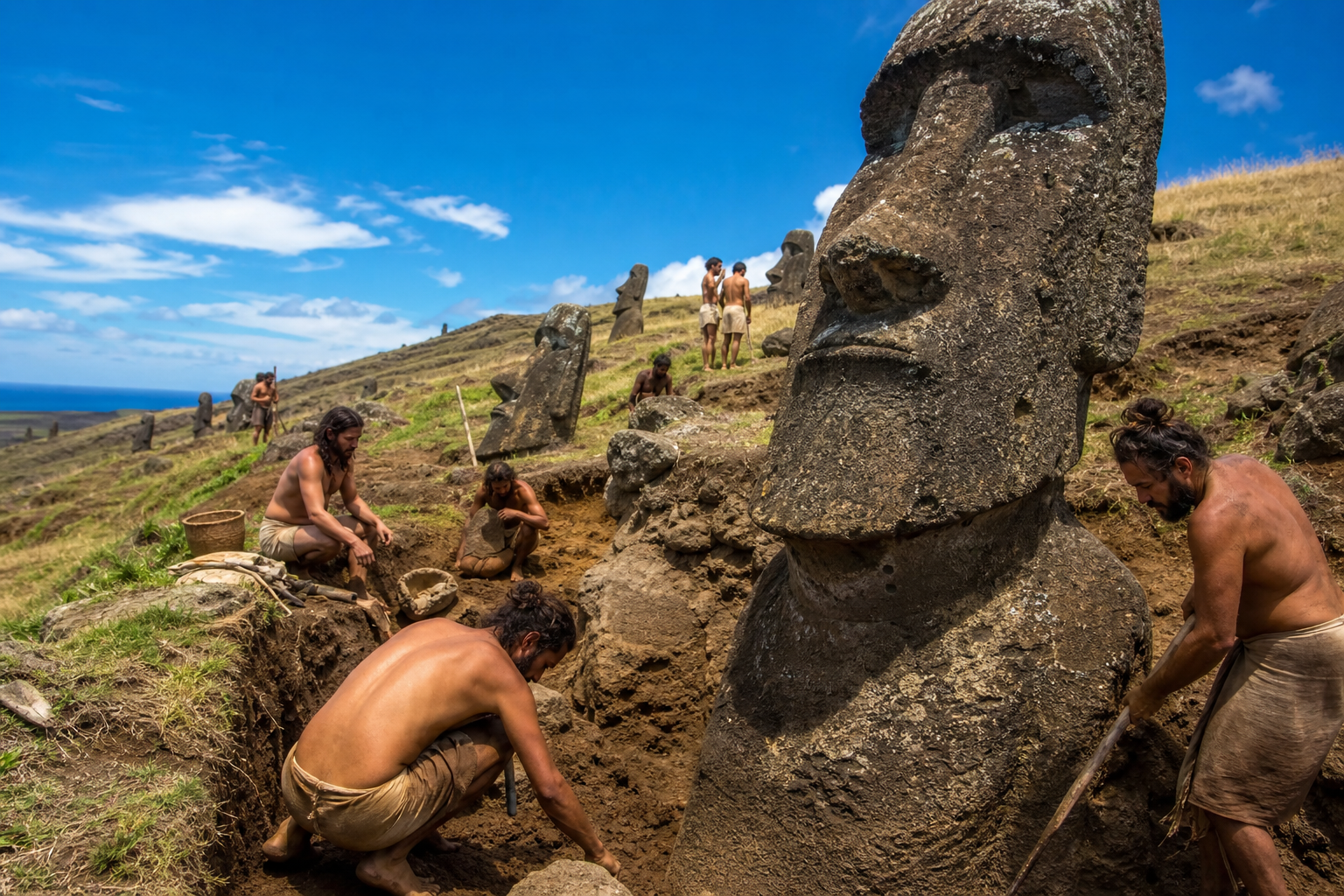
If Rapa Nui’s story is told in stone, then Rano Raraku is its workshop. This volcanic crater on the island’s eastern flank served as the primary quarry for the soft volcanic tuff from which the majority of moai were carved. Today the slopes of Rano Raraku are littered with statues at every stage of completion—some still attached to the bedrock, others released and abandoned, and many toppled on their flanks. The quarry is a vivid archaeological record of carving sequences, tool marks, and workplace organization.
Did you know? Experimental archaeology has shown that moai replicas can be ‘walked’ upright with ropes and coordinated rocking, a method demonstrated by researchers Terry Hunt and Carl Lipo.
Most moai were sculpted from the island’s compacted volcanic ash, a relatively workable stone that allowed carvers to achieve fine facial details. Tools used were basalt picks and hand-held chisels; the characteristic elongated heads, heavy brows, and prominent noses of the moai were produced with repeated, controlled strikes. The process of carving usually began with an outline on the rock face, then a methodical removal of surrounding stone to leave a raised figure; final shaping often took place after the statue was partially detached from the bedrock. Many moai were never fully removed—these partially finished figures provide direct evidence of working techniques and permit a rare window into the methods of ancient stonemasons.
The scale of carving activity suggests coordinated labor and social organization. Some moai are modest statues of 2–3 meters in height, but others are colossal. The largest moai erected on an ahu is often cited as Paro, nearly 10 meters tall and estimated to weigh around 82 tons. Across the island, nearly 900 moai were carved according to many archaeological tallies, though counts vary. Many remain in the quarry, the number of abandoned or unfinished figures pointing to shifts in social priorities or interruptions in transport and installation.
Carvers also made choices about material variety. Red scoria from the Puna Pau quarry was used to fashion pukao—the topknots or ‘hats’ some moai wear—which required a different stone type both for visual contrast and for relative lightness. The moai’s eyes were typically carved as sockets; original installations included white coral inlay and pupils carved from obsidian or red scoria, details that produced a startling, life-like gaze when the statues were complete and installed on their ahu.
Did you know? The Polynesian rat (Rattus exulans) is considered by some researchers to have played a major role in preventing palm seed regeneration, contributing to deforestation.
The presence of so many figures in the quarry and the variation in workmanship have stimulated debates about social change. Abandoned carvings are sometimes interpreted as evidence of interrupted projects, perhaps due to conflict, resource constraints, or shifting priorities—changes that archaeologists try to place in a broader environmental and social timeline. But whether those interruptions signaled decline or reorganization remains a central question in interpretations of the island’s past.

Moving Giants: Theories of Transportation and Erection
Perhaps the most enduring fascination with Rapa Nui centers on the practical problem of how these massive carved stones were moved from Rano Raraku to distant ahu and then erected upright. Early scholars, confronted with statues weighing many tons, invoked timber sledges and large teams of workers dragging stones over log rollers. Such explanations, however, posed an immediate puzzle: Rapa Nui’s pre-contact forests had been reduced dramatically by the time of European arrival, and the availability of timber for large-scale transport has been questioned. The conundrum inspired intense experimental archaeology and a variety of creative hypotheses.
Two broad families of theories have emerged. One emphasizes the use of wooden rollers or sledges and coordinated human labor—machines and brute force, essentially. Experiments have shown that with substantial manpower and the right apparatus, hauling large statues on wooden sledges or rollers is feasible. This model implies access to substantial timber resources and a level of social organization capable of mobilizing communal labor.
Did you know? The Birdman competition at Orongo was a later ritual that shifted religious prestige away from moai and toward annual contests to retrieve sooty tern eggs from offshore islets.
The second family proposes a quite different mechanism: that the moai were ‘walked’ upright. Inspired partly by Rapa Nui oral traditions that describe statues moving and by Rapa Nui stonecarving practices that used ropes and levers, modern experiments—most notably those led by archaeologists Terry Hunt and Carl Lipo—demonstrated that a team using ropes and a concerted rocking motion could produce a controlled walking movement for a replica moai, moving it upright along a prepared path with a remarkably small crew. The technique avoids the need for massive logs. Lipo and Hunt’s work attracted broad public interest, because it offered a plausible solution that also resonates with island stories that attribute agency to statues.
Other researchers have proposed hybrid approaches or argued for different techniques used at different times or for different statues. Recent studies combining ethnographic accounts, experimental archaeology, and topographic analysis suggest that multiple transport strategies may have coexisted, reflecting differences in statue size, destination, and available resources. The final act—erection upon an ahu—required careful earthworks. Many ahu show sophisticated stone masonry and foundations designed to bear tremendous vertical loads. Erecting a moai and stabilizing it would have been a complex, ritualized community task.
Understanding transport is more than an engineering puzzle. It speaks to social relationships: who could command labor, how groups coordinated, and what meanings were inscribed into the act of moving an ancestor figure across the landscape. Whether hauled on rollers or walked upright, the journey itself was a public performance, a social contract between the living and the ancestors whose images were being positioned to watch over villages and fields.
Did you know? Rapa Nui National Park was inscribed on the UNESCO World Heritage List in 1995, recognizing the island's unique archaeological landscape and moai monuments.

The Rise and Fall: Society, Environment, and Collapse Debates
One of the most contested chapters of Rapa Nui’s history concerns the causes and timing of what earlier authors framed as a dramatic societal collapse. In popular accounts—most notably Jared Diamond’s influential narrative—Rapa Nui became a cautionary tale of ecological overreach: deforestation, soil erosion, and the labor demands of moai construction supposedly led to catastrophic resource exhaustion, warfare, and societal breakdown. This ecological collapse model gained traction because it appeared to be a clear example of human agency producing environmental ruin with dire consequences.
However, archaeological and paleoecological research over the past few decades has complicated and, in many respects, challenged a simplistic collapse narrative. Radiocarbon dating and renewed analysis of settlement layers have suggested that the intensive phase of moai construction and the era of deforestation overlapped with climatic fluctuations and the arrival of invasive species, most notably the Polynesian rat (Rattus exulans). The rat hypothesis holds that introduced rodents consumed palm seeds and inhibited forest regeneration, exacerbating the impact of human clearing and reducing the island’s ability to reforest once tree stands were cut. Pollen cores and charcoal records document a sharp decline in palm pollen, but disentangling the roles of humans, rats, and changing climate remains an active area of research.
Equally important are recent reassessments of demographic timing and the role of European contact. Scholars such as Terry Hunt and Carl Lipo have argued that the most severe population collapses and social disruptions occurred after European contact—through introduced diseases, slave raiding in the 1860s, and other violent interventions—rather than as an inevitable outcome of islanders’ environmental mismanagement. This revision does not deny environmental stressors but situates them within a more complex sequence of internal innovation, conflict, and external shocks.
Did you know? The largest moai erected on an ahu, the statue known as Paro, approaches 10 meters in height and weighed several dozen tons, illustrating the range of monument sizes carved on the island.
The archaeological record attests to episodes of conflict—evidence of fortifications and toppled moai suggest inter-group violence in the later pre-contact centuries. At the same time, the emergence of the Birdman cult and the shifting emphasis toward new ritual practices indicate cultural adaptation. Rather than a single, terminal collapse, the island’s history may be better understood as a series of adjustments to environmental stress, social competition, and external contact.
This debate matters because it shapes how the moai are interpreted: as relics of a doomed civilization or as components of a dynamic culture that responded to challenges. The nuance emerging from recent scholarship honors the resilience evident in agricultural innovation, in complex social institutions, and in the capacity of Rapa Nui people to navigate a changing world—until, ultimately, the intrusive forces of the 19th century decimated population numbers and disrupted traditional life.
Rituals, Ahu, and the Changing Beliefs
To understand the moai fully is to understand the ritual landscapes that sustained them. The statues were not random sculptures but were integrated into a system of ancestor veneration and community identity. Moai were typically erected on ahu—stone platforms that acted as ceremonial centers, tomb repositories, and markers of clan territory. Facing inland, many moai look over archaeological villages and terraced fields, interpreted as guardians of kin groups and embodiments of deified ancestors whose mana (spiritual power) was believed to bless the living.
Did you know? Early European contact began with Jacob Roggeveen's landing on Easter Sunday, April 5, 1722, the event that gave the island its European name.
Ahu architecture itself is varied and sophisticated. Foundations usually include a carefully leveled platform and retaining walls; some ahu contained stone-lined graves beneath the platform where elite individuals might be interred. The orientation, scale, and assemblage of artifacts at particular ahu suggest differentiated identities across the island: some platforms are stately and massive, perhaps belonging to high-status lineages, while others are smaller and more modest. The relationship between statue size, ahu investment, and social status remains a central line of inquiry in Rapa Nui archaeology.
In the later pre-contact period the moai-centered ritual regime appears to have shifted in emphasis. As political competition intensified, the Birdman (Tangata manu) cult rose to prominence at the ceremonial village of Orongo on the rim of the Rano Kau crater. The Birdman competition involved annual contests to retrieve the first manu tara (sooty tern) egg from offshore islets; the competition conferred rites and privileges upon the winner. Many scholars see this ritual system as reflective of a reorientation of political power, where competitive religious performance and new forms of leadership replaced earlier moai-centric ancestor cults. The rise of new ceremonies did not necessarily imply collapse; rather, it could indicate cultural transformation in response to social stress.
The ritual life of Rapa Nui also included petroglyphs, stone houses, and a rich oral tradition. Many of the island’s names, myths, and genealogies have been preserved and provide key insight into how inhabitants made sense of their past. Rituals around moai erection would have been communal performances, involving coordinated labor, song, and ceremony—events that reinforced social ties and transmitted cultural values.

Rediscovery, Archaeology and Modern Restoration Efforts
From early explorers’ accounts to 20th- and 21st-century archaeological work, Rapa Nui has drawn a succession of outsiders eager to document, interpret, and sometimes restore the island’s monuments. Katherine Routledge’s early 20th-century fieldwork provided a foundational catalog of moai and oral histories. In the mid-20th century, the Norwegian explorer Thor Heyerdahl visited Rapa Nui and popularized controversial ideas about South American contact. Heyerdahl’s public visibility helped draw global attention to the island but his diffusionist theories—suggesting significant prehistoric trans-Pacific contact from South America—have been largely discounted in favor of a Polynesian-origin model supported by linguistic, cultural, and genetic evidence.
Archaeologists like William Mulloy and teams from international institutions undertook excavations and restorations during the later 20th century. Such projects sought both to stabilize monuments and to interpret their archaeological contexts. Large-scale restoration has returned several important ahu to something approximating their former presence—most notable among them is Ahu Tongariki, a dramatic row of restored moai that now stands as a powerful image of both ancient achievement and modern conservation.
The designation of Rapa Nui National Park as a UNESCO World Heritage Site in 1995 emphasized the global importance of the island’s archaeological landscape. This status has helped to direct international funds toward conservation, but it has also raised complex issues of local control, tourism management, and cultural sovereignty. The Rapa Nui people have pressed for greater input into the management of heritage sites and greater recognition of their rights—an ongoing negotiation between national Chilean authorities, local Rapa Nui governance, and international bodies.
Contemporary research blends scientific techniques with community collaboration. Radiocarbon dating, isotopic analysis, ancient DNA studies, and paleoenvironmental core sampling have deepened chronological precision and refined interpretations of diet, mobility, and ecological change. At the same time, Rapa Nui descendants play a central role in storytelling, site stewardship, and cultural revitalization. Restoration projects increasingly aim to be sensitive to indigenous perspectives, combining archaeological expertise with local knowledge.
Conclusion: The Moai's Legacy and Questions Ahead
The moai of Easter Island endure as monuments that resist simple answers. As archaeological practice has matured, the story of Rapa Nui has shifted from a single moralizing arc of self-inflicted collapse to a more intricate narrative of adaptation, external disruption, and enduring cultural identity. The stone faces that dot the island are not just relics of a vanished people; they are anchors for a living culture that continues to interpret its past while addressing pressing contemporary issues—heritage management, tourism pressure, and cultural revival.
Future research will likely continue to refine our chronological frameworks and to clarify the interplay between human agency and environmental forcing. Advances in paleoecology, ancient DNA analysis, and high-resolution radiocarbon calibration will tighten the timeline of settlement, deforestation, and social change. Yet scientific advances are only one part of the journey; meaningful engagement with Rapa Nui communities ensures that interpretations remain grounded in the voices of those whose ancestors created the moai.
There is a poetic symmetry to the island’s trajectory. Created as expressions of ancestor power and community identity, moai were at once functional and symbolic—constructed by hands that had braved vast ocean distances to settle a tiny, fertile patch of rock. That the statues remain—some toppled but many re-erected—speaks to resilience. They provoke questions about human creativity under constraint and about the risks and possibilities that accompany any society’s decisions regarding its environment and cultural priorities.
As visitors stand before a row of weathered faces and lift their cameras, they engage in a new chapter of the moai’s biography: global attention, conservation, and the complicated ethics of heritage tourism. The statues will continue to be studied, repaired, and interpreted, but perhaps their greatest lesson is less about technique than about humility. In the silent, enduring gaze of the moai we read a reminder that human societies have long grappled with environmental limits, external forces, and the need to reinvent social forms. Their story, like the island itself, is unfinished.
How we verify this article
By the History Unlocked editorial team
This text is built on historical facts stored in our database and drafted with AI assistance. No signed human review is recorded for this article. Report any inaccuracy: we correct it and update the modified date.
Updated on
AI-assisted drafting.
Read our editorial standardsEnjoyed this? Discover more articles in the category Archaeology & Discoveries